What are the Medicare parts?
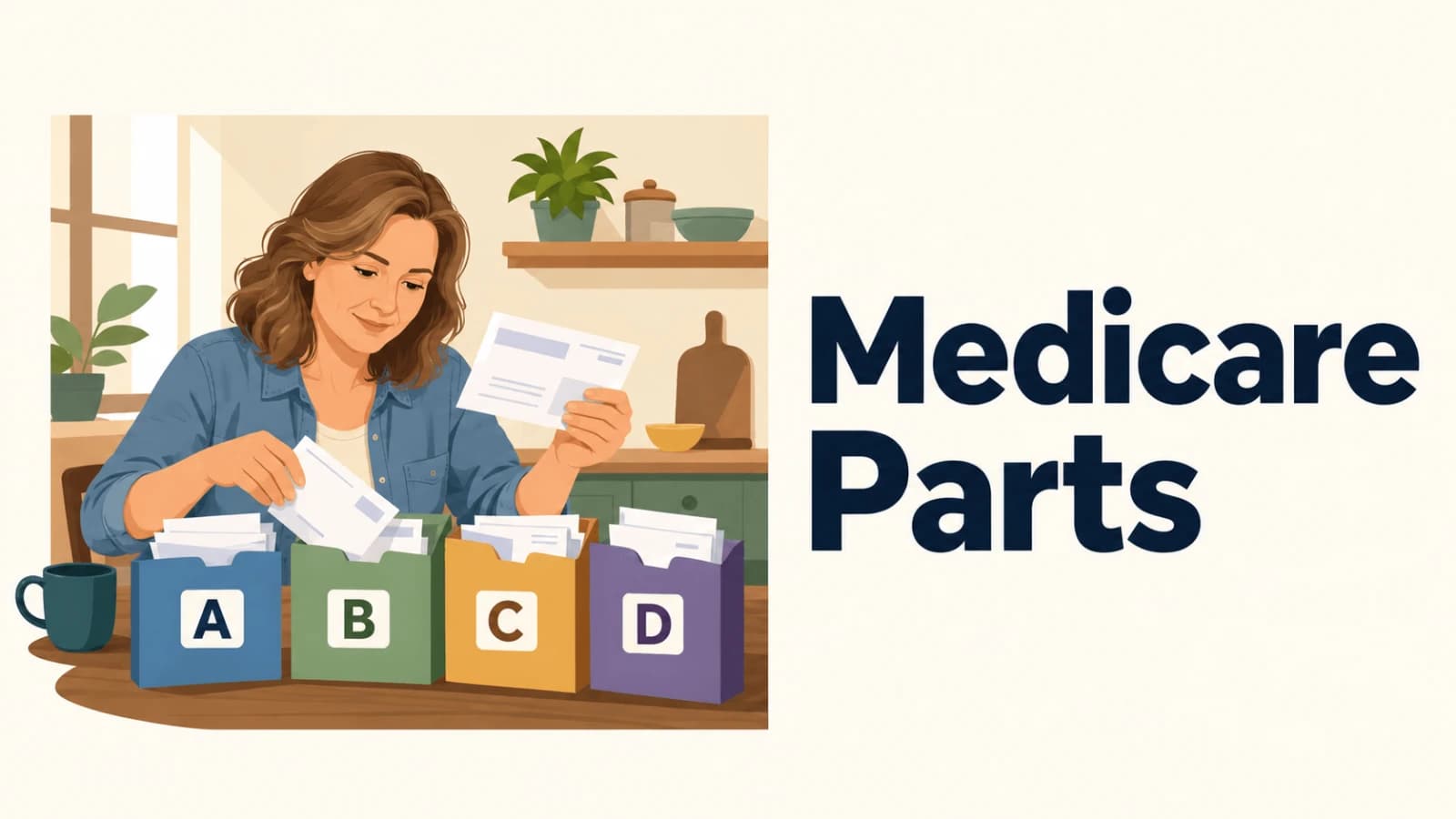
In short: The Medicare parts are four lettered pieces. Part A is hospital insurance, Part B is medical insurance, Part C is Medicare Advantage, and Part D is drug coverage. A and B together are Original Medicare.
Your mother's mail arrives with one letter on it, and the letter is rarely the same as the one on yesterday's envelope. A hospital bill says Part A. The walker invoice says Part B. The pharmacy talks about Part D. Nobody explained that these are pieces of one program, and that the piece in question tells you who to call. If the follow-through is what is piling up after the letter, a navigator can make those calls and track them. Navigate Care explains how that works and what it may cost on its what you will pay page.
If you want the longer tour of how the parts sit together, our guide to Medicare parts explained goes further than this post does. This one does something narrower. It starts from what happened to your parent and works back to the part.
The four Medicare parts side by side
Medicare.gov describes each in a line. Part A "helps cover inpatient care in hospitals, skilled nursing facility care, hospice care, and home health care." Part B covers doctors and other providers, outpatient care, preventive services and durable medical equipment, "like wheelchairs, walkers, hospital beds." Part C "offers an alternative to Original Medicare for your health and drug needs." And Part D "helps cover the cost of prescription drugs."
That's the whole map. The rest is detail, and the detail is money.
The four parts of Medicare and the 2026 numbers that go with them
| Part | What it is | Mostly covers | 2026 number to know |
|---|---|---|---|
| A | Hospital insurance | Inpatient stays, skilled nursing facility care, hospice, some home health | $0 premium for most people; $1,736 deductible per benefit period |
| B | Medical insurance | Doctor visits, outpatient care, preventive services, equipment | $202.90 a month premium; $283 yearly deductible |
| C | Medicare Advantage | A private plan that bundles A and B, usually D too | Costs vary by plan, and you still pay the Part B premium |
| D | Drug coverage | Prescription drugs | No plan may have a deductible above $615; $2,100 yearly out-of-pocket limit |
Source: Medicare.gov, Medicare costs and Medicare.gov, drug coverage costs
Two things in that table catch families out. First, home health appears under both A and B on Medicare.gov, so you cannot sort a home health bill by the letter alone. Second, Part A being "free" means the premium. It does not mean the hospital stay costs nothing. The $1,736 deductible comes back each benefit period, which can happen more than once in a year.

Original Medicare and Part C: the choice behind the letters
Parts A and B make up Original Medicare. Part D is an add-on you buy beside it. Part C is different in kind. It is a private company's plan, approved by Medicare, that takes the place of Original Medicare and usually carries drug coverage inside it.
So the four letters are really two routes. Either your parent has A and B (plus a stand-alone D if they want one), or they have C, which wraps all of it.
KFF reports that in 2026 more than half of eligible beneficiaries, 55%, were in Medicare Advantage. That is 35.2 million of the 64.2 million people with both Part A and Part B. It is not a vote on which route is right. It tells you why the card in your parent's wallet may show an insurer's name instead of "Medicare."
If you are not sure which route your parent is on, look at that card, or call the number on it and ask: "Is this Original Medicare or a Medicare Advantage plan?" The answer changes who pays the bill and which rules apply to a referral. Our post on Medicare insurance plans compared sets the choice out, and what is Medicare Part C covers the plan types.
Which Medicare part is this bill or letter about?
Try this at the kitchen table. Ask where your parent was, and what was done.
Matching what happened to the part that handles it
| What happened | Usually this part | Where to read more |
|---|---|---|
| Admitted to the hospital as an inpatient | Part A | Medicare Part A |
| A doctor visit, a scan, a walker or a hospital bed | Part B | Medicare Part B |
| A prescription at the pharmacy | Part D | Medicare Part D |
| Hospice care | Part A | Does Medicare cover hospice? |
| A plan card with an insurer's name on it | Part C | Medicare Part C |
| Nursing facility stay after the hospital | Part A, with conditions | See below |
Notice the first row has a trap in it: "in the hospital" is not the same as "admitted." A person can lie in a bed overnight and still be under observation, and observation is not an admission. Ask the hospital which one your parent is. Ask it by name, and ask early.

The nursing facility stay after the hospital
This is the one where the part matters most in money. Medicare.gov says skilled nursing facility coverage needs a prior inpatient hospital stay of "at least 3 days in a row." Observation or emergency room time doesn't count, "even if you're there overnight."
Here is a round-number example, not a real bill. Your father is admitted for 3 days in a row and then moves to a facility for 25 days. In 2026, days 1 to 20 cost $0 a day after the $1,736 deductible is met. Days 21 to 100 cost $217 a day. So the last 5 of his 25 days are $217 each.
If he had been under observation for those same 3 days, the nursing facility days would not qualify under the standard rule. Same bed, same nurses, a different part and a different answer. Medicare.gov notes some exceptions (a facility 3-day waiver through certain accountable care organisations, or a Medicare Advantage plan that waives the rule), so ask the plan or the hospital what applies.

What each part costs in 2026
You will hear these figures over and over, so here they are in one place. Each is the 2026 number from Medicare.gov.
Part B is the one most people feel, because it comes out of a monthly check. The standard premium is $202.90 a month, and it can be higher depending on income. The deductible is $283 a year. After that, your parent usually pays 20% of the approved amount for a covered service. Say a service has an approved amount of $1,000 and the deductible is met. Your parent owes 20%, which is $200.
Part A has no premium for most people. Those who do not qualify for premium-free Part A can buy it, at $311 or $565 a month depending on their work history.
Part D plans vary. By law none of them may charge a deductible above $615 in 2026, and once out-of-pocket spending on covered drugs reaches $2,100 in 2026, the plan pays the covered drug costs for the rest of the year.
If the premium is the worry, help exists for some people on lower incomes, and SHIP counsellors can look at your parent's situation for free. Neither this post nor a navigator can tell you what you personally qualify for. That is for SHIP, Medicare or Social Security to say.

What none of the parts pays for
Every family finds this edge sooner or later. NCOA says Original Medicare "does not cover most outpatient prescription drugs," and generally leaves out routine dental, vision and hearing care and most long-term care, meaning custodial care in a nursing home or assisted living. Medicare does not pay for the help with bathing and dressing that many families need most.
You haven't missed something. That's where the programme draws its line. Part D fills the drug gap, and some Part C plans add dental, vision or hearing, though those vary by plan, so read the plan's own papers. A plan that mentions an extra benefit has not promised it for your parent's situation.
For daily personal care, the usual next calls are your state Medicaid agency and your Area Agency on Aging. Our guide on how to get a caregiver through Medicare walks through what home health will send and what it will not.
When the part is decided
Choosing among the parts is not a once-and-done event. If your parent is turning 65, you enrol in A and B first, and the rest comes after. Our guide on how to apply for Medicare has the windows, and who qualifies for Medicare has the tests.
If your parent already has Medicare, the yearly Open Enrollment runs October 15 to December 7, 2026. That is the window to look at Part C or Part D again, and it is open right now. Before you change anything, call SHIP. It is free, and it does not sell plans.
Three questions to ask before you call anyone
Most of the confusion goes away if you have three answers in hand. They take a few minutes to get, and they are what any plan, doctor's office or Social Security will ask first.
First: is your parent on Original Medicare or a Medicare Advantage plan? The card tells you. Second: was the stay an inpatient admission or observation? The hospital can say, and you can ask for it in writing. Third: which part is on the letter? Part A, B, C or D is usually printed on the bill, the Medicare Summary Notice or the plan's explanation of benefits.
With those three, a call stops being "my mother got a bill" and becomes "my mother was admitted as an inpatient on this date and the bill says Part A." People on the other end answer the second kind of call faster.
Where a navigator comes in
Knowing the part is the start. The harder bit is the follow-through: the referral that never got booked, the walker that was ordered and never arrived, the call after discharge. A navigator coordinates that work, but does not diagnose, treat or choose your parent's coverage, and does not replace SHIP.
Medicare does not automatically cover navigation. Eligibility depends on a qualifying condition or need and a provider visit, the cost is usually $0 with supplemental coverage, and we confirm your cost before you start.
Frequently asked questions
What are the 4 parts of Medicare?
Part A is hospital insurance. Part B is medical insurance. Part C is Medicare Advantage, a private plan that bundles the others. Part D is prescription drug coverage. A and B together are called Original Medicare.
Is Part C part of Medicare?
Yes, but it works differently. Medicare.gov calls it an alternative to Original Medicare. A private company runs the plan, and it usually bundles Part A, Part B and Part D. Your parent keeps paying the Part B premium.
Do I need all four Medicare parts?
No. Many people have A and B, and add D. Others choose C instead of A and B. Medigap, a separate policy that helps with Original Medicare's costs, is a different product again. Our post on Medicare insurance plans explains how the pieces combine.
Which Medicare part covers a hospital stay?
Part A covers inpatient care, but only if your parent was admitted. Time under observation is not an admission and does not count toward the 3 days for a nursing facility. Ask the hospital which status applies. In 2026 the Part A deductible is $1,736 per benefit period.
Which Medicare part covers a walker or wheelchair?
Part B, as durable medical equipment, according to Medicare.gov. After the $283 yearly deductible in 2026, your parent usually pays 20% of the approved amount.
Which Medicare part covers prescriptions?
Part D, either as a stand-alone plan or inside a Medicare Advantage plan. Original Medicare alone does not cover most outpatient prescription drugs, says NCOA.