The short answer
In short: To get a caregiver through Medicare, your parent's doctor must order skilled home health, and a Medicare-certified agency sends the aide. Medicare won't pay for daily personal care on its own.
That second sentence is the one that catches families out. You ask the hospital for "someone to help Mom at home" and hear "Medicare covers home health." Both are true, and they are not the same thing. Medicare sends a nurse or therapist, and an aide may come along with them. It does not send a person to be there all day.
If your parent's doctor has recommended home care and nobody has arranged it, a navigator can make those calls and track them. Navigate Care explains how that works and what it may cost on its what you will pay page.
To talk to a navigator now, call 628 234 2273. You can also start on our contact page, and the team calls you back within one business day.
So what will Medicare send, and how do you get it?
What Medicare will and will not send to the house
Medicare.gov says home health needs two things. Your parent needs part-time or intermittent skilled services, such as nursing or therapy. And your parent has to be homebound. The page puts it this way: "You're normally unable to leave your home and leaving takes a lot of effort." A doctor's appointment or a short outing doesn't cancel that.
A home health aide, the person who helps with bathing and dressing, is covered only alongside those skilled services. When the skilled care ends, so does the aide.
What Medicare home health does and doesn't cover
| At home | Covered? |
|---|---|
| Skilled nursing, such as wound care or injections | Yes, part-time or intermittent |
| Physical, occupational or speech therapy | Yes, if conditions are met |
| Home health aide | Only alongside skilled care |
| Bathing or dressing help as the only care | No |
| Round-the-clock care at home | No |
| Meal delivery and housekeeping | No |
Source: Medicare.gov, home health services
For covered services your parent pays nothing, according to Medicare.gov. Equipment is different: after the Part B deductible, 20% of the Medicare-approved amount. Our Medicare Part B guide goes through those costs.

How to get a caregiver through Medicare: the steps
Do these in order. Each one unlocks the next.
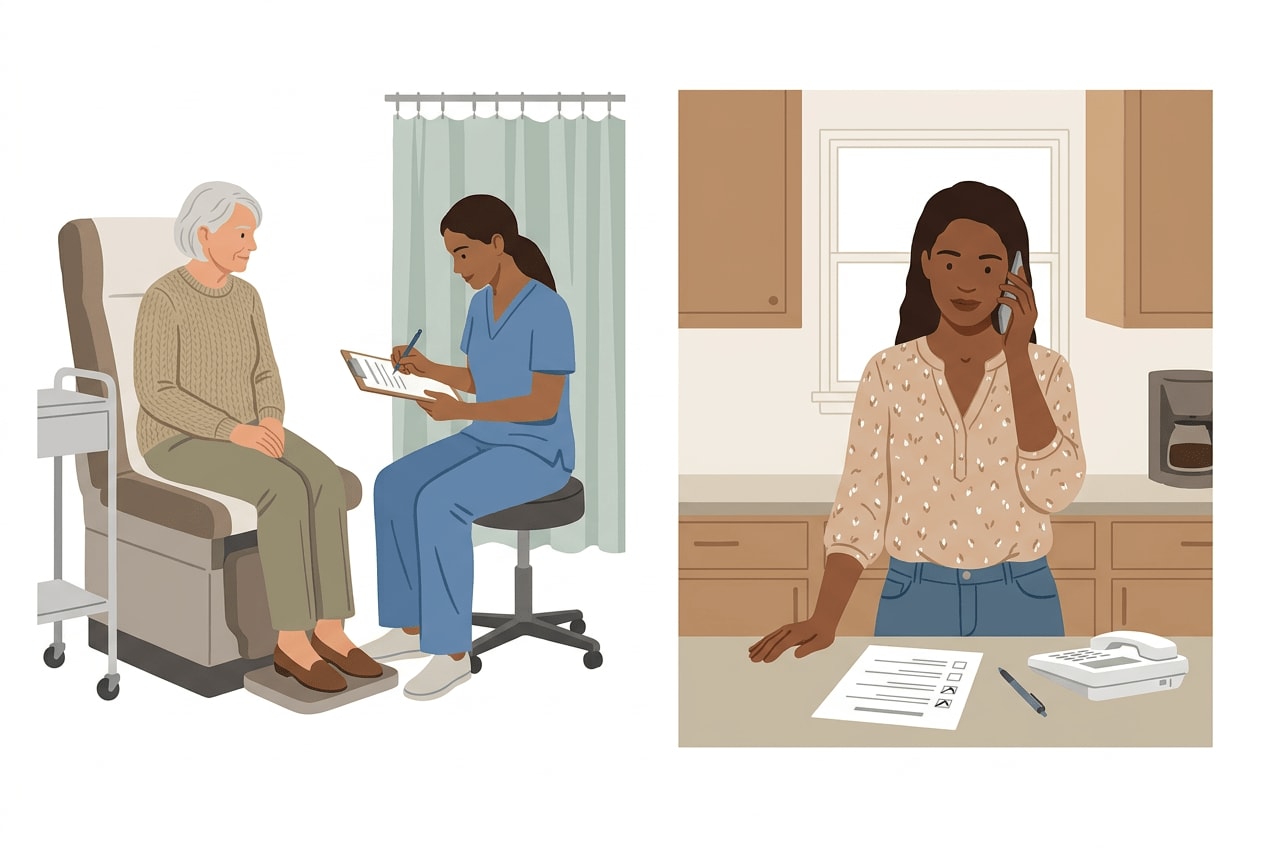
- Say what your parent needs help with, in plain terms. Write down what has changed: can't climb the stairs, can't manage the dressing on a wound, can't shower alone. The doctor needs specifics to order the right thing.
- Make sure you're allowed to talk. Medicare can't share claim or billing information with a caregiver unless your parent authorizes it, says AARP. If your parent can't sign, a personal representative can, but the legal papers proving that authority must be attached. Ask your parent's doctor's office and 1-800-MEDICARE what they accept. Do it early, while your parent can sign.
- Ask the doctor for a home health order. Say it by name: "home health." Medicare.gov says a doctor or other provider has to see your parent in person, confirm the need and order the care. In a hospital, ask for the discharge planner or social worker.
- Find a certified agency. Medicare must approve the agency, according to AARP. Medicare's Care Compare tool lists certified ones near you. Under Original Medicare you can ask the doctor's office which agencies it works with, then check them there.
- Check the plan type. If your parent has a Medicare Advantage plan, AARP notes you may have to use an agency that works with the plan. Some of those plans also offer in-home help with daily tasks. Call the plan and ask what it includes, by name, in writing.
- Call the agency and confirm the order arrived. Ask when the first visit will be, what services are on the plan and who your contact is. Don't assume the referral got through. Check.
- Ask what Medicare won't pay for. The agency should tell you, verbally and in writing, before it provides anything Medicare won't cover. Medicare.gov says that notice is called the Advance Beneficiary Notice, or ABN. Read it before signing.
- Track the visits. Keep a note of every visit and who came. If visits stop and the doctor hasn't discharged your parent from care, call the agency first, then the doctor.
The checklist
Copy this into your phone or print it.
- Wrote down what your parent can no longer do alone
- Permission on file so Medicare and the doctor can talk to you
- Doctor has seen your parent in person and ordered home health
- Confirmed your parent is homebound under Medicare's definition
- Checked whether it's Original Medicare or Medicare Advantage
- Picked a Medicare-certified agency (or the plan's agency)
- Called to confirm the order arrived and the first visit date
- Asked what Medicare won't pay for, and got it in writing
- Wrote down the agency contact and each visit
If Medicare says no, or isn't enough
Sometimes your parent isn't homebound. Or the need is daily help with bathing, meals and company, not nursing. Medicare.gov is plain about it: "Medicare doesn't pay for long-term care." That includes the personal care kind.
That is not you failing at this. It is the line the programme draws.
What families do next depends on money and place. Medicaid may pay for long-term care if your parent meets the requirements in your state, according to Medicare.gov. Your state Medicaid agency has the real answer. Our guide on Medicaid vs Medicare explains the split, including why the look-back period matters before any gifts or transfers. For help that isn't medical, your Area Agency on Aging may offer caregiver support. We cover it in What Is a Caregiver? Who Counts and Where Help Is.
If a denial letter arrives for care the doctor ordered, you can appeal. We can't say an appeal will succeed. We can say the clock runs, so read the letter early. Our guide on how to appeal a Medicare denial takes it step by step. SHIP, the free State Health Insurance Assistance Program, is a good first call for any of this.

Where a navigator comes in
In short: one dedicated navigator can coordinate the calls in the steps above. That means asking for the home health order, confirming the agency has it and tracking the visits, so you aren't chasing each one alone.
A navigator doesn't treat anyone or give medical advice, and doesn't replace SHIP. What a navigator does is the follow-through: asking the doctor's office for the order, checking the agency got it, tracking visits. Medicare doesn't automatically cover navigation. Eligibility depends on a qualifying condition or need and a provider visit, and we confirm your cost before you start. It is usually $0 with supplemental coverage. Our compare page sets out how it differs from a private advocate or care manager.
To talk to us, call 628 234 2273. You can also apply on our contact page: give your name, date of birth, ZIP code, whether your parent has active Medicare Part B and a phone number, and we call you within one business day. There is no booking calendar, so the call or the form is how you start.
Frequently asked questions
Can I get paid to be my parent's caregiver through Medicare?
No. Medicare doesn't pay family members for caregiving hours. Support for the caregiver usually comes through your Area Agency on Aging, and rules differ by state. For questions about pay or taxes, ask the relevant agency.
Does Medicare pay for a home health aide every day?
Only alongside skilled care that your parent's doctor orders, and only part-time or intermittent. Medicare.gov says 24-hour-a-day care at home isn't covered.
Does my parent need a Medicare Advantage plan to get in-home help?
Not for home health, which Original Medicare covers. Some Advantage plans also offer in-home help with daily tasks, according to AARP, so check your parent's plan documents.
Can I call Medicare on my parent's behalf?
Usually only with your parent's permission on file. AARP says a personal representative can sign if your parent cannot, with the legal papers attached.
What does "homebound" mean?
Medicare.gov says your parent is normally unable to leave home and leaving takes a lot of effort. Medical visits and short outings don't count against that.