Does Medicare cover hospice? Yes, and most of the bill
In short: Yes. Medicare covers hospice when a doctor certifies a life expectancy of 6 months or less and your parent chooses comfort care. An approved hospice costs nothing, bar small copays.
If you are reading this because a doctor just said the word "hospice", you are probably tired and wanting plain answers. Here they are, and then the detail. If the next problem is the phone calls, the order, the agency, the follow-up that nobody booked, a navigator can make those calls and track them. Navigate Care explains how that works and what it may cost on its what you will pay page.
The detail matters because the benefit has edges. It pays for a lot. It does not pay for everything, and the gap most families don't see coming is the roof over your parent's head.
The two things that make your parent eligible
Medicare.gov lists the conditions on its hospice care page. Your parent needs Part A. Then two more things have to be true at once.
First, doctors certify that your parent is terminally ill, "with a life expectancy of 6 months or less". That certification comes from the hospice doctor and your parent's regular doctor, if there is one. It is a medical judgement, and your family can't make it for them. The benefit is built to be renewed, which we cover below.
Second, your parent accepts comfort care, which Medicare calls palliative care, instead of care meant to cure the illness. Your parent signs a statement saying so. CMS calls it the election statement, and by signing it your parent gives up Medicare payment for treatment aimed at curing that terminal illness and related conditions.
That is the trade, and it is worth saying out loud in the room. Hospice is not "less care". It is a different goal: comfort, pain control and support for the family, rather than treatment meant to cure. Some families find that a relief. Others need a few days. Neither is a failing.
Who has to agree to what before hospice starts
| Step | Who does it | What it means |
|---|---|---|
| Part A in place | Your parent | The benefit sits inside Original Medicare |
| Terminal illness certified | Hospice doctor, plus regular doctor if any | Life expectancy of 6 months or less |
| Comfort care chosen | Your parent | Care to cure the terminal illness stops being billed to Medicare |
| Choice statement signed | Your parent | Medicare-approved hospice takes over the plan of care |
Source: Medicare.gov, hospice care, read 2026-10-12
If your parent can no longer sign or decide, who can do it for them is a legal question that depends on the papers in place. Ask the hospice and your parent's doctor what they accept. A healthcare power of attorney is the document people usually mean, and it is far easier to arrange earlier than later.
What the hospice benefit covers
Once your parent chooses hospice, the hospice team writes a plan of care. Medicare.gov says the benefit "should cover everything you need" for the terminal illness. CMS lists what that includes, and the list is longer than most families expect.
- Services from a hospice doctor or nurse practitioner
- Nursing care
- Hospice aide and homemaker services
- Medical social services
- Physical, occupational and speech therapy
- Dietary and spiritual counselling
- Medical equipment and supplies
- Drugs for pain and symptoms
- Short-term inpatient care for pain control and symptom management, and respite care
- Grief and loss counselling for the family, before and after the death
That last line is the one people overlook. The family is part of the plan. Grief counselling for you is on the list, and it carries on after your parent has died.
There are four levels of care behind that list, according to CMS. Routine home care is the everyday level, when your parent is not in crisis. Continuous home care is for brief periods of crisis, mainly nursing at home. General inpatient care is for pain or symptoms that can't be managed anywhere else. And inpatient respite care gives you a rest, for up to 5 consecutive days at a time.
Respite is not a luxury. If you have been the one doing the nights for months, ask about it by name. You are not failing at this. It is what the job does to people when they do it alone, and respite exists for exactly that.

What Medicare hospice does not cover
This is the section the other pages bury, and it is where families get surprised.
Treatment meant to cure the terminal illness. Medicare.gov lists treatment intended to cure your terminal illness and related conditions, and prescription drugs to cure it, as not covered once hospice starts. If your parent is thinking about treatment to cure the illness, Medicare.gov's advice is to talk with the doctor first.
Room and board. This is the big one. Medicare.gov says Medicare doesn't cover room and board if your parent gets hospice at home, or in a nursing home or hospice inpatient facility. At home that rarely bites, because your parent is already paying the rent or the mortgage. In a nursing home it does. Medicare.gov says you may have to pay for room and board if you live in a facility, like a nursing home, and choose to get hospice care. The hospice pays for the hospice services. The nursing home bill for the bed is a separate bill. Ask the facility who pays what, in writing, before anything is moved.
That second point is where long-term care and Medicare split, and where our guide on Medicaid vs Medicare comes in. Medicaid, for people who meet their state's income and asset limits, may help with room and board. Your state Medicaid agency has the real answer, and so does a free SHIP counsellor. We don't give legal or financial advice.
Care for other health problems isn't excluded. Medicare.gov says Original Medicare "will still pay for covered benefits for any health problems that aren't part of your terminal illness." So a broken wrist is still a broken wrist. Where the line falls between related and unrelated is a clinical call, and the hospice team makes it. Ask them early, and ask which number to call before your parent goes to an emergency room. Medicare.gov says hospital outpatient care, such as the emergency room, isn't covered unless the hospice team arranged it or the problem is unrelated to the terminal illness.
Round-the-clock help at home. Hospice aides and homemaker services are on the list above, but they are visits. Medicare does not pay for custodial care or for someone to be there all day, in hospice or out of it. Our guide on how to get a caregiver through Medicare explains where that line sits and what families do about it.

What your parent pays
Medicare.gov, as it read in October 2026, says: "You pay nothing for hospice care if you get your care from a Medicare-approved hospice provider." Three costs sit around that sentence.
What your parent may pay under the Medicare hospice benefit, as listed on Medicare.gov in October 2026
| Item | What your parent may pay |
|---|---|
| Hospice care from an approved provider | Nothing |
| Outpatient drugs for pain and symptoms | A copayment of up to $5 for each prescription |
| Inpatient respite care | 5% of the Medicare-approved amount |
| Room and board in a nursing home or facility | Not covered by hospice, so you may owe it |
Source: Medicare.gov, hospice care, read 2026-10-12
Here is what 5% looks like, using round numbers that are an illustration and not a real price. Say a respite stay has a Medicare-approved amount of $1,000. Five per cent of that is 50, so the family would owe $50. The real approved amount depends on the facility and the days. And Medicare.gov says the respite copay can't be more than the inpatient deductible, though it does not give the dollar figure in the text we read, so ask the hospice to give you the actual number in writing.
One caution. "You pay nothing" holds only if the hospice is Medicare-approved. Ask before you sign.
How long hospice lasts
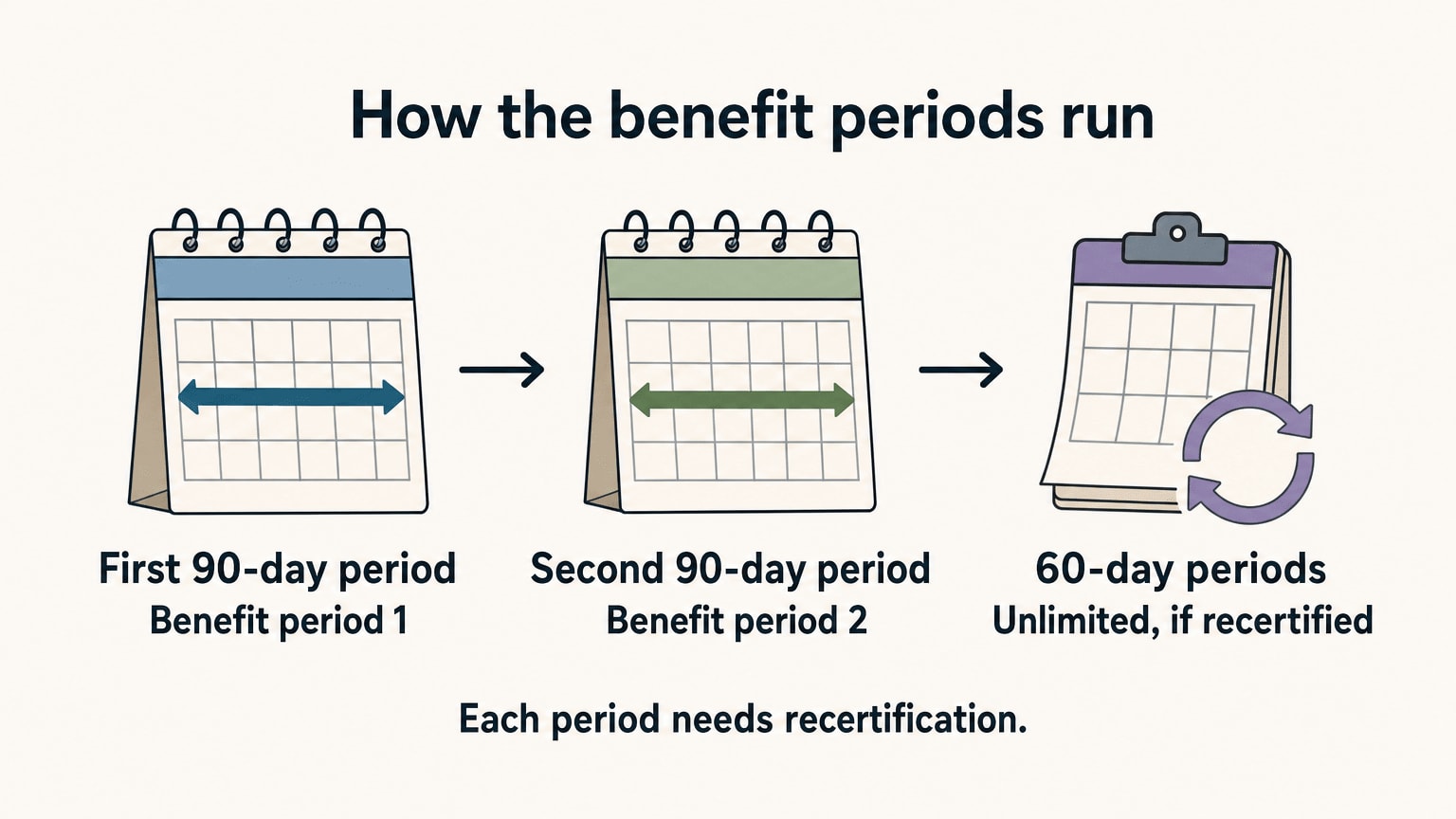
People worry that six months is a cliff. It isn't. Medicare.gov describes the benefit as "two 90-day benefit periods, followed by an unlimited number of 60-day benefit periods."
To continue past the first six months, the hospice medical director or hospice doctor has to recertify that your parent is still terminally ill, after a face-to-face meeting with the hospice doctor or nurse practitioner. AARP says the same recertification happens at the start of each period. So a parent who lives longer than expected does not lose the benefit for that reason alone. They are reassessed, and if the doctor still certifies, it continues.
You also have the right to change hospice providers once during each benefit period, according to Medicare.gov. If the first hospice isn't answering the phone at night, or the nurse isn't a fit, that option exists. It's worth knowing before you need it.
What if your parent changes their mind about hospice? Medicare.gov's page lists the question without an answer in the text we read, so we won't guess. Ask the hospice directly, and call 1-800-MEDICARE or your SHIP counsellor for a second view before you decide.
Medicare Advantage and hospice
If your parent has a Medicare Advantage plan, the hospice benefit usually still comes from Original Medicare. AARP says "Original Medicare will cover your hospice benefits, even if you've chosen a Medicare Advantage plan." AARP adds that your parent can stay in the plan by paying its monthly premium.
This is the point where families trip over networks. Ask two questions on the first call. Is the hospice approved by Medicare? And what does my parent's plan still handle? Because Advantage plans differ, the plan's own member services line and a free SHIP counsellor can confirm the details for your parent. Our guide on Medicare insurance plans explains how Original Medicare and Advantage sit next to each other, and our Medicare Part B post covers what Part B still pays for the problems that aren't part of the terminal illness.
How to start: the steps
Do these in order. Each one unlocks the next.
- Ask the doctor about hospice, by name. Say "I would like to talk about hospice." Your parent's regular doctor or the hospital's discharge planner can refer you. You can ask at any point, and it doesn't commit you to anything.
- Pick a Medicare-approved hospice. Medicare.gov points you to its Care Compare tool, which has a ZIP code search for providers near you that take Medicare.
- Ask for a first visit. The hospice will meet your parent, review the medical picture and propose a plan of care. Use that meeting to ask questions. Nothing is signed by asking.
- Check who the hospice doctor is and who the attending doctor will be. Medicare.gov says your parent can still see their regular doctor if they choose that doctor to help supervise hospice care.
- Ask what is not covered, in writing. Room and board, drugs not related to the illness, anything the hospice team doesn't arrange. Get the answer before the paperwork.
- Sign the choice statement only when your parent, and you, are ready. It is a real choice, and you are allowed to take a day.
- Write down the night and weekend number. Put it on the fridge. The hard moment is rarely mid-afternoon. It's the middle of the night, and you want to know who picks up.
- Ask about respite and grief support now. They are in the benefit. It is easier to ask on day one than on day ninety.
If the word comes up at the hospital
Hospice is often raised in a hospital corridor, at the end of a long day, when the discharge date is already set. That timing is the hardest part. You are being asked to take in the diagnosis, the goal of care and the logistics in one conversation.
You can slow the conversation down without refusing anything. Ask the discharge planner or social worker to explain, in plain words, what changes if your parent chooses hospice and what stays the same. Ask which Medicare-approved hospices they work with, and whether you can meet one before discharge. Ask who will be at the house on the first day, and who delivers any equipment. Then write the answers down, because the details that matter are the ones said once and never repeated.
Our guide to how to get a caregiver through Medicare has the same questions for home health, and the order of calls is similar.

The checklist
- Doctor has talked with your parent about hospice and what it means
- Hospice is Medicare-approved
- Your parent has Part A, and you know whether it is Original Medicare or Advantage
- You know who the attending doctor will be
- Written answer on room and board if your parent lives in a facility
- Written answer on which drugs carry the copayment
- Night and weekend phone number written down
- Permission or legal papers on file so you can speak for your parent
Where a navigator comes in
A navigator doesn't treat anyone, give medical advice or decide who qualifies, and doesn't replace SHIP, the doctor or a lawyer. What a navigator does is the follow-through: making the calls, checking the hospice has the orders, tracking equipment and what is still unresolved. Medicare doesn't automatically cover navigation. Eligibility depends on a qualifying condition or need and a provider visit, and we confirm your cost before you start. It is usually $0 with supplemental coverage. Our compare page sets out how that differs from a private advocate or care manager.

Frequently asked questions
Does Medicare cover hospice in a nursing home?
It covers the hospice services, which the hospice team brings to your parent where they live. It doesn't cover room and board. Medicare.gov says you may have to pay for room and board if you live in a facility, like a nursing home, and choose hospice. Ask the facility in writing what the bed costs.
Does Medicare pay for hospice at home?
Yes. Hospice is usually delivered at home. Medicare covers the nursing, aide visits, equipment, supplies and drugs for pain and symptoms in the plan of care, with a copayment of up to $5 for each outpatient prescription, per Medicare.gov. The rent or mortgage, groceries and utilities are not part of the benefit.
How long will Medicare pay for hospice?
As long as your parent keeps being certified. Medicare.gov describes two 90-day benefit periods, followed by an unlimited number of 60-day benefit periods. Each period needs recertification that your parent is still terminally ill.
Does Medicare Advantage cover hospice?
The hospice benefit is paid by Original Medicare even if your parent has an Advantage plan, according to AARP. The plan may still cover care unrelated to the terminal illness. Call the plan and a free SHIP counsellor to confirm what applies to your parent.
What does Medicare hospice not cover?
Treatment meant to cure the terminal illness, drugs to cure it, and room and board in a nursing home or hospice inpatient facility. Emergency room visits aren't covered unless the hospice team arranged them or the problem is unrelated to the terminal illness.
Can my parent still see their own doctor in hospice?
Yes, if they choose that doctor as their attending medical professional to help supervise their hospice care, says Medicare.gov. The hospice team still writes and runs the plan of care.
Is hospice the same as palliative care?
Hospice is the Medicare benefit for people with a life expectancy of 6 months or less who choose comfort care (Medicare.gov also calls it palliative care) instead of care to cure the illness. If a doctor uses either word, ask which one is being offered and whether it means stopping treatment meant to cure. That one question clears up most of the confusion.
Who do I call if I don't understand the bill?
Start with the hospice's billing contact, then 1-800-MEDICARE. SHIP counselling is free. If a denial letter arrives, our guide on how to appeal a Medicare denial takes it step by step. We can't say an appeal will succeed. We can say the clock is real.