The short answer
In short: To know if you have Medicare or Medicaid, check your cards. A red, white and blue card is Medicare. A separate card from your state is Medicaid. Unsure? 1-800-MEDICARE or your state agency can confirm.
Most people who ask this are holding a drawer of cards and a letter nobody explained. You haven't missed something obvious. The two programmes have near-identical names, and plans from private companies add a third kind of card on top.
If you're checking this for a parent, and the next job is chasing referrals or equipment, a navigator can make those calls and track them. Navigate Care explains how that works and what it may cost on its what you will pay page. First, though, the cards.
How do I know if I have Medicare or Medicaid? Start with your wallet
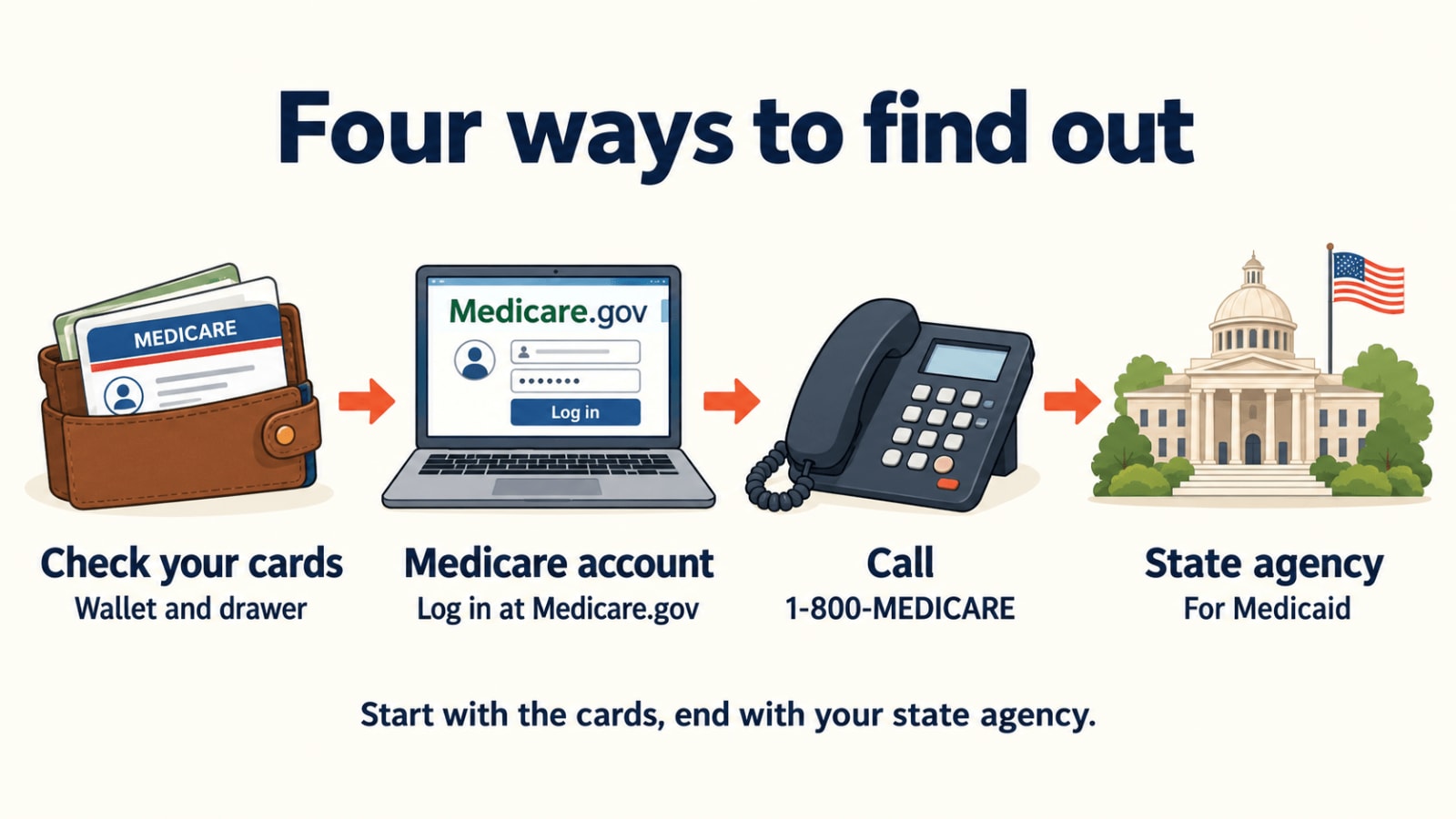
Empty the wallet onto the table. Or the kitchen drawer, which is where a parent's cards often live. You're looking for up to three kinds.
The Medicare card. NCOA says the red, white and blue card holds your unique Medicare number and the start date of your Part A and/or Part B benefits. If you have this card, you have Medicare. It doesn't say who runs your coverage day to day, only that you're in.
A card from a health plan. With a Medicare Advantage (Part C) plan, NCOA says you use the plan's card when you see providers. That's still Medicare. It's a private company running Medicare for you.
A card from your state. If you're enrolled in Medicaid, NCOA says you'll receive separate cards. I couldn't find a national description of what one looks like, and that makes sense: the programme is run state by state, so the card differs. Look for your state's name and the word Medicaid.
Which card means which programme
| What you're holding | What it usually means | Where to confirm |
|---|---|---|
| Red, white and blue card with a Medicare number | Original Medicare (Parts A and B) | Medicare account, 1-800-MEDICARE |
| A plan card that says Medicare Advantage | Medicare, run by a private plan | The member number on the back |
| A card from your state that says Medicaid | Medicaid | Your state Medicaid agency |
| A plan card with Medicaid and Medicare both named | A plan for people with both, often a D-SNP | The plan, then your state agency |
Source: NCOA, understanding your Medicare card

A private plan card is not the answer on its own
This is the one that trips people up. Your card says UnitedHealthcare, or Humana, or another company. Is that Medicare or Medicaid?
The company name alone doesn't settle it. Read the card for the programme's name. Then call the number on the back. Member services can tell you which programme the card belongs to in one call.
A D-SNP is the version for people with both. NCOA describes it as a type of Medicare Advantage plan for people who qualify for both Medicare and state Medicaid assistance, and says it must cover everything Original Medicare covers. If your card names a "dual" or "special needs" plan, you very likely have both programmes. Your state decides which D-SNPs are offered, so details differ.
How to check: online and by phone
If the cards are gone or confusing, don't guess. Every route below ends with a person or an account that knows.
- Medicare account. Log in at Medicare.gov. AARP says you can print an official copy of your card from your online account, which also tells you quickly whether you have Medicare at all.
- My Social Security account. The same AARP page says a replacement can be ordered there, under the Medicare tab.
- 1-800-MEDICARE (800-633-4227). AARP lists this for a lost card. A mailed card takes about 30 days, so print one meanwhile.
- Social Security, 1-800-772-1213. Medicare enrolment goes through Social Security, so they can tell you whether you've enrolled.
- Your state Medicaid agency. Medicaid.gov says: "To find out for sure if you're eligible for Medicaid, you must contact your state Medicaid agency." The page has a state selector that points you to yours.
There's no single database for both. That's the part nobody explains. Medicare is federal and Medicaid is state, so you check each one separately.
If you can't find any card: which one you'd likely have
Cards go missing. The programmes also work on different tests, which gives you a rough guess before you call. It's only a guess.
The test that separates them
| Medicare | Medicaid | |
|---|---|---|
| Based on | Age 65 or older, or a qualifying disability | Limited income and assets |
| Run by | The federal government | Your state |
| Where you enrol | Social Security | Your state agency |
Our guide to Medicaid vs Medicare goes through the split in full. If your parent is over 65 and has never enrolled in Medicare, our guide to applying for Medicare covers the windows. And who qualifies for Medicare explains the tests.
Do you have both, or only some help?
Having both is common enough to have a name: dual eligible. Within it there's a difference most pages skip.
Some people get full Medicaid on top of Medicare. Others get only help with Medicare's costs through a Medicare Savings Program. You can hold that help without ever hearing the word Medicaid. Medicare.gov says the QMB level helps pay Part B premiums, deductibles, coinsurance and copayments. In 2026 its limit is $1,350 a month in income for one person, with $9,950 in resources.
One clue you may have it: Medicare.gov says providers aren't allowed to bill you for services Medicare covers, cost-sharing included, once you have QMB. If you've never had that protection and think you might qualify, Medicare.gov says "Even if you don't think you qualify, you should still apply." Our guide to applying for dual Medicare and Medicaid shows the two applications, and Extra Help covers drug costs.
If you have both, which pays first?
Medicare. Medicare.gov says Medicare pays first when you're a dual eligible and get Medicare-covered services. Medicaid is secondary and covers costs that remain.
That's why Medicare.gov's QMB advice is to show both your Medicare card and your Medicaid card (or QMB card) every time you get care. Hand the front desk both.

Where a navigator comes in
A navigator doesn't give medical advice, doesn't replace SHIP counselling, and can't tell you whether you qualify for Medicaid. SHIP is free and is a good first call. Once you know what coverage your parent holds, a navigator follows through: booking the referral, checking the equipment arrived. Medicare doesn't automatically cover navigation. It depends on a qualifying condition or need and a provider visit, and we confirm your cost before you start. It is usually $0 with supplemental coverage. Our compare page sets out the categories of help.
Frequently asked questions
Can you have Medicare and Medicaid at the same time?
Yes. People with both are called dual eligible. Medicare pays first on Medicare-covered services, and Medicaid covers costs that remain, according to Medicare.gov.
How can I check my Medicare status online?
Log in to your Medicare.gov account. AARP says you can print an official copy of your card there. You can also use My Social Security, or call 1-800-MEDICARE.
How can I find out if I have Medicaid?
Contact your state Medicaid agency. Medicaid.gov says that's the only way to find out for sure, and its eligibility page has a state selector.
My card is from a private company. Is that Medicare or Medicaid?
The company name doesn't tell you. A Medicare Advantage plan is Medicare, run by a private company. Read the card or call the number on the back and ask which programme it belongs to.
What does the Medicare card look like?
It's the red, white and blue card. NCOA says it shows your unique Medicare number and when Part A and/or Part B started.
What if I'm not enrolled in either?
Medicare goes through Social Security, and Medicaid goes through your state. They're separate applications. SHIP counselling is free and can help you work out which to start with.