What are Medicare insurance plans, exactly?
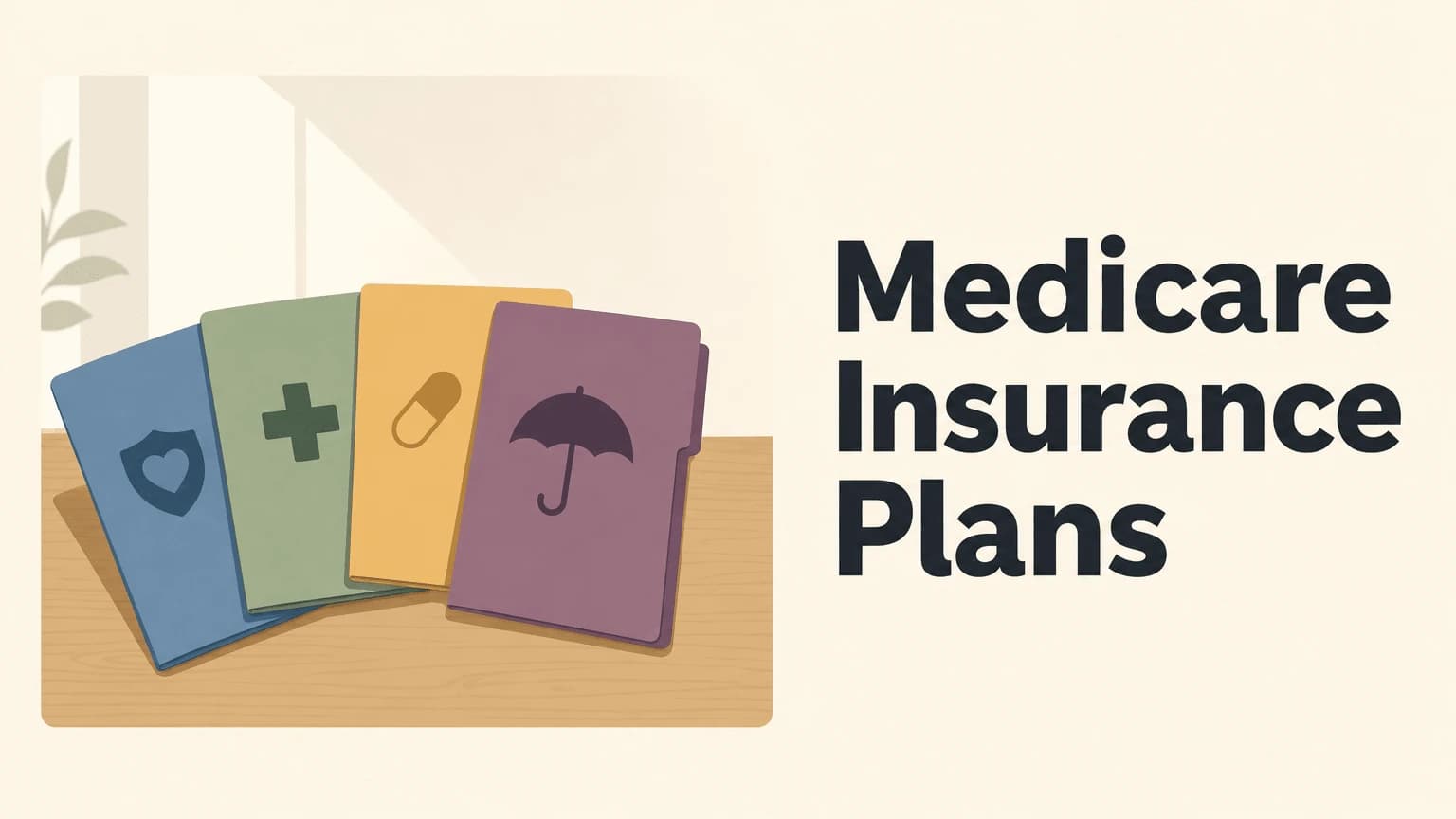
In short: Medicare insurance plans means one of four things: Original Medicare, Medicare Advantage, Part D drug coverage, or Medigap. You can combine some of them, not all four.
That's the whole source of the confusion, honestly. Your mother gets a letter calling itself a "Medicare plan," and so does the hospital, and so does the company that calls about her "benefits," and none of them mean the same thing. Four different products share one name.
Choosing the plan is step one. Using it well is the part that eats evenings: booking the referral, chasing the equipment, following up after a hospital stay. If that's the part piling up, a navigator can take it on. Navigate Care explains how that works and what it may cost on its what you will pay page.
So, in plain terms, what are the four and how do they actually sit next to each other?
The four kinds of Medicare insurance plan in 2026, side by side
| Plan type | Who runs it | What it adds | 2026 cost or rule to know |
|---|---|---|---|
| Original Medicare (Parts A and B) | The federal government | Hospital stays, doctor visits, outpatient care, equipment | $202.90 standard Part B premium a month, $283 deductible |
| Medicare Advantage (Part C) | A private company approved by Medicare | A bundled replacement for Parts A and B, usually with Part D built in | Must cover at least what Original Medicare covers |
| Part D | A private company, stand-alone or inside an Advantage plan | Prescription drug coverage | Deductible capped at $615; out-of-pocket spending capped at $2,100 |
| Medigap | A private company, sold alongside Original Medicare only | Helps pay Original Medicare's copayments, coinsurance and deductibles | Doesn't work with Medicare Advantage at all |
Source: Medicare.gov, Medicare costs, Medicare.gov, parts of Medicare, Medicare.gov, Part D costs, Medicare.gov, Medigap

Two of those four can stand alone. Original Medicare works on its own. Medicare Advantage works on its own, and usually comes with drug coverage already inside it. The other two are add-ons: Part D fills a gap in Original Medicare, and Medigap fills a different gap in Original Medicare. Neither Part D nor Medigap replaces anything by itself.
Original Medicare vs Medicare Advantage: the question that actually decides it
Most people aren't really deciding between four things. They're deciding between two: stay with Original Medicare, or move to a Medicare Advantage plan. Everything else hangs off that one choice.
More than half of eligible beneficiaries, 55% in 2026, have already made that move, according to KFF. That's 35.2 million of the 64.2 million people on both Part A and Part B, up from just 19% back in 2007. So "most people have Advantage now" is true, but it wasn't always, and it isn't a vote on which one is right for your parent.
Here's the question that actually separates them: does your parent care more about keeping a specific doctor and traveling freely, or about having a cap on what a bad year could cost? Original Medicare lets your parent see almost any doctor who takes Medicare, anywhere in the country, with no network to check first. What it doesn't have is a yearly ceiling. The coinsurance just keeps going, bill after bill, unless Medigap is there to catch it. Medicare Advantage plans run on networks, and leaving that network can mean paying more or not being covered at all. What they're required to have, by law, is a yearly out-of-pocket maximum, something Original Medicare alone doesn't offer.

Neither one is the "normal" choice and neither one is a mistake. It's a trade: freedom of choice on one side, a cost ceiling on the other. A parent who travels to see grandchildren in another state, or who's attached to a specialist of twenty years, usually leans one way. A parent on a fixed income who's worried about one bad hospital stay usually leans the other. SHIP, the free State Health Insurance Assistance Program, walks through this trade-off for free and doesn't sell anything, which makes it a good first call before either decision. Our guide to Medicare parts explained goes further into that comparison than this post does.
Where Part D and Medigap fit in
Say your parent picks Original Medicare. Two more decisions usually follow it, and they're smaller ones.
Part D pays for prescription drugs, which neither Part A nor Part B touches beyond a short list of drugs given in a doctor's office. You buy it as a stand-alone plan if you're on Original Medicare. In 2026, no Part D plan can charge a deductible above $615, according to Medicare.gov, and once your parent's out-of-pocket drug spending hits $2,100 for the year, the plan picks up the rest of covered drugs through December. Skip Part D with no other drug coverage in place, and a late penalty can follow later, the same way it does with Part B.
Medigap is the one people mix up most. It doesn't pay for drugs and it doesn't replace Original Medicare. It sits next to it, picking up some of the coinsurance and deductibles that Original Medicare leaves to your parent, according to Medicare.gov. You need Part A and Part B already in place to buy one, and here's the part that surprises people: Medigap won't work alongside a Medicare Advantage plan at all. It's one or the other.

If your parent already has an Advantage plan and someone's trying to sell a Medigap policy on top of it, that's worth a second call to SHIP before any paperwork gets signed. SHIP counselling is free and doesn't sell plans, which makes it a cleaner first opinion than a sales call.
When any of this actually needs deciding
If your parent is newly turning 65, the plan decision comes after enrolling in Parts A and B, not before. Our guide on how to apply for Medicare walks through that first step and the window around it.
If your parent already has Medicare, the yearly chance to switch between Original Medicare and Advantage, or change a Part D plan, is Open Enrollment, which runs October 15 to December 7, 2026. Outside that window, switching usually isn't an option until the next one comes around, so a decision made in a hurry in November tends to stick for a year.
Frequently asked questions
What's the difference between Medicare and a Medicare Advantage plan?
Medicare is the federal program itself: Parts A, B, C and D are all Medicare. Medicare Advantage is Part C, a private company's bundled version of A and B, usually with D included, that Medicare has approved and that has to cover at least what Original Medicare covers. "Medicare" and "Medicare Advantage" aren't two competing programs. One is a route through the other.
Can my parent have Medigap and Medicare Advantage at the same time?
No. Medigap only pairs with Original Medicare, according to Medicare.gov. If your parent has a Medicare Advantage plan and wants different cost protection, the options are switching plans, not adding Medigap on top, and that decision is worth a free call to SHIP before anything is signed.
Does Medicare automatically enroll everyone in a drug plan?
No. Original Medicare doesn't include drug coverage on its own. Your parent has to pick a stand-alone Part D plan, or get drug coverage through a Medicare Advantage plan that includes it. Going without either for too long can mean a late penalty down the line.
Is a Medicare insurance navigator the same as a Medicare insurance plan?
No, and it's worth being clear about that. A navigator doesn't sell or choose a plan, and doesn't replace SHIP for that decision. What a navigator does, once your parent is already on a plan, is the follow-through afterward: booking referrals, tracking equipment, chasing what a denial letter means. It isn't automatically covered. It depends on a qualifying condition or need and a provider visit, and the cost is usually $0 with supplemental coverage, confirmed before anything starts. Our compare page sets out how that differs from a private advocate or care manager.