What Medicare Part D is, in plain terms
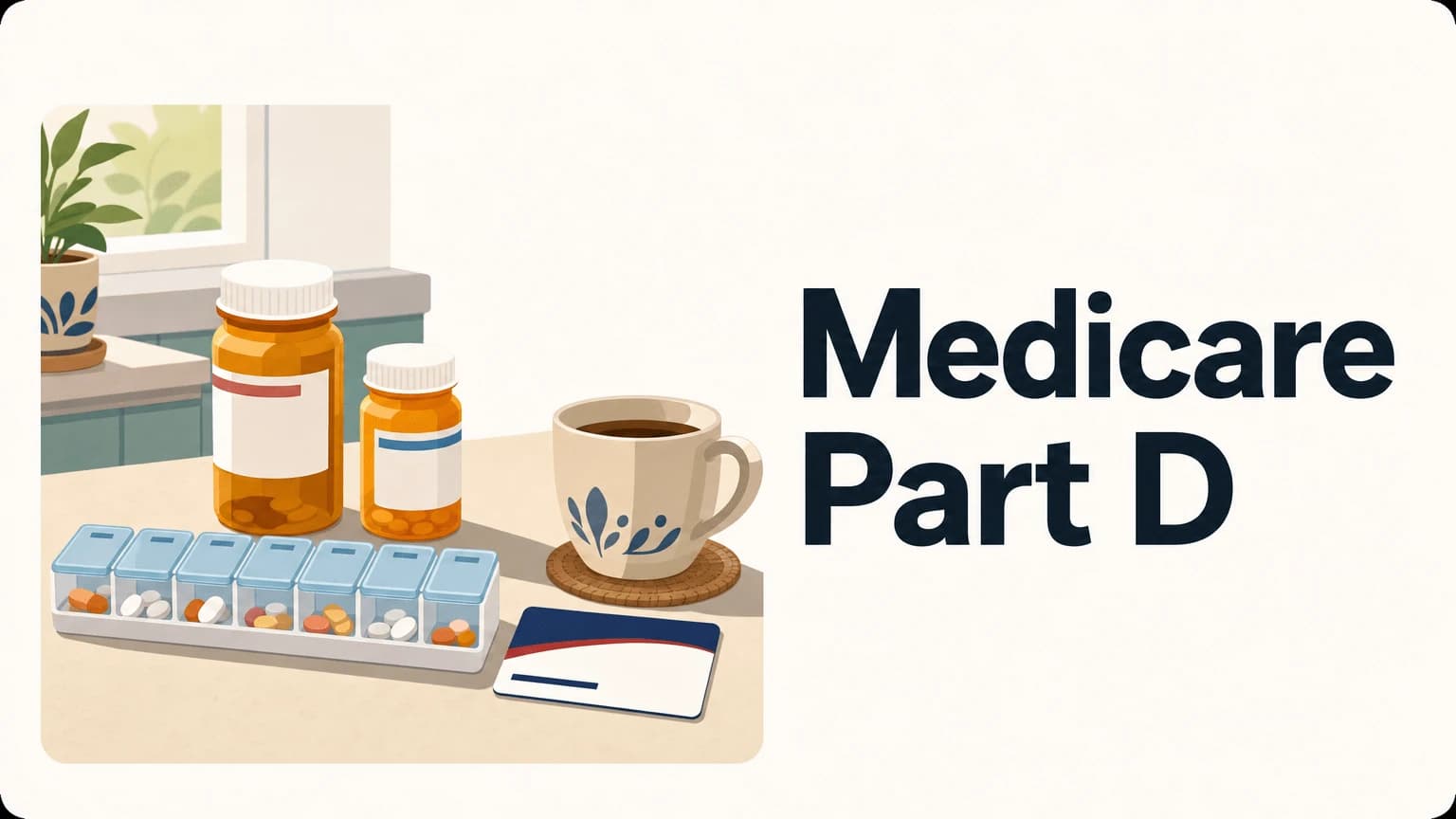
In short: Medicare Part D pays for prescription drugs from a pharmacy. It's optional and separate from Part A and B, and in 2026 it's capped at a $615 deductible and a $2,100 out-of-pocket ceiling.
Here's the part that actually trips families up: nobody signs your parent up for this automatically, the way a lot of people assume. Original Medicare, Parts A and B, doesn't touch most day-to-day prescriptions at all. If your parent wants drug coverage, they have to go get it, either as a stand-alone Part D plan next to Original Medicare, or built into a Medicare Advantage plan.
Picking a drug plan is one decision. Making sure a formulary exception request actually gets filed, or a denied prescription gets sorted before the next refill is due, is the part that eats an evening. Navigate Care explains how a navigator takes on that kind of follow-through, and what it may cost, on its what you will pay page.
So what does the plan your parent picks actually have to do for them?
What Part D covers, and what it doesn't
Every Part D plan, stand-alone or bundled inside Medicare Advantage, has to cover a wide range of the prescription drugs people with Medicare actually take. Medicare.gov says plans must cover most drugs in protected classes, including those for cancer, HIV/AIDS and depression. Beyond that, each plan draws up its own formulary, the list of drugs it covers, and sorts those drugs into tiers. A drug on a low tier usually costs less than one on a high tier, even within the same plan.
Check that before your parent fills a prescription under a new plan, not after. Two Part D plans sold in the same town can have genuinely different formularies. A drug your parent has taken for years might sit on a cheap tier with one insurer and a pricier one with another, or not be on the list at all. If that happens, your parent's doctor can ask the plan for a formulary exception, arguing the listed alternative isn't appropriate for them. It isn't automatic. We can't promise it will be approved. It is, at least, a real process with a real form and a deadline the plan has to meet.
What Part D generally doesn't do is duplicate what's already covered elsewhere. A drug Part B already pays for, something given by infusion in a doctor's office, for instance, isn't also something a Part D plan has to add. Our Medicare Part B guide goes through where that line sits. And a pharmacy shelf isn't the same thing as a formulary: plans aren't required to list every product a person could buy there, so check the plan's own drug list rather than assume something is covered.

What Part D costs in 2026
There are three phases, and they run in this order every year, resetting each January.
How a Part D plan's costs run through the year, 2026
| Phase | What happens | 2026 figure |
|---|---|---|
| Deductible | Your parent pays the full price of covered drugs until the deductible is met | Capped at $615 |
| Initial coverage | Your parent pays 25% coinsurance on covered drugs | Runs until out-of-pocket spending reaches $2,100 |
| Catastrophic coverage | Your parent pays nothing more for covered Part D drugs | For the rest of the calendar year |
Source: Medicare.gov, costs for Medicare drug coverage
Two things about that table are worth saying plainly. First, $615 is a ceiling, not a floor. Plenty of plans set their own deductible lower, some at $0, so check the plan's summary of benefits rather than assume the maximum applies to your parent. Second, the $2,100 figure is new enough that some families haven't caught up with it. For years there was no hard stop on drug spending at all, just a confusing gap in coverage that eased the coinsurance rate without ever actually ending it. Now there's a real ceiling, and once your parent crosses it in a given year, covered drugs cost nothing for the rest of that year.

None of this touches the monthly premium, which is paid whether or not your parent fills a single prescription that month. KFF's 2026 analysis puts the average stand-alone plan premium at $36 a month, down from $39 in 2025, and the average premium for drug coverage bundled into a Medicare Advantage plan at $8, up from $7. That gap is one of the real reasons families end up comparing the two routes rather than treating Part D as one simple product. More on that below.
Enrollment: when to sign up, and how
To join a Part D plan, your parent needs Part A or Part B, not necessarily both, according to Medicare.gov. They also have to live in the plan's service area.
Three windows govern when that join, switch or drop can actually happen.
The three Part D enrollment windows
| Window | Who it's for | When |
|---|---|---|
| Initial Enrollment Period | Everyone, around turning 65 | 3 months before the birthday month to 3 months after |
| Open Enrollment Period | Everyone with Medicare | October 15 to December 7, 2026, for coverage starting January 1 |
| Special Enrollment Period | People with a qualifying life event | Opens when the event happens; triggers include moving, losing other coverage, getting Medicaid or getting Extra Help |
Source: Medicare.gov, joining a health or drug plan
The Initial Enrollment Period is the one most families hit first, the same seven months around the 65th birthday that governs Parts A and B. Our guide on how to apply for Medicare covers that window in full. Miss it without other drug coverage in place, and the next stop is the late penalty, which is its own, separate headache.
The late enrollment penalty
This is the one that catches people who skipped Part D because they weren't taking any medication yet, and didn't think it mattered.
Medicare.gov calculates it by multiplying 1% of the national base beneficiary premium, $38.99 in 2026, by the number of full months your parent went without Part D or other creditable drug coverage. The result is rounded to the nearest 10 cents and added to the monthly premium. Not for a year. For as long as your parent keeps Part D.
Here's the arithmetic, with a round number of months standing in for a real one. Say someone went 10 months without creditable coverage. The penalty is 10% of that $38.99 base figure, about $3.90 a month, stacked on top of whatever the plan's own premium is. Over several years that adds up, and it doesn't reset on its own once your parent is behind.
There are two ways out, and Medicare.gov is specific about both. Your parent won't owe the penalty if they had creditable drug coverage, coverage similar in value to Part D, the whole time, as long as the gap never ran 63 days or more. And they won't owe it at all while getting Extra Help, which is the next thing worth checking.
Extra Help: lower costs for people on a limited income
If money is the reason your parent hasn't signed up, or the reason they're stretching a prescription further than they should, Extra Help, also called the Low-Income Subsidy, is worth checking before anything else. It's a Medicare program, not a loan or a one-time grant, and it lowers the premium, the deductible and the coinsurance for people who qualify.
Medicare.gov lists the 2026 income and resource limits as $23,940 a year and $18,090 in resources for a single person, and $32,460 and $36,100 for a married couple living together. Some people get Extra Help automatically, through full Medicaid coverage or a Medicare Savings Program. Everyone else applies through Social Security. We don't give financial advice here, and your parent's own income and resources are the only thing that decides eligibility, so Social Security is the one to confirm the exact numbers against.

Part D, Medicare Advantage and Medigap: how they sit together
Your parent gets drug coverage one of two ways. Either a stand-alone Part D plan sits next to Original Medicare, or a Medicare Advantage plan folds drug coverage in alongside the hospital and doctor coverage it already bundles. KFF's 2026 figures put 24.9 million people in stand-alone plans and 31.4 million in the bundled Medicare Advantage version, out of 56 million people with Part D coverage overall.
The two routes aren't interchangeable mid-year. If your parent is on Medicare Advantage, the drug coverage usually comes from inside that plan, and switching to a different stand-alone Part D plan on its own generally isn't possible while staying enrolled in the Advantage plan. Our guides to Medicare Part C and Medicare insurance plans compared go further into how Advantage and Original Medicare split.
One plan Part D never pairs with is Medigap. Medigap helps with Original Medicare's coinsurance and deductibles, but it doesn't touch drug costs at all. If your parent is comparing Medigap policies, that's a separate decision from Part D, not a substitute for it.

Where navigation fits
A navigator doesn't pick your parent's Part D plan, and doesn't replace the free counselling SHIP, the State Health Insurance Assistance Program, offers on exactly that choice. SHIP doesn't sell anything, which makes it a good first call before comparing plans.
What a navigator does is the work that starts after the plan is chosen: following up when a pharmacy says a drug needs prior authorization, tracking a formulary exception request, making sure a denied prescription actually gets resolved instead of quietly dropped. It isn't automatically covered. It depends on a qualifying condition or need and a provider visit, and the cost is usually $0 with supplemental coverage, confirmed before anything starts. A navigator doesn't treat, diagnose or give medical advice either. That stays with the doctor.
If a drug claim is denied outright, our guides on reading a Medicare denial letter and how to appeal a Medicare denial cover what the letter means and the clock you're working against. For Part D, that first-level appeal deadline is 65 days, shorter than the 120 days Original Medicare allows. We can't promise an appeal will succeed. We can tell you the clock is real, and shorter than you'd think.
Frequently asked questions
Do I have to sign my parent up for Medicare Part D?
No, but there's a cost to skipping it without other drug coverage in place. If your parent goes 63 days or more without Part D or a creditable drug plan, a late enrollment penalty can apply once they do join, and it lasts for as long as they have Part D. Even someone taking no medication now may want a low-cost plan in place, since the penalty is based on the gap, not on what was used.
Does Medicare automatically enroll my parent in a Part D plan?
No. Original Medicare, Parts A and B, doesn't include drug coverage, and nobody is signed up for Part D without choosing it. Your parent picks a stand-alone plan or a Medicare Advantage plan that includes drug coverage, during one of the enrollment windows above.
What's the difference between Part D and Medicare Advantage's drug coverage?
Both pay for prescriptions, but a stand-alone Part D plan sits next to Original Medicare, while Medicare Advantage bundles drug coverage into the same plan as hospital and doctor care. KFF's 2026 figures show the average stand-alone premium, $36 a month, running well above the average bundled premium, $8 a month, though the formulary and pharmacy network still differ by plan either way.
Can I switch Part D plans if a drug my parent needs isn't covered?
Usually only during an enrollment window, unless a qualifying life event opens a Special Enrollment Period. In the meantime, your parent's doctor can ask the current plan for a formulary exception. It's a real process, not a guarantee, and the plan has to respond within a set timeframe.
Is Medicare Part D free for low-income patients?
Not automatically, but Extra Help can bring the premium and deductible down to very little for people who qualify. In 2026 the income limits are $23,940 for a single person and $32,460 for a married couple, with resource limits of $18,090 and $36,100. Applying is through Social Security.