What families say in reviews
64 reviews mention Placement Advisors, all rated 5.0★. That is 19% of 5★ reviews. Peace of Mind (54 reviews, 5.0★) appears alongside it 52% of the time. What families value most is relief.
"This is a free service and they guided me through the process of placing someone in a nursing home."
"Once I met with Matthew he immediately put my mind at ease."
The lowest-rated topics tell the other half. No-Shows and Unavailability (24 reviews, 1.2★) and Caregiver Neglect (21 reviews, 1.0★) sit near the bottom. Few reviews mention food. But a missed visit can leave groceries sitting at the door.
"I schedule our grocery deliveries for when our aid is scheduled to be here, so they can get our groceries inside"
"I take a lot of medications and need good food to help me with the medicines but the caregivers can't cook!"
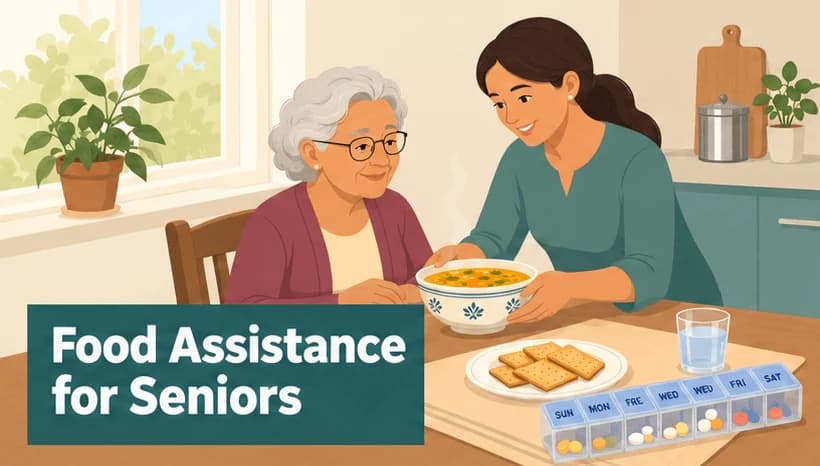
Good food matters when you're on medications
In short: Food assistance for seniors on a fixed income starts with SNAP, home-delivered and group meals, and food boxes. Original Medicare doesn't usually pay for meal delivery. Some Medicare Advantage plans may. Florida and Texas each have their own first calls, covered below.
Readers write to us with the same worry. One said it plainly: "I take a lot of medications and need good food to help me with the medicines but the caregivers can't cook!" Maybe it's your mother, living on crackers and tea because a real meal means standing at a stove. You're not failing at this. Nobody hands families a map of who pays for what.
If the follow-through is what wears you down, a navigator can look into which food programs your parent may qualify for, make the calls and track them. Navigate Care explains how that works and what it may cost on its what you will pay page.
First, the part that is her doctor's job and not ours. If she takes several medicines, ask her doctor or pharmacist which ones need food and which don't. A navigator doesn't give medical advice, and neither does this post. But that one question tells you how urgent a hot meal really is, and it gives you something concrete to say when you ask for help.
The need is not small. NCOA reports that roughly 7.4 million seniors (age 60 and over) faced food insecurity in 2023. It also says just 38% of eligible adults age 65 and older took part in SNAP that year. That gap is the part nobody explains.
Food assistance for seniors on a fixed income: Social Security and SNAP
Yes, a parent on Social Security can get SNAP, the Supplemental Nutrition Assistance Program. Social Security income doesn't rule anyone out. What counts is the total picture: income, savings and, for older adults, medical bills.
SNAP treats households with someone 60 or older differently. NCOA says such a household generally has to meet the net income test, the one that comes after deductions, and the deductions include excess medical expenses. NCOA adds that adults 60 and older can deduct out-of-pocket medical costs above $35 a month, with no cap. A parent with a pile of prescriptions, premiums and co-pays may find that deduction does a lot of work.
For the federal year that ended September 30, 2026, NCOA's figures for one adult 60 or older were $1,696 gross and $1,305 net income a month. Households with a member 60 or older can have $4,500 or less in countable resources. A home and lot, and most retirement and pension plans, generally don't count. That year is over, and the limits are set again for each new federal year, so check the current numbers with your state before you rule your parent out. States run the application.
What might it be worth? NCOA says the average SNAP benefit for a one-person senior household is $188 a month, or $2,256 a year. That's an average, not a promise, and your parent's amount is set by the state.

Meal delivery, group meals and senior food boxes
SNAP puts money on a card. It doesn't cook. If the real problem is that nobody can make dinner, look at the programs that hand over food or a meal.
Programs that bring food or meals to older adults
| Program | What your parent gets | Worth knowing |
|---|---|---|
| Meals on Wheels and local home-delivered meals | Meals brought to the door, often with a friendly visit | Run locally. Find one through your Area Agency on Aging or the Meals on Wheels website |
| Commodity Supplemental Food Program (CSFP) | A monthly box of foods, such as milk, juice, cereal and canned fruit and vegetables | For eligible adults age 60 and older. Not offered in every state |
| Senior Farmers' Market Nutrition Program (SFMNP) | Coupons for locally grown foods | For eligible low-income older adults. Not every state offers it |
| The Emergency Food Assistance Program (TEFAP) | Food at no cost, through local food banks | For people with low income. Rules vary by state and local agency |
Source: NCOA, Food Assistance Programs for Older Adults
The CSFP box is what many people mean by the senior food box program. It's food, not a hot meal, so it helps most when someone can heat a can of soup or open a carton of milk. If cooking is the obstacle, start with home-delivered meals.
Your local Area Agency on Aging is the usual door to meals. Ask what it offers for home delivery and for group meals at a senior centre, and ask how long the wait is. Availability differs town to town. NCOA also points to its free BenefitsCheckUp tool, where you enter a ZIP code and see which benefits may apply.
What Medicare plans may offer for food
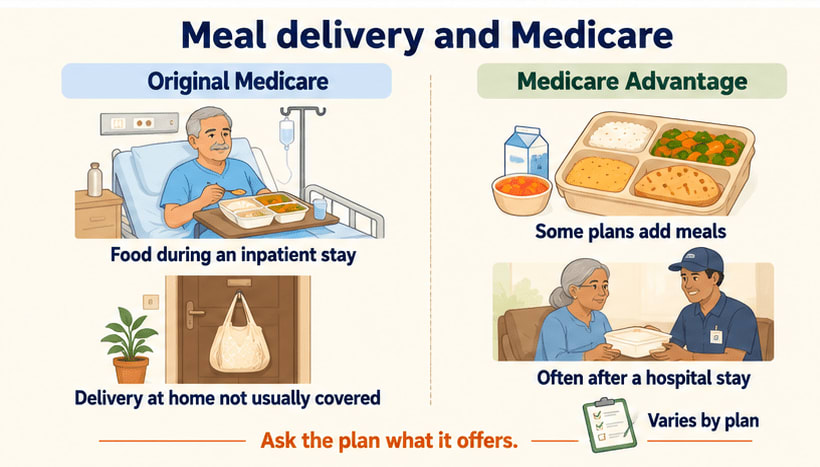
Here is the answer that surprises people. Original Medicare doesn't usually cover food delivery. Healthline says Part A covers food during an inpatient stay, but not delivery to your home. Medicare doesn't pay for routine meals at home, and it doesn't automatically cover anything on this page.
Some Medicare Advantage plans do add meals. According to Healthline, many plans offer temporary help for a set number of meals or a set length of time after a hospital or facility stay. Some may cover meals for a condition like heart failure, diabetes or kidney disease.
KFF has the 2026 count. It reports that 65% of individual Medicare Advantage plan enrollees are in plans with meal benefits, down from 70% in 2025. A separate food and produce benefit for chronically ill members reaches 8% of individual plan enrollees in 2026. KFF also says it isn't known how many people actually use these benefits.
So "the plan has a meal benefit" can mean a short run of meals after a hospital stay, not a standing supply. Call the plan, or read its Evidence of Coverage, and ask three things: what is offered, for which condition or stay, and how many meals.
Meals under Original Medicare and Advantage, 2026
| Original Medicare | Medicare Advantage | |
|---|---|---|
| Food during an inpatient stay | Yes, under Part A | See the plan |
| Meal delivery at home | Not usually | Some plans, often for a limited time |
| Meals for a chronic condition | Not usually | Some plans |
| Who decides | Medicare rules | Each plan |
Source: Healthline and KFF
Our Medicare insurance plans compared guide sets the two routes side by side. If money for the whole Medicare bill is the squeeze, Extra Help Medicare is the page on drug costs. Whether to switch plans is a question for SHIP, the free State Health Insurance Assistance Program, or Medicare itself. We can't make that call for you.
Food help for seniors in Florida and Texas
SNAP, meal programs and Medicare Advantage rules are federal in outline, but your state runs the day-to-day. In Florida and Texas the first calls differ, so start in the right place.
Florida. SNAP applications go through the Florida Department of Children and Families and its ACCESS Florida portal. For meals, the Elder Helpline at 1-800-96-ELDER (1-800-963-5337) can help you find a meal provider and start an application, according to UF/IFAS. Home-delivered meals are open to adults 60 and older, and providers give priority to people with low income, people in rural areas and people who are homebound. The helpline may have a wait.
Texas. SNAP is handled by Texas Health and Human Services (HHSC), and you can apply at YourTexasBenefits.com. HHSC runs a shorter application, the Texas Simplified Application Project, for households where everyone is 60 or older or has a disability and no one has earned income. Ask whether your parent fits it. For meals, your local Area Agency on Aging is the usual door, and availability differs by county.
In both states, check your parent's Medicare Advantage plan for a meal benefit before you pay for delivery yourself. Benefits differ by plan and by county, so the plan's Evidence of Coverage is the page to read.
How to apply without the runaround
Most of the delay is paperwork, not refusal. This order keeps it short.
- Check what may fit. BenefitsCheckUp takes a ZIP code and a few answers.
- Apply for SNAP through your state, online, by mail or in person, depending on the state. NCOA says you should hear within 30 days. Expedited benefits can arrive within 7 days for very low cash and income.
- Do the interview. First-time applicants usually do one by phone, and many states let an authorized representative take the call for your parent.
- Call the Area Agency on Aging about meals, in the same week. Don't wait for the SNAP answer.
- Follow up. Put the date in the calendar.
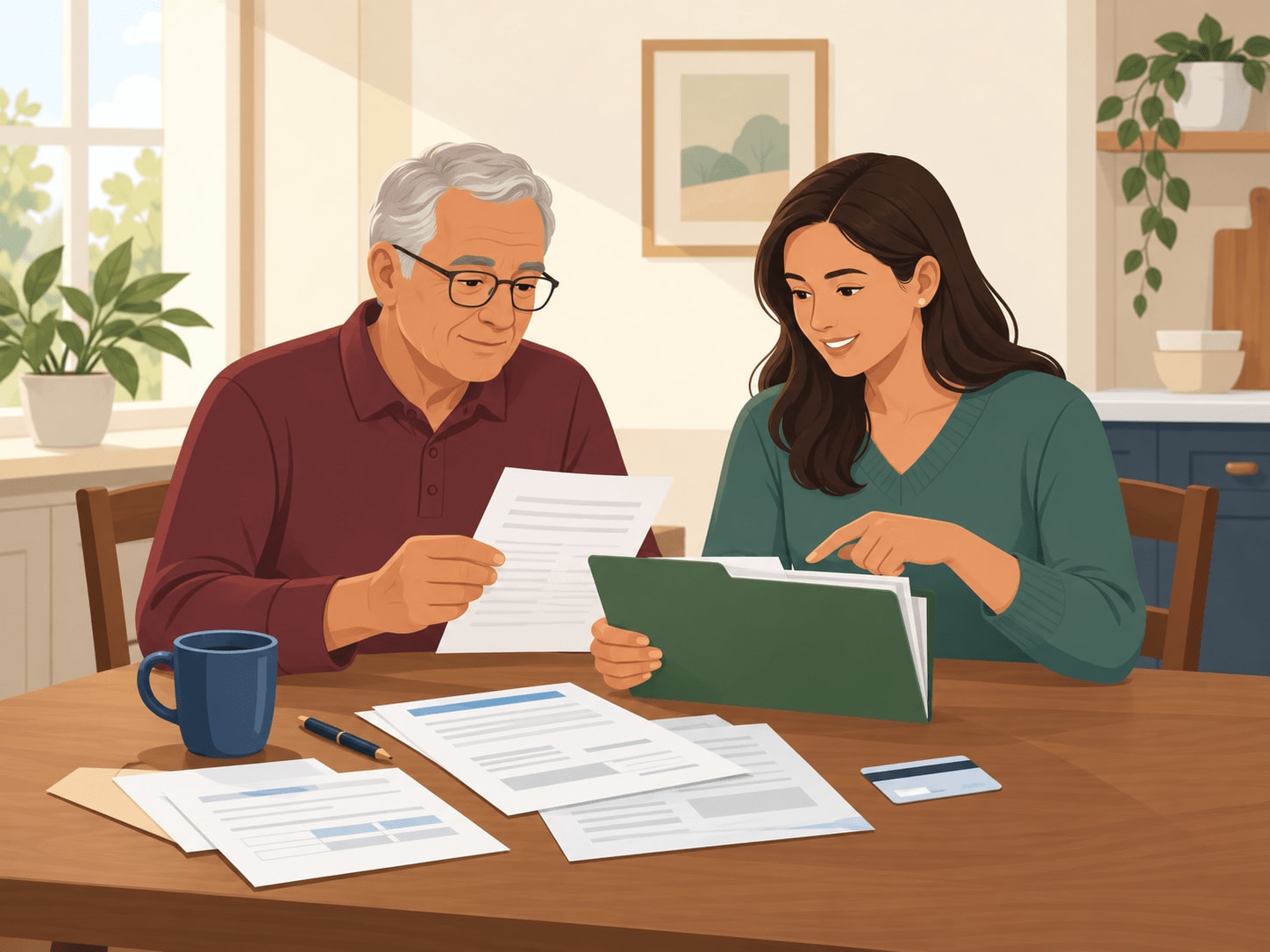
Gather before you start: proof of who your parent is and where they live, their income (a Social Security statement is usual), what's in their bank accounts, and the medical bills if you're claiming that deduction. Your state's form lists what it wants. Keep copies of everything you send, and write down who you spoke to.

Where a navigator comes in
A navigator doesn't treat anyone, give medical advice or replace SHIP. What a navigator can do is the checking and the follow-through: which programs your parent may qualify for, helping with the applications, the calls to the agency, and tracking what comes back. Medicare doesn't automatically cover navigation. Eligibility depends on a qualifying condition or need and a provider visit, and we confirm your cost before you start. It is usually $0 with supplemental coverage. The what you will pay page sets out the detail.
Frequently asked questions
Can seniors on Social Security get SNAP?
Yes. Social Security income doesn't disqualify anyone. For a household with someone 60 or older, SNAP generally uses the net income test, and out-of-pocket medical costs above $35 a month can be deducted, according to NCOA. The state makes the decision.
Does Medicare pay for meal delivery?
Original Medicare doesn't usually cover food delivery, says Healthline. Some Medicare Advantage plans cover a set number of meals, often after a hospital stay or for a chronic condition. Ask the plan what it offers.
What is the senior food box program?
Usually it means the Commodity Supplemental Food Program. NCOA says eligible adults age 60 and older can receive a free box of foods, such as milk, juice, cereal and canned fruit and vegetables. It isn't offered in every state.
How do I find food assistance for seniors near me?
Start with your local Area Agency on Aging for meals, and your state's SNAP office for benefits. NCOA's BenefitsCheckUp tool takes a ZIP code. For food right away, NCOA says a local food bank can connect you with pantries and free food programs.
How do seniors in Florida get food help?
SNAP applications go through the Florida Department of Children and Families and its ACCESS Florida portal. For meals, the Elder Helpline at 1-800-96-ELDER (1-800-963-5337) can help you find a meal provider and start an application, according to UF/IFAS. Home-delivered meals are open to adults 60 and older, and providers give priority to people with low income, people in rural areas and people who are homebound. The helpline may have a wait.
How do seniors in Texas get food help?
SNAP is handled by Texas Health and Human Services (HHSC), and you can apply at YourTexasBenefits.com. HHSC runs a shorter application, the Texas Simplified Application Project, for households where everyone is 60 or older or has a disability and no one has earned income. Ask whether your parent fits it. For meals, your local Area Agency on Aging is the usual door, and availability differs by county.