The Medicare plans comparison chart, all four routes side by side
In short: A Medicare plans comparison chart has one row for each thing that changes your bill: doctors, yearly ceiling, drugs, referrals. Fill in the same rows for every plan you weigh.
Open Enrollment runs October 15 to December 7, 2026, and plan mailings pile up around it. Each one comes with its own table, and each table picks its own rows. One leads with the premium. Another buries the doctor network on page six. You can't compare two plans when each one chose the questions.
Once the plan is chosen, the harder part is following through on it: the referral, the equipment, the call after discharge. Navigate Care explains how a navigator helps with that and what it may cost on its what you will pay page.
This post is the chart you fill in yourself. Our other posts explain what each kind of plan is. If you want that tour first, Medicare insurance plans compared and Medicare parts do it well. This one assumes you know the four names and need a way to put real plans next to each other.
Start with the routes. Your parent ends up on one of four, and the differences that matter most are below.
The routes your parent can take, and what changes on each
| Route | Doctors | Yearly ceiling on what you pay | Drugs |
|---|---|---|---|
| Original Medicare alone | Any doctor or hospital that takes Medicare, anywhere in the US | None | Join a separate Part D plan, or go without |
| Original Medicare, Medigap and Part D | Same as above | Medigap helps with deductibles, copayments and coinsurance | Stand-alone Part D plan |
| Medicare Advantage, HMO type | In the plan's network, usually with a referral for specialists | Yes: the CMS maximum is $9,250 in-network in 2026 | Often built in, but check |
| Medicare Advantage, PPO type | In the plan's network, no referral needed | Yes: the CMS maximum is $13,900 for in-network and out-of-network combined in 2026 | Often built in, but check |
Source: Medicare.gov, your coverage choices, Medicare.gov, compare plan types and KFF, Medicare Advantage in 2026
Read the second column and the third column together. They are the whole trade. Original Medicare lets your parent walk into almost any office, and Medicare.gov says plainly that there is "no yearly limit on what you pay out-of-pocket, unless you have supplemental coverage." Advantage plans do the reverse. They cap the year and narrow the doors.

More than half of eligible people have already chosen the second route. KFF counts 35.2 million of the 64.2 million beneficiaries with both Part A and Part B in Medicare Advantage in 2026, which is 55%. That figure tells you what's popular. It doesn't tell you what fits your mother.
The rows that decide it
Here is the part the plan brochures skip. A good chart has maybe eight rows, and you can fill most of them in an evening. Print this one, or copy it into a notes app, and give each plan its own column.
The rows to fill in for every plan you compare
| Row | What to write down | Why it decides things |
|---|---|---|
| Monthly premium | The plan's premium, plus the Part B premium of $202.90 in 2026 | Part B is paid either way, so compare only what the plan adds |
| Yearly deductible | The amount paid before the plan starts | It lands in the first bad month of the year |
| Yearly out-of-pocket limit | The cap on covered services, if there is one | It is the ceiling of a bad year |
| Doctors and hospitals | Each one your parent sees, checked by name | A network is only good if their doctors are in it |
| Drugs | Every prescription, checked against the plan's list | One missing drug can outweigh a lower premium |
| Referrals and approvals | Whether specialists need a referral and which services need prior authorization | This is where care slows down |
| Extra benefits | Dental, vision, hearing, and exactly what they pay | "Covered" can mean a full allowance or a small credit |
| Switching rules | When your parent can change again | A choice made now may hold for a year |
Source: the 2026 Part B premium is from Medicare.gov, Medicare costs. The rest of the table is our own checklist.
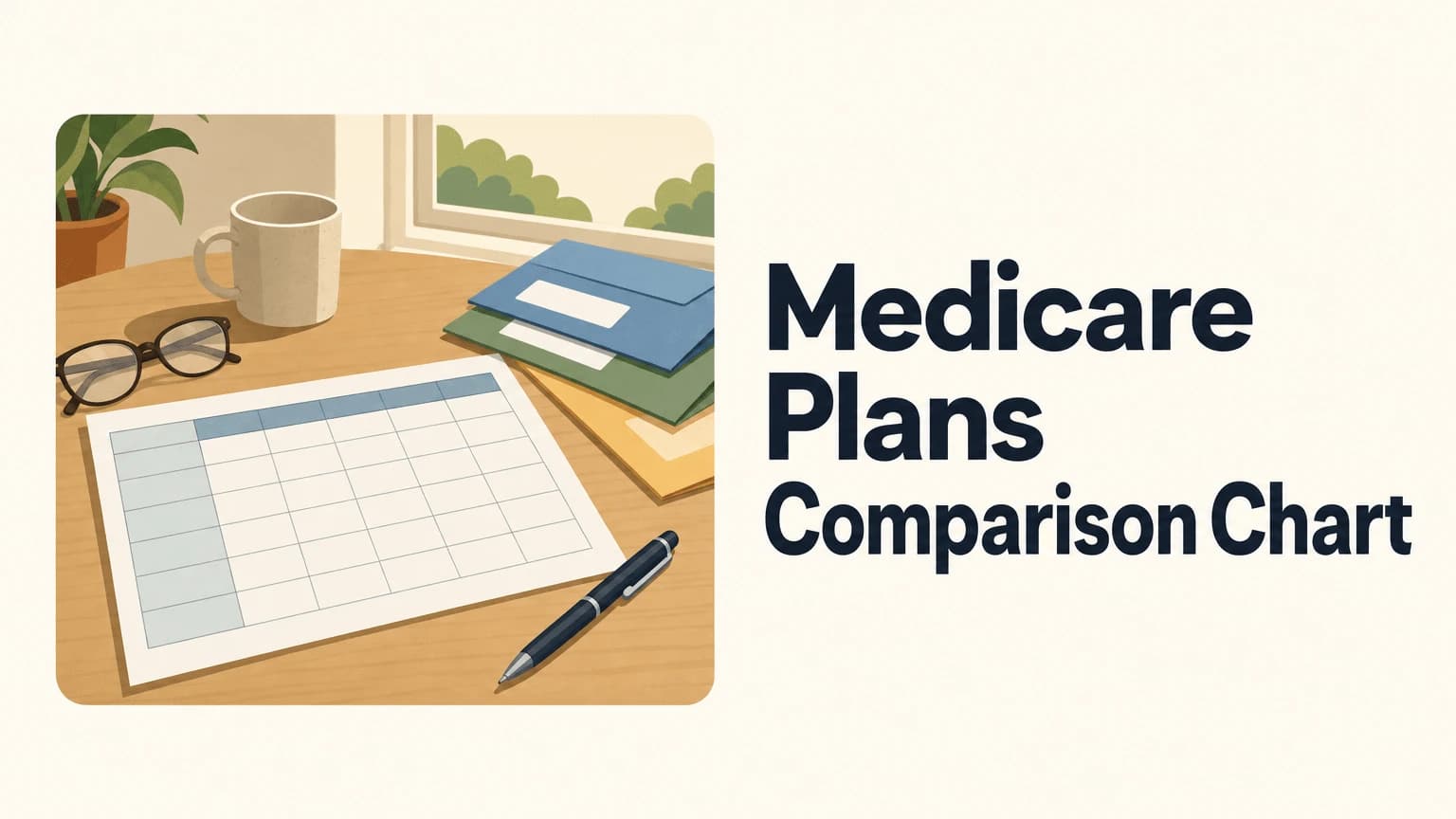
Your chart to print or copy: one column for each plan you compare
| Row | Plan 1 | Plan 2 | Plan 3 |
|---|---|---|---|
| Plan name and type | |||
| Monthly premium (beyond Part B) | |||
| Yearly deductible | |||
| Yearly out-of-pocket limit | |||
| Doctors and hospitals (each one, in or out) | |||
| Drugs (each one, on the list or not) | |||
| Referrals and prior authorization | |||
| Extra benefits (what each pays) | |||
| Switching rules |

Let's go through the rows that cause the most surprises.
Premium: compare only what the plan adds
Everyone pays Part B. Medicare.gov puts the 2026 standard premium at $202.90 a month, and it can be higher depending on income. So when a plan says "$0 premium", it means $0 on top of that. It never means $0 total.
How common is $0? KFF reports that in 2026, 75% of enrollees in individual Medicare Advantage plans with drug coverage pay no premium beyond Part B. The other 25% pay an average of $59 a month. Across everybody, the average added premium is $15 a month. That's an average, and it hides a wide spread, so use it as a sense of scale and not as a number to expect from the plan on your table.
The yearly ceiling: the row the brochure makes small
Say a hospital outpatient service has a Medicare-approved amount of $1,000 and your mother has already met her $283 Part B deductible for 2026. Under Original Medicare, she usually owes 20%, which is $200. That's an example, not a real bill. Now say it happens 5 times in a year. She owes $1,000 for the year from those five alone, and Original Medicare has no ceiling that stops the count.
That's what the "no yearly limit" line means in practice. It isn't a warning. It's a reason Medigap exists, and a reason the ceiling row deserves real attention for a parent with several conditions.
Advantage plans carry a ceiling by design. CMS sets the 2026 maximum at $9,250 for in-network care. Most plans land under it. KFF's enrollment-weighted average for in-network care in 2026 is $5,421. For plans that mix in out-of-network care, the CMS maximum is $13,900, and KFF's average for those combined limits is $9,825. Write down both numbers for every Advantage plan you chart. If a plan's papers show only one of them, ask for the other.
Doctors: check by name, not by "yes, we have a network"
Medicare.gov says Advantage members "may need to use doctors and other providers who are in the plan's network and service area" for non-emergency care. Original Medicare lets your parent use "any doctor or hospital that takes Medicare, anywhere in the U.S."
So the row isn't "network: yes or no". It's a list. Write down the primary doctor, the cardiologist, the hospital your mother would be taken to, and the pharmacy. Then check each name against each plan, one at a time. It's dull work. It's also the check that most often decides whether a plan fits.
If your parent splits the year between two states, a service area matters as much as a network. Medicare.gov ties Advantage care to the plan's service area. Original Medicare works anywhere in the US.
Drugs: one list, one name at a time
Most Advantage plans include Part D, according to Medicare.gov. Some types don't. A PFFS plan "may" cover drugs, and an MSA plan needs a separate drug plan. Special Needs Plans must offer Part D. If your parent is on Original Medicare, there's a stand-alone Part D plan to choose, and the drug list is the first thing to check.
The numbers are moving this year. For 2026, Medicare.gov says no drug plan may have a deductible above $615, and once out-of-pocket spending on covered Part D drugs reaches $2,100, your parent pays nothing for covered drugs for the rest of the year. For 2027, the same page lists $700 and $2,400.
Part D limits, by plan year
| Limit | 2026 | 2027 |
|---|---|---|
| Highest allowed deductible | $615 | $700 |
| Out-of-pocket cap on covered drugs | $2,100 | $2,400 |
Source: Medicare.gov, costs for Medicare drug coverage
That matters because the plan your parent picks this fall is the one that runs in 2027. If you're comparing drug plans for the new year, our guide to comparing Medicare drug plans for 2027 goes through it in more detail, and Medicare Part D covers what the part pays for.
Check the specific plan's own list for every drug your parent takes, by name and strength. A cap is a ceiling for the year. It says nothing about whether a drug is on the list.
Referrals and approvals: where care slows down
The referral rule differs by type. Medicare.gov says an HMO generally needs you to use the plan's network, and a referral is required. A PPO, a PFFS plan and an MSA don't require one. For Original Medicare, "in most cases you don't need a referral to see a specialist."
Prior authorization is the other half of this row, and it's the one that catches people. The plan has to approve certain services before it pays. The Medicare.gov plan comparison page says you'll typically need that approval for certain services or supplies. KFF finds that 99% of Advantage enrollees in 2026 are in plans that require it for some services.
None of that means a request will be refused. It means there's a step, and someone has to make the call and track it. If a service is refused, the clocks are short: 65 days for a first-level Medicare Advantage appeal, against 120 days after the Medicare Summary Notice for Original Medicare. We can't say any appeal will succeed. Our guide to how to appeal a Medicare denial takes it step by step.
Extra benefits: ask what "covered" means
This is the row where Advantage plans look best on a chart, and where the chart is least informative. KFF reports that in 2026, in individual Advantage plans, more than 99% offer eye exams and/or glasses, 98% offer dental (including plans that cover only preventive dental care) and 95% offer hearing exams and/or aids. Original Medicare, by contrast, doesn't cover some services such as routine physical exams, eye exams and most dental care.
Don't read "95%" as "your parent's hearing aids are paid for". What a plan pays, and how much your parent shares, varies from plan to plan. So the row to fill in isn't "has hearing coverage". It's three things: what it pays toward, the dollar limit for the year, and whether your parent has to use a particular clinic. Our post on what Medicare pays for hearing aids shows what that looks like in practice, and chiropractic is a second example of a service where the plan's own rules matter.
Medigap on one grid
If your parent stays on Original Medicare, Medigap is the part of the chart that confuses people most, because it comes in letters. Medicare.gov says Medigap can "help pay your share of out-of-pocket costs in Original Medicare," and that, generally, you must have Original Medicare Parts A and B to buy one.
The official chart on Medicare.gov lists each lettered plan against a long run of benefits: the Part A deductible, coinsurance, the Part B deductible, excess charges and so on. We can't reproduce its check marks here, so open Medicare.gov's Medigap benefits chart alongside this post. What we can give you are the details in that chart that change the bill, because they are easy to miss.
Medigap details worth checking on the 2026 chart
| Plan | Detail that changes your bill |
|---|---|
| K | Pays 50% of several listed benefits; out-of-pocket limit of $8,000 in 2026 |
| L | Pays 75% of several listed benefits; out-of-pocket limit of $4,000 in 2026 |
| M | Pays 50% of the Part A deductible |
| N | Pays 100% of Part B coinsurance, except a copayment of up to $20 for some office visits and up to $50 for emergency room visits when you aren't admitted |
| High-deductible version of Plan G, in some states | You pay up to $2,950 in 2026 before the policy pays anything |
| D, G, M and N | Foreign travel emergency care at 80%, up to plan limits |
Source: Medicare.gov, compare Medigap plan benefits
Two practical points follow. First, a Medigap policy doesn't have its own doctors. It sits next to Original Medicare, so the doctor row on your chart reads the same as for Original Medicare alone. Second, Medigap and Advantage don't go together. Medicare.gov says you can't buy Medigap while you're in an Advantage plan unless you're switching back to Original Medicare, and that Medigap can't pay an Advantage plan's copayments, deductibles or premiums. If someone offers your parent a Medigap policy "on top" of an Advantage plan, stop and call SHIP before signing anything. SHIP is the State Health Insurance Assistance Program. Its counselling is free, and it doesn't sell plans.

The window that makes Medigap easier
Timing matters more for Medigap than for almost anything else on this chart. Medicare.gov describes a one-time, 6 month Medigap Open Enrollment Period. It begins the first month your parent has Part B and is 65 or older. During it, insurers must sell any Medigap policy they offer, whatever your parent's health, and can't charge more because of a pre-existing condition.
After it closes, the same page says options may shrink and prices may rise, and insurers may deny a policy if your parent doesn't meet their medical underwriting. Exceptions called guaranteed issue rights may apply. Your State Insurance Department can tell you what your state adds.
That's the reason to chart Medigap early, before the Part B start date and not after it. If your parent is already past the window, don't guess. Ask SHIP which rights apply where you live.
Filling in the chart for real plans
A chart is only useful if the numbers on it are real. Here is an order that works.
First, the card. Is your parent on Original Medicare or an Advantage plan? The answer decides which column you're filling in.
Second, the people and the pills. Write the doctors, the hospital, the pharmacy and every prescription on one page, with strengths. You'll reuse that page for every plan.
Third, pull two or three plans, no more. Medicare's Plan Finder is the place to look for plans in your ZIP code. Each plan's own documents carry the numbers, so copy from those and not from an advertisement.
Fourth, fill each row from the plan's own papers: premium, deductible, ceiling, referral rule, prior authorization, extras. If a row is blank on the brochure, that's an answer too. Call the number on the plan and ask.
Fifth, check every name. Each doctor and each drug, against each plan. Anything that sounds like "it depends" gets asked again, and the answer gets written down or sent by email.
Last, call SHIP before you decide. It's a second pair of eyes with nothing to sell.

Here's a worked example, in round numbers that are an illustration and not a real plan. Say two Advantage plans are on your table. Plan A has a $0 premium. Plan B charges $100 a month. But Plan B's yearly ceiling sits $1,000 lower than Plan A's.
Which is cheaper? It depends on the year. In a quiet year, when your mother sees her doctor a few times and never gets near either ceiling, Plan A wins, because she never pays Plan B's $100 a month. In a year with a hospital stay and a run of specialists, she may reach Plan A's ceiling and not Plan B's, and the premium gap can be smaller than the ceiling gap. Neither plan is the "right" one. The chart just makes the trade visible, so you're choosing it and not stumbling into it.
That's why you don't average. A plan with a lower premium can cost more in a bad year, and a plan with a higher premium can cost less. A parent with 1 or 2 hospital stays a year and several specialists reads the chart differently from one who sees a single doctor twice a year. Weigh the row that fits the year you're afraid of, and say so out loud to whoever is helping you.
What the chart can't tell you
Be honest about the limits. A chart can't tell you how long the phone queue is when a referral stalls, or how often a particular plan asks for prior authorization on the services your parent actually uses. It can't tell you whether your mother's doctor will still be in the network next year. Networks and drug lists can change from one year to the next. That's one more reason to look again every autumn, and the reason a chart you filled in last year is a starting point and not an answer.
It also can't make the decision for you. People often want a winner. What you get is a clear loser or two, a plan that fails on a doctor or a drug, and then a trade between what's left. That's a good result. Cutting four plans to two is most of the work.
When the chart is done, show it to someone. A SHIP counsellor can check the rows you filled in against what's offered where you live, and can say which row you've missed. It's easier to ask for that with a one-page chart in hand than with a shoebox of letters.

When you can change your mind
The chart isn't a lifetime decision, though a rushed one in November can stick for a year. For someone already on Medicare, Open Enrollment runs October 15 to December 7, 2026. It's the main window to move between Original Medicare and Advantage, or change a Part D plan. Our Medicare Part C guide goes through the narrower windows that open for people already in an Advantage plan, and how to apply for Medicare covers the first enrolment.
If your parent is newly eligible, the order is Parts A and B first, then the rest. Who qualifies for Medicare explains the tests. And if the monthly cost is the worry, our guide to Extra Help and what each part costs in 2026 are the next pages to read. Neither this post nor a navigator can tell you what you personally qualify for. SHIP, Medicare and Social Security can.
Where a navigator comes in
A navigator doesn't pick the plan and doesn't replace SHIP. What a navigator coordinates is what comes after: booking the referral, chasing the approval, tracking the equipment, following up after a discharge. Medicare doesn't automatically cover navigation. Eligibility depends on a qualifying condition or need and a provider visit, the cost is usually $0 with supplemental coverage, and we confirm your cost before you start. Our compare page sets out how that differs from a private advocate or care manager.
Frequently asked questions
What is the difference between Original Medicare and Medicare Advantage?
Original Medicare lets your parent use any doctor or hospital that takes Medicare, anywhere in the US, and has no yearly limit on what they pay unless there's supplemental coverage. Medicare Advantage plans use networks and service areas, and every plan has a yearly limit on covered services. The CMS maximum in 2026 is $9,250 in-network.
Which Medicare plan costs the least?
It depends on the kind of year your parent has. In 2026 the standard Part B premium is $202.90 a month on any route. KFF reports an average added Advantage premium of $15 a month, and 75% of enrollees in individual plans with drug coverage pay nothing beyond Part B. A low premium can still mean a higher bill in a bad year, so compare the yearly ceiling too.
Can my parent have Medigap and Medicare Advantage together?
No. Medigap helps pay Original Medicare's out-of-pocket costs, and your parent generally needs Parts A and B to buy it. If your parent has an Advantage plan and someone offers Medigap on top, call SHIP before signing.
Does a Medicare Advantage plan include drug coverage?
Most do, says Medicare.gov. Special Needs Plans must offer Part D. PFFS plans may cover drugs, and an MSA plan needs a separate drug plan. With Original Medicare, your parent joins a separate Part D plan.
When is the best time to compare Medicare plans?
For people already on Medicare, the main window is Open Enrollment, October 15 to December 7, 2026. For Medigap, timing runs on a different clock: a one-time 6 month window that begins the first month your parent has Part B and is 65 or older.
Who can help me compare plans without selling me one?
SHIP, the State Health Insurance Assistance Program. Its counselling is free, and it doesn't sell plans. Medicare itself can also answer questions about the plans in your area.