Does Medicare cover cataract surgery? Yes, with limits
In short: Yes. Part B covers medically necessary cataract surgery with a standard lens. In 2026 your parent pays the $283 Part B deductible, then 20% of the approved amount. Toric and multifocal upgrades are extra.
Your mother has been saying the night driving is getting hard, and the eye doctor has used the word "cataract". The surgeon's office hands over a price sheet with two columns, and nobody explains why one of them is not Medicare's. If a parent has the surgery ordered and nobody has booked the pre-op visit or checked the plan, a navigator can make those calls and track them. Navigate Care explains how that works and what it may cost on its what you will pay page.
The rest of this post is the part nobody explains: what Medicare pays for, where the line sits between a covered lens and a paid-for upgrade, and what the bill looks like in four ordinary situations.
What Part B pays for
Cataract surgery is an outpatient operation, so it falls under Part B, not the hospital side of Medicare. Our guide to what Parts A and B are explains why, and Medicare Part B goes through the costs.
AARP says Medicare covers medically necessary cataract surgery, which includes removing the cataract and putting in a basic intraocular lens. That is the artificial lens that replaces the cloudy natural one. It also says Medicare won't cover advanced technology lenses or elective surgery.
So the word that matters is "medically necessary". A cataract is a cloudy area in the lens of the eye. NEI says more than half of all Americans age 80 or older either have cataracts or have had surgery to get rid of them. Having one is common. Medicare pays when the cataract is getting in the way of your parent's sight and the eye doctor records that. Ask the surgeon's office what they have documented, in plain words: which tasks have become harder, and what the vision test showed.
Your parent hasn't done anything wrong by asking. The surgeon decides whether the surgery is needed, and the paperwork should say why.
The lens is where the bill splits
Here is the one idea that explains most surprise bills. Medicare pays for the surgery and a standard lens. If your parent chooses a more advanced lens, Medicare still pays what it would have paid for the standard one, and your parent covers the difference.
AAO's EyeNet puts it as Medicare paying "what it would cost to restore functional vision". Its piece is from October 2018, so lens lists may have moved, but the principle has held in every page we read. Patients can be billed for the premium part, and for work that corrects natural astigmatism with such a lens.
Lens types and Original Medicare
| Lens | What it does | Does Part B pay? |
|---|---|---|
| Monofocal (standard) | One focus, usually distance; glasses for near | Yes, usually 80% after the deductible |
| Toric | Also corrects astigmatism | Not the upgrade; your parent pays the extra |
| Multifocal | Focuses near and far | Not the upgrade; your parent pays the extra |
Source: HealthPartners and AAO EyeNet
We could not find a trustworthy national price for the upgrade. Consumer sites give wide ranges, with no primary source behind them. So we won't quote one. Ask the surgeon's office for a written figure, split into "Medicare's part" and "your part", before you agree to anything.

What your parent pays: four worked examples
The rule under Original Medicare is short. After the Part B deductible, your parent pays 20% of the Medicare-approved amount. The 2026 deductible is $283, according to RISE Health, quoting the CMS fact sheet. Medicare Advantage and Medigap change the picture. Our Medicare cost 2026 guide lists what each part costs, and what an out of pocket maximum is shows where Medicare has a yearly limit and where it doesn't.
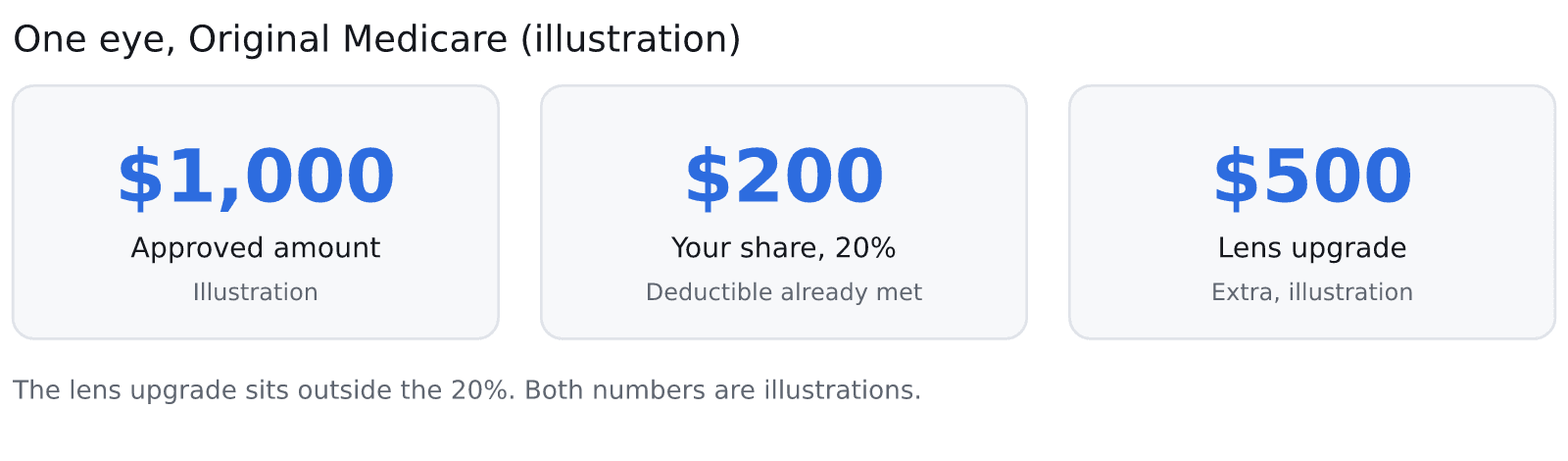
These are round-number illustrations, not real prices. Say the Medicare-approved amount for one eye is $1,000, surgeon and facility together, and your mother has already met the deductible this year.
One eye, four situations (illustration, 2026 rules)
| Situation | Your mother's share | How it works |
|---|---|---|
| Original Medicare alone | $200 | 20% of $1,000 |
| Original Medicare plus Medigap | May be $0 | Medigap may cover all or part of the 20% |
| Medicare Advantage | The plan's copay, say $100 | Set by the plan, in network |
| Original Medicare plus a premium lens | $200 plus $500 | 20% of $1,000, plus the lens upgrade she chose |
Source: figures are illustrations built on AARP's description of the 20% rule
Two things to take from it. First, the $200 is a share of a covered bill, and the real approved amount is set by Medicare, not by the surgeon. Second, the lens upgrade sits outside that share entirely. The $500 here is invented to show the point. Your parent's number will be different, and it is the one to get in writing.
If she hasn't met the deductible yet, the first claim carries it. Ask whether it has been met before you pick a date. A surgery in December and one in January can land in different deductible years.
Medigap pairs only with Original Medicare. Our guide to Medicare insurance plans compared shows how the pieces fit, and the Medicare plans comparison chart lets you fill in your parent's own rows.
Does Medicare cover glasses after cataract surgery?
Yes, once, and it surprises people because Medicare generally doesn't pay for routine glasses or eye exams. AARP says that after cataract surgery with an intraocular lens, Part B pays for one set of corrective glasses or contacts. Your parent pays 20% of the Medicare-approved amount. Coverage is limited to standard frames, and the glasses have to come from a Medicare-approved supplier. AARP's page was last updated in January 2024, so check the current rule with Medicare when the time comes.
Here is what that looks like in round numbers. If the approved amount for the glasses is $100 and the deductible is already met, your mother pays $20. Nicer frames, or a second pair, are hers to pay for.
Ask the surgeon's office when to order them, and from whom. The supplier question is the one people forget.
Both eyes, laser surgery, YAG and astigmatism
These are the questions the top pages skip.
Both eyes. Treat each eye as its own operation with its own bill. We did not find a primary source on how the deductible and 20% apply to the second eye, beyond the general rule that each covered service carries them. Your parent should ask the office to price each eye separately.
Laser-assisted surgery. Surgeons do cataract surgery with traditional techniques or lasers, says AARP. AAO's guide says that when a laser is used for covered steps with a standard lens, the surgeon and facility may not collect extra payment from Medicare or the patient for that. If an office wants a separate laser fee for a standard lens, ask them to explain it in writing, and call SHIP, the free State Health Insurance Assistance Program, if the answer isn't clear.
Astigmatism. Medicare pays for the standard lens. Correcting astigmatism with a toric lens is the upgrade. Glasses afterwards, under the one-pair rule above, still do the job for many people.
YAG capsulotomy. Some people find their vision clouding again after surgery, and a laser treatment can address it. HealthPartners says Original Medicare and Advantage plans help cover it when the doctor considers it medically necessary. It is a separate procedure, so it carries its own cost sharing.
If your parent has Medicare Advantage
Advantage plans have to cover cataract surgery too. AARP says you may pay different deductibles or copayments, and may need an in-network provider. The question changes from "does the surgeon take Medicare?" to "is the surgeon and the surgery centre in the plan's network, and what is the copay for each?"
Some plans also help with premium lenses. AAO notes that Part B doesn't cover premium lenses, but some Advantage and commercial plans do, and the plan's own terms decide payment. Call the number on the card and ask by name: "Does this plan pay toward a toric or multifocal lens, and what is my share?" Our Medicare Part C guide covers how these plans work.
Before you book: six questions
- Has the eye doctor documented that the cataract affects daily life?
- Is the surgeon, and the surgery centre, enrolled in Medicare, and do they accept assignment? That means taking Medicare's approved amount as full payment.
- Which lens is Medicare paying for, and what is the written price of any upgrade?
- Has the Part B deductible been met this year?
- If your parent has an Advantage plan, are the surgeon and facility in network, and is prior approval needed?
- When are the glasses due, and who is the Medicare-approved supplier?

If a bill looks wrong afterwards, our guide to reading a Medicare denial letter is the place to start. We can't promise any appeal will succeed. SHIP counselling is free.
Where a navigator comes in
A navigator doesn't treat cataracts, give medical advice, or choose a lens. That is for the eye doctor. What a navigator does is the follow-through: booking the pre-op visit, checking the surgeon is in network, tracking the second eye and the glasses. Medicare doesn't automatically cover navigation. Eligibility depends on a qualifying condition or need and a provider visit, and we confirm your cost before you start. It is usually $0 with supplemental coverage. Our compare page sets out how that differs from a private advocate or care manager. For the wider picture, see healthcare navigation: what it is and who does it.
Frequently asked questions
Does Medicare cover cataract surgery for both eyes?
Each eye is its own operation, and each medically necessary one can be covered. Plan for cost sharing on each. We did not find a primary source that spells out how the deductible applies to the second eye, so ask the surgeon's office to price both.
Does Medicare cover laser cataract surgery?
Surgeons use traditional techniques or lasers, says AARP. AAO's guide says that with a standard lens, the surgeon and facility may not collect extra payment for a laser used on covered steps. An upgrade lens is the part your parent pays for.
Does Medicare cover multifocal or toric lenses?
No. Medicare pays what it would have paid for a standard lens, and your parent pays the difference for a toric or multifocal one. Some Medicare Advantage plans may help, so ask the plan.
Does Medicare pay for glasses after cataract surgery?
Once. Part B pays for one set of standard-frame glasses or contacts after surgery with an intraocular lens, and your parent pays 20% of the approved amount, says AARP.
Is YAG laser capsulotomy covered?
When the doctor considers it medically necessary, Original Medicare and Advantage plans help cover it, says HealthPartners. It carries its own deductible and cost sharing.
How much will I pay with Medicare?
In 2026, the $283 Part B deductible if it isn't met yet, then 20% of the approved amount. Medigap may cover some or all of the 20%. An Advantage plan charges its own copay. Premium lens upgrades are extra.