There is no rollator walker CPT code
In short: There is no rollator walker CPT code. It bills under an HCPCS Level II E-code, usually E0143, or E0149 for a heavy duty frame. The frame, the weight and the chart decide which.
Your mother's walker invoice shows a letter and four digits, and you were told to look for a five-digit code. Or you are the biller with a rollator order in front of you and no obvious line to put it on. Both are fair places to be stuck. CPT is for services. Equipment lives on the other list.
If a walker was ordered and never arrived, or the claim came back denied, a navigator can make those calls and track them. Navigate Care's medical equipment page explains how that follow-through works, and we confirm your cost before you start.
Our guide to reading Medicare CPT codes on a bill explains the two levels. This post picks one item and follows it to the claim line.
Which E-code fits which rollator
"Rollator" is not a code descriptor. The coding words are wheeled, folding, rigid, heavy duty and enclosed. So you start from the frame in front of you, then find the descriptor that matches. The descriptors below are as AAPC prints them.
Rollator types and the code that usually fits
| What you have | Code | Official descriptor | The catch |
|---|---|---|---|
| Standard 4-wheel folding rollator | E0143 | Walker, folding, wheeled, adjustable or fixed height | The usual starting point |
| Rigid wheeled frame, no fold | E0141 | Walker, rigid, wheeled, adjustable or fixed height | Check it really is rigid |
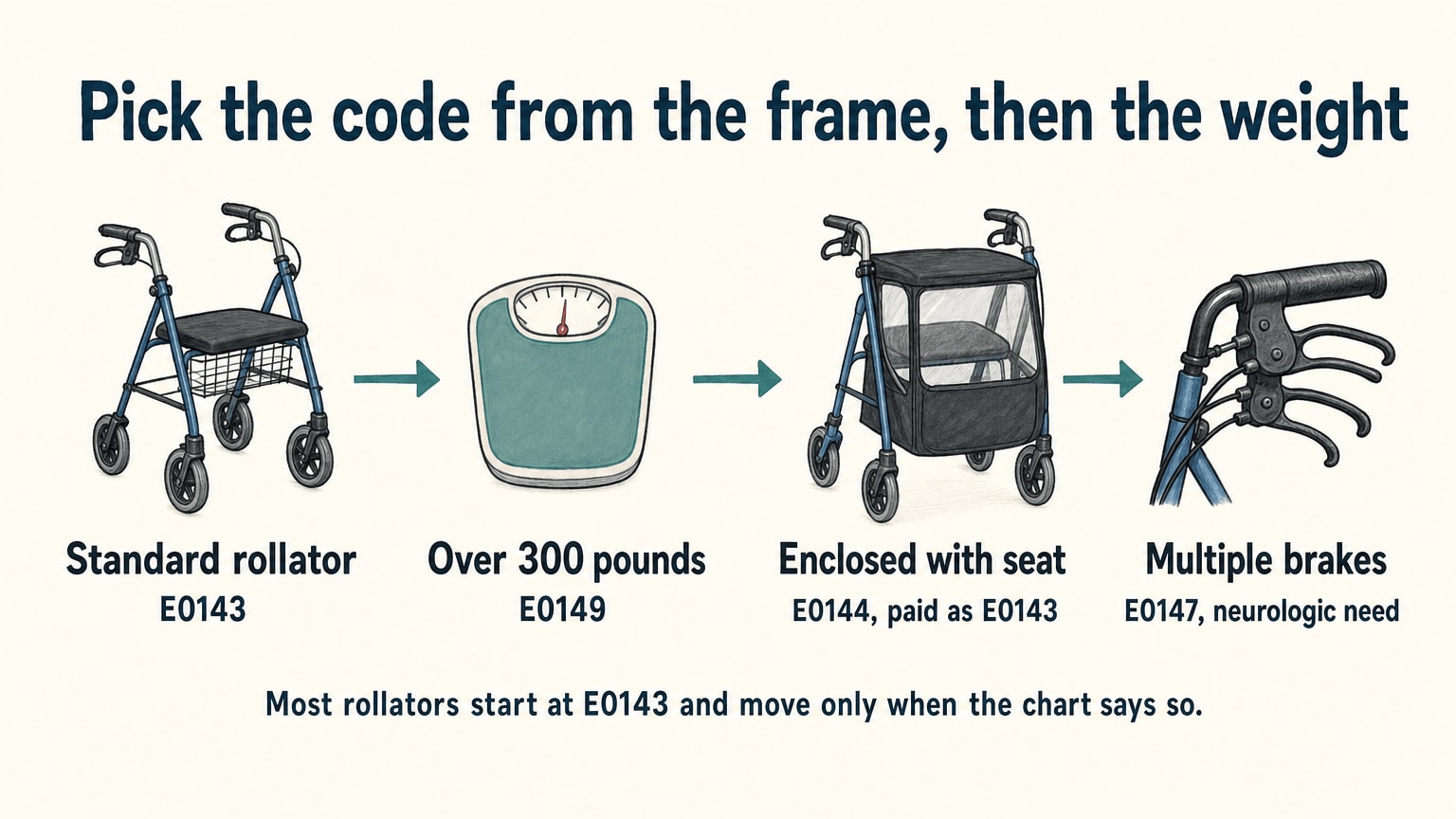
| Heavy duty rollator | E0149 | Walker, heavy duty, wheeled, rigid or folding, any type | Patient must weigh more than 300 pounds |
| Enclosed frame with seat | E0144 | Walker, enclosed, four sided framed, rigid or folding, wheeled with posterior seat | Pays at the E0143 allowance |
| Heavy duty, multiple brakes | E0147 | Walker, heavy duty, multiple braking system, variable wheel resistance | Needs a severe neurologic disorder |
| Seat sold as an add-on | E0156 | Seat attachment, walker | Not payable if the walker already has a seat |
Source: AAPC code pages for the descriptors; the catches come from a supplier's summary of the Medicare policy and a billing vendor's summary
Two rows trip people up. A rollator with a seat built in is not E0143 plus E0156. The seat attachment code is only payable when the walker being supplied does not already include a seat, according to the vendor's reading of Policy Article A52503. And the enclosed E0144 frame has not been shown to be medically necessary over E0143, so it is paid at the E0143 allowance.
On E0147, the supplier's summary is blunt: obesity by itself is not a sufficient reason. If the extra criteria are not met, payment drops to E0143 or E0149 depending on weight.
We could not open the CMS pages for the policy itself, because they refused our requests. Treat the table as a map, and check the current local coverage determination, L33791, before you bill.
Modifiers and what a claim line looks like
The same vendor lists the modifiers that matter on a walker line. NU means new equipment, RR rental and UE used. GA says a waiver of liability is on file, and GY says the item is statutorily excluded.
KX is the one that gets misused. It says the policy requirements are met. For E0149 that means the supplier holds a weight record, taken within one month of delivery, showing more than 300 pounds.
Here is an illustration, not a real claim: E0143, modifier NU, modifier KX, 1 unit, with the diagnosis taken from the chart. For a heavy duty frame it becomes E0149 with the same modifiers, and the weight record in the file. Never add KX because the claim looks thin. It says the record exists.
What the record needs
The vendor says a Standard Written Order is needed before delivery. It names the patient, the order date, the item or its code, and the practitioner's signature, date and NPI. A verbal order does not count. The clinical notes then have to show why the patient needs it.
The standard criteria, in the supplier's wording, are three ideas. The patient has a mobility limitation that significantly impairs everyday movement in the home. The patient can use the walker safely. And the walker can sufficiently resolve the problem.
If the chart says "weak, uses rollator" and nothing more, expect a question. A note that says what the patient cannot do without it is the one that gets paid.
Why walker claims come back
None of these promises a claim will be paid. They are the first checks.
Common walker denials and the first thing to look at
| What happened | First check |
|---|---|
| E0149 billed for a lighter patient | Is a weight over 300 pounds on file, dated within a month of delivery? |
| E0147 billed without the neurologic reason | Pay drops to E0143 or E0149, so check the chart |
| E0156 billed with a built-in seat | Remove it, the seat is already in the walker |
| No KX | Add it only if the record exists |
| Order dated after delivery | A retrospective order does not meet the rule |
If a denial lands, read it first. Our guides on reading a Medicare denial letter and how to appeal a Medicare denial take you through it. We can't say an appeal will succeed.

If you are the family member, not the biller
You do not need the codes to get a rollator. Part B covers walkers as durable medical equipment, and our Medicare Parts guide says so. In 2026, after the $283 yearly deductible, your parent usually pays 20% of the approved amount. A rollator is not a given: it has to be ordered, and the patient has to meet the criteria above.
If the notice has a code you do not recognise, ask the supplier what it is and whether they accept assignment. SHIP, the free State Health Insurance Assistance Program, will go through the notice with you. Our Medicare Part B guide covers the deductible and the 20%.

Frequently asked questions
Is there a CPT code for a rollator walker?
No. CPT covers services, in five digits. A rollator is equipment, so it uses an HCPCS Level II code, one letter and four digits. E0143 is the usual one.
What HCPCS code is a four-wheeled rollator with a seat?
Usually E0143, walker, folding, wheeled. If the seat is built in, do not add E0156. An enclosed frame with a seat is E0144, which is paid at the E0143 allowance.
When is E0149 billed instead of E0143?
For a heavy duty wheeled walker, when the patient meets the standard criteria and weighs more than 300 pounds. The weight must be documented within one month of delivery.
Which modifiers does a rollator claim need?
NU for new or RR for rental, plus KX when the policy requirements are met. GA, GY and UE apply in other cases.
Does Medicare cover a rollator?
Part B can cover a walker as durable medical equipment for an eligible patient with a written order. In 2026 the patient usually pays 20% after the $283 deductible.