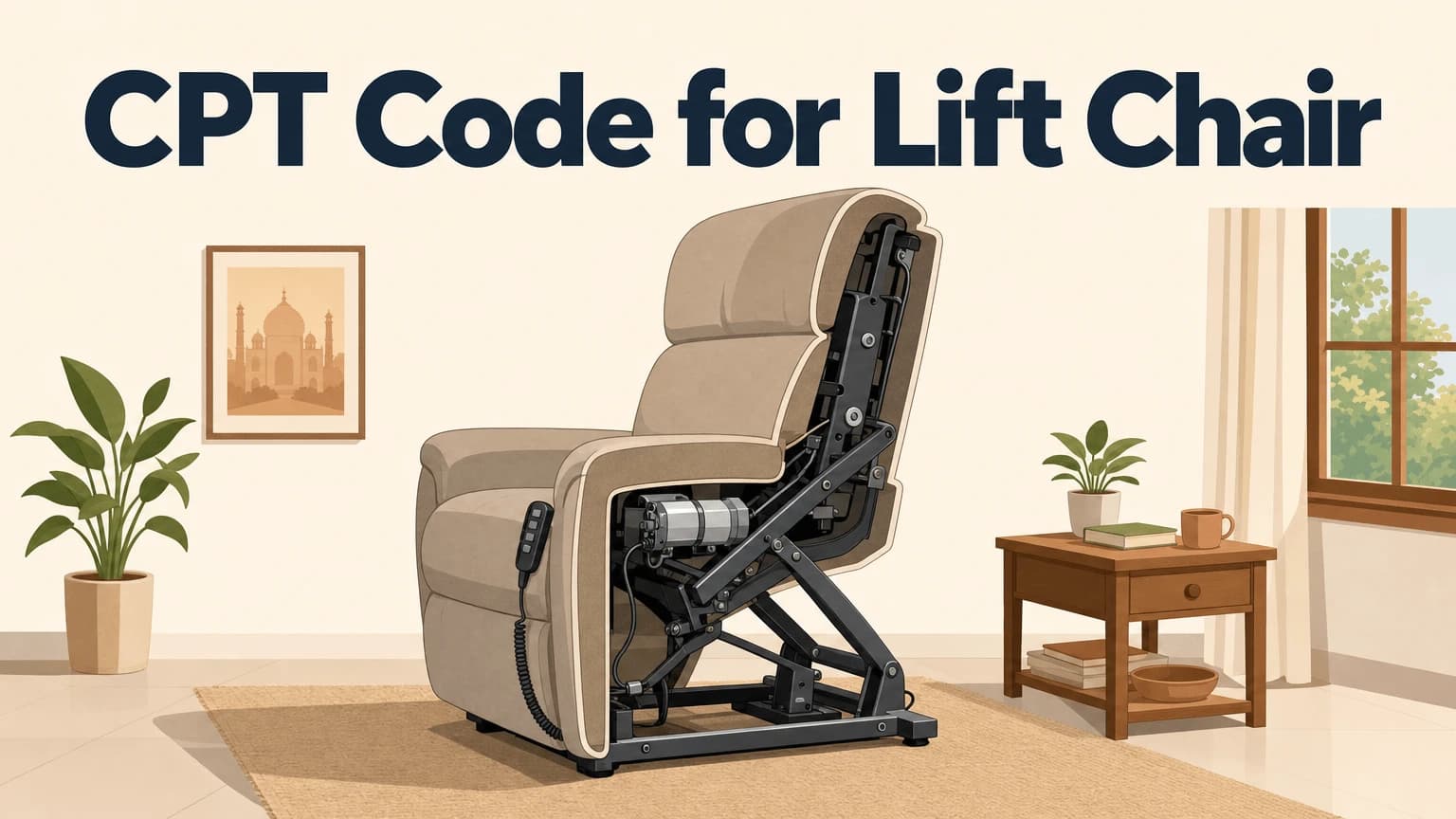
No CPT code for lift chair claims: the code is E0627
In short: There is no CPT code for lift chair claims. The seat lift mechanism bills under HCPCS Level II code E0627 (electric) or E0629 (non-electric), and Medicare pays toward the mechanism, not the chair.
Your mother's supplier invoice shows a letter and four digits, and the search you ran told you to look for five. Or you are the biller with a lift chair order on the desk and no obvious line to put it on. Both are fair places to be stuck. CPT is the list for services. A chair that helps someone stand lives on the other list.
If a lift chair was ordered and never arrived, or the claim came back denied and nobody is chasing it, a navigator can make those calls and track them. Navigate Care's medical equipment page explains how that follow-through works, and we confirm your cost before you start.
Our guide to reading Medicare CPT codes on a bill explains the two code levels. We followed one item to the claim line in the rollator walker post. This post does the same for the lift chair, and the lift chair is trickier. The code does not name a chair at all.
Here is what the rest of the page covers, in the order a claim runs:
- why "CPT" is the wrong word, and why that matters less than people think
- the codes that sit next to E0627, and the ones coders mix it up with
- what the code pays for and what it leaves to the family
- the coverage test, the diagnosis and the paper that has to exist before delivery
- a worked claim, the denials we would check first, and what changes for Medicare Advantage
Why "CPT" is the wrong word, and why it doesn't matter
People search for this as a CPT code, and nobody should feel silly about it. Billers say "CPT" for anything that goes on a claim. Families hear it from a customer service line and repeat it.
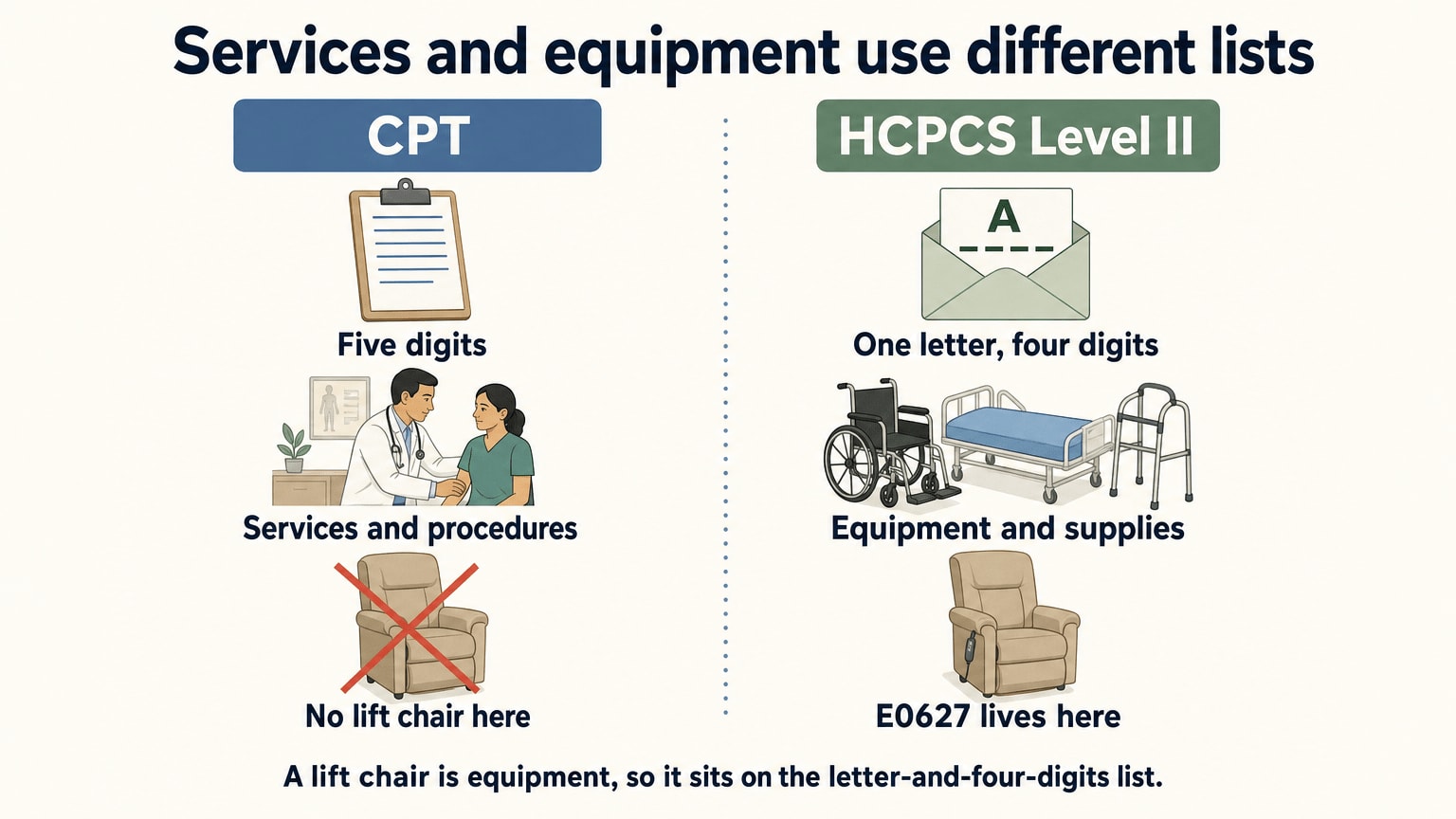
Strictly, CPT codes are five digits, they are maintained by the American Medical Association, and they describe services and procedures. A doctor's visit to decide whether your father needs a lift chair has a CPT code. The chair itself does not. Equipment, supplies and a long list of other items are coded on Level II of the same system, HCPCS. Those codes are one letter followed by four digits, and equipment falls in the E range.
So the straight answer is this. If a form, a portal or a colleague asks for the "CPT code for the lift chair", they mean the HCPCS code. It is E0627 when the mechanism is electric. It is E0629 when it is not. Put that on the claim and the claim is on the right list.
Two quick checks keep you out of trouble. First, a code that is a letter plus four digits is never a CPT code, whatever the form calls the box. Second, the visit that produced the order is a different line from the equipment. The office visit is billed by the practitioner with its own code. The supplier bills the E-code. Those are two claims from two businesses, and they only meet in the paperwork.
The codes next to E0627, side by side
The trouble with lift chair coding is not finding E0627. It is the family of nearby codes that sound alike. They sit in two blocks. AAPC places E0627 in the Patient Lifts and Support Systems range, E0621 to E0642. The commode chairs with a lift built in sit in a second range, E0163 to E0175. A coder scrolling the list quickly can land on the wrong block.
Here are the codes people confuse, with the descriptors as AAPC prints them.
Lift chair codes and their neighbours
| Code | Official descriptor | Is it the lift chair? |
|---|---|---|
| E0627 | Seat lift mechanism, electric, any type | Yes, the usual code |
| E0629 | Seat lift mechanism, non-electric, any type | Yes, for a non-electric mechanism |
| E0628 | Separate seat lift mechanism for use with patient owned furniture-electric | No. Deleted effective Jan. 1, 2017 |
| E0170 | Commode chair with integrated seat lift mechanism, electric, any type | No. A commode chair |
| E0171 | Commode chair with integrated seat lift mechanism, non-electric, any type | No. A commode chair |
| E0172 | Seat lift mechanism placed over or on top of toilet, any type | No. A toilet frame |
| E0630 | Patient lift, hydraulic or mechanical, includes any seat, sling, strap(s) or pad(s) | No. A patient lift |
| E0637 | Combination sit to stand frame/table system, any size including pediatric, with seat lift feature, with or without wheels | No. A standing frame |
Source: AAPC code pages for E0627, E0629, E0628, E0170, E0171, E0172, E0630 and E0637
Read the middle column slowly, because the descriptors do the work. Three details are worth a minute each.
E0627 and E0629 differ by how the mechanism is powered. Electric versus non-electric. Neither descriptor says "chair". Neither says recliner, either. The code describes the part that lifts. If the order says "electric lift recliner" and you are looking for a word to match, you will not find one, and that is normal.
E0628 is gone. It described a separate mechanism for use with furniture the patient already owns. AAPC lists it as a deleted code, effective Jan. 1, 2017. You may still meet it on an old order template, an old fee list or a payer's out-of-date cheat sheet. If your system accepts it, check the date of service, because a deleted code is the kind of thing that sails through a scrubber and then fails at the payer. Read the descriptor itself, on the code page, rather than a summary or a cheat sheet. Descriptors change, and E0628 is the proof.
E0170, E0171 and E0172 are about the bathroom. The first two are commode chairs with a seat lift built in. E0172 is a lift that sits over or on top of a toilet. A patient who needs help getting up from a toilet may have an order that mentions a "lift", and a quick coder may pick E0627 by reflex. Read what is being delivered. A lift seat over a toilet is E0172, and a commode chair that lifts is E0170 or E0171. One more point on E0172. A Blue Cross Blue Shield of South Carolina policy that we read says in its history that E0172 was removed on 01/01/2026. So even where payers once listed it, you should confirm it is still on the policy you are billing against.
E0630 and E0637 are not chairs at all. The patient lift E0630 is the hoist with a sling that moves a person who cannot bear weight. A sit to stand frame, E0637, supports someone while they stand. Coders confuse these with lift chairs because all three sit in the same E0621 to E0642 range and because the word "lift" appears in each. A lift chair lets a person who can bear weight and walk get up from a seat. A patient lift moves a person who cannot. Different equipment, different need, different code.
If you want one rule to carry: E0627 or E0629 only when the item is the seat lift mechanism of a chair that rises and tilts the person forward. Everything else on the table is something else.
Four words that get used for the same thing
Orders and invoices use "lift chair", "lift recliner", "power recliner" and "seat lift" as if they were one product. For billing they are not quite the same, so it helps to sort them before you pick a code.
A lift chair or lift recliner is a piece of furniture with a motor that tilts the whole seat forward and up. The furniture is the family's. A seat lift mechanism is the part the code describes: the motor and the frame that does the lifting. A seat elevator is something else. The South Carolina policy defines it separately, as a device that raises or lowers a seat while the person stays seated, and it does not treat it as a seat lift. The same policy puts powered seat elevation systems for powered wheeled mobility devices outside its scope. If the order says "power seat elevation", stop and find out what is being ordered before you reach for E0627.
Then there is the spring-release lift, a seat that is released and pushes the person up in a sudden, catapult-like motion. That policy excludes it. A supplier may call it a lift seat, and the order may too, so ask what kind of mechanism it is.
What E0627 covers and what it leaves out
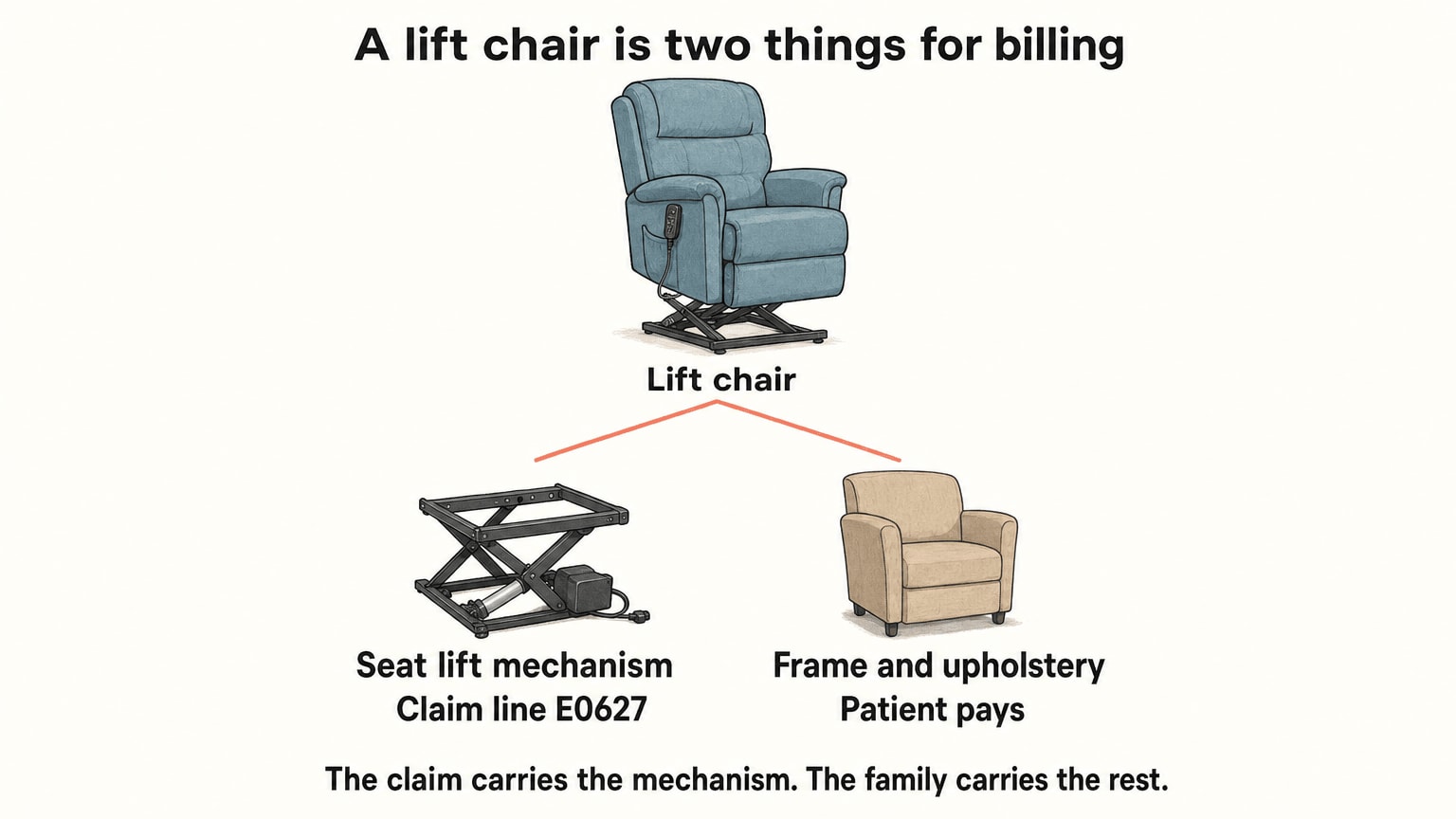
Here is the part families and new billers both tend to miss. A lift chair is two things bolted together. There is the lift mechanism, the motor, the frame that tilts, the hand control. And there is the chair: the upholstery, the cushion, the wood or metal, the recline.
According to a GoHealth guide to lift chair coverage, Medicare only covers the lifting mechanism. In its words, "No matter what type of lift chair you choose, Medicare will only cover 80% of the chair's lifting mechanism." The same page says you are also "responsible for the cost of the chair's other parts, such as the frame and upholstery." GoHealth is an insurance broker's page, not CMS. We could not open the CMS pages that set the policy, so treat this as a plain description to be checked against the policy, which we point you to below.
That split explains a good deal of what a family sees.
- The supplier's quote is for a chair. Medicare's allowed amount is for a mechanism.
- The family pays for the chair part, whatever Medicare decides about the mechanism.
- The Medicare payment is calculated on the mechanism code alone, so the price on the showroom tag and the Medicare allowed amount are two different numbers.
This is also why a reasonable supplier will often send a family two lines: one for the code Medicare is billed, and one for the part of the price that is the family's to pay. If your father is handed one number and no explanation, that is where to ask.
The same split matters to the biller in a more technical way. The E-code goes on the claim as the mechanism. The chair is not a second line to a Medicare claim in disguise. If a supplier tries to add the whole chair price to the E0627 line, the claim no longer matches what the code describes.
What the claim and the family each carry
| Part of the lift chair | Who pays | Where it appears |
|---|---|---|
| Seat lift mechanism, electric | Medicare toward the mechanism when the criteria are met, the patient for the rest | Claim line E0627 |
| Seat lift mechanism, non-electric | The same, under the other code | Claim line E0629 |
| Frame, cushions, upholstery, extras | The patient | Supplier's invoice to the family, not a Medicare line |
Source: GoHealth, lift chair coverage for the mechanism-only rule, AAPC for the code descriptors
What Medicare Part B usually pays on the mechanism
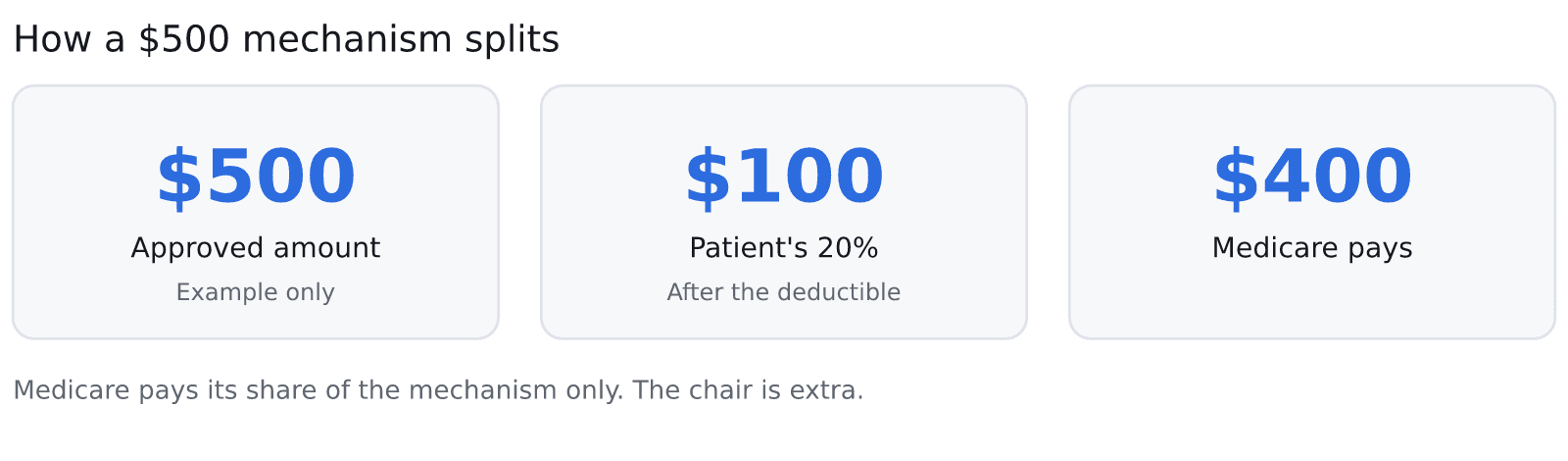
When Medicare does pay, it works like other durable medical equipment under Part B. In 2026, the Part B annual deductible is $283.00, according to the Federal Register notice that sets it. After the deductible, the patient usually pays 20% of the Medicare-approved amount. GoHealth says the same of the mechanism: Medicare pays 80% of its approved cost, after the Part B deductible.
Take a round-number example, not a real price. Say the approved amount for the mechanism is $500. After the deductible is met, 20% is $100, and the patient owes that. Medicare pays the other $400. The chair, on top of that, is the family's. A Medigap plan may cover the 20% on the mechanism, GoHealth says, and it does not cover the chair, because Medicare doesn't.
Two cautions for the coder. We did not find a current Medicare allowed amount for E0627 that we could read on a primary page, so we are not quoting one. Look it up on the DME fee schedule for the date of service, in the jurisdiction where the patient lives. And a figure you find on a vendor page with no year attached is not a figure you can rely on.
Our Medicare Part B guide explains the deductible and the 20% in more detail. For the broader 2026 picture, see what each Medicare part costs.
Buying or renting
Two of the modifiers on an equipment line say which one happened: NU for new, RR for rental, UE for used. GoHealth says Medicare decides whether a lift chair mechanism must be bought or rented, and that in some cases the patient may choose. We could not confirm that on a CMS page, so ask the supplier which it is before delivery, and make sure the modifier on the claim matches what actually happened. A rental line billed as a purchase is an easy error to make when an order says "lift chair" and the supplier's system defaults to a sale.
A family member can ask for two things in writing at this point. First, which code and modifier the supplier will bill. Second, the amount the family is expected to pay, split into the mechanism's 20% and the chair. It sounds fussy. It is the single best way to avoid a surprise three weeks later.
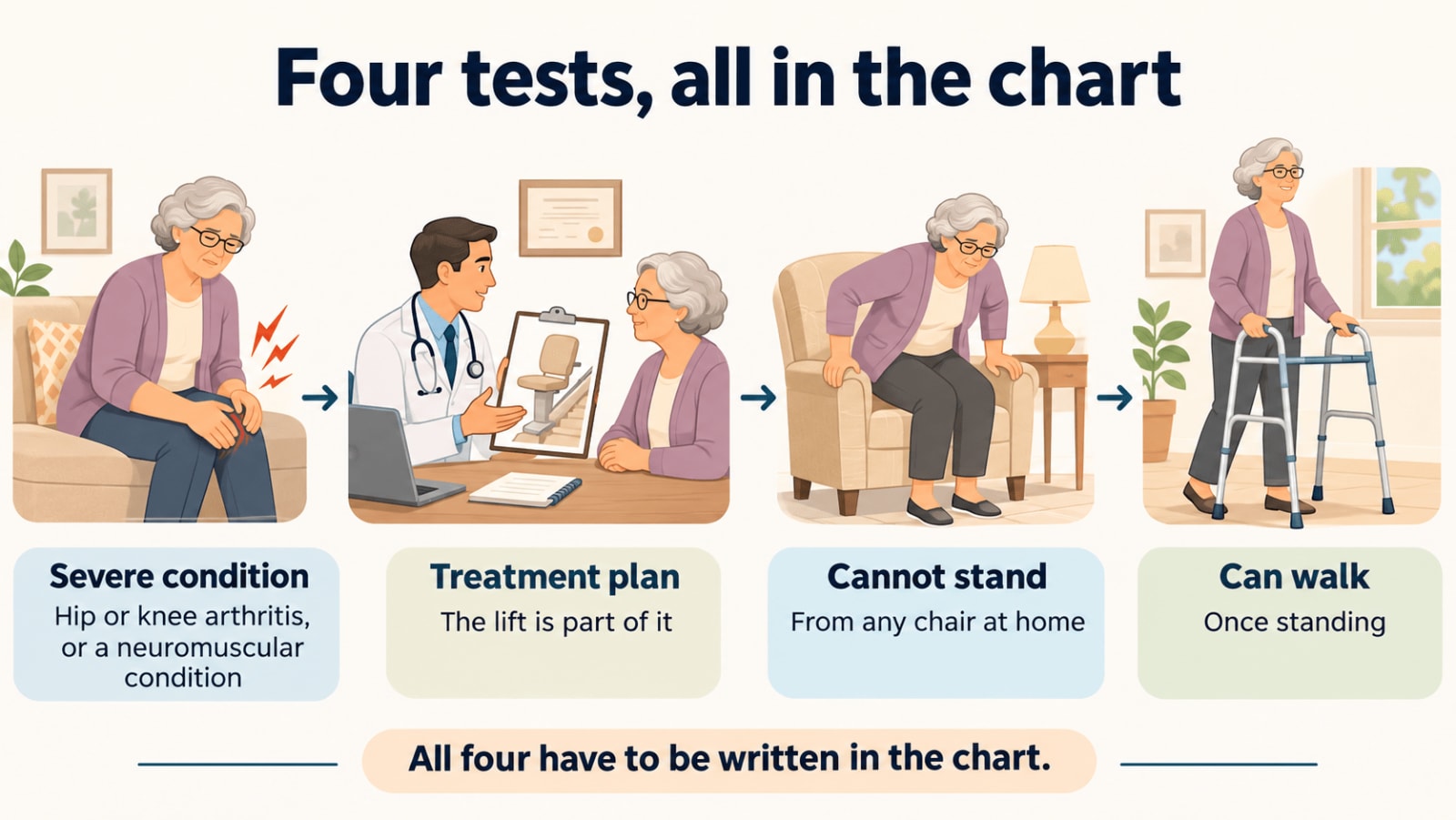
The coverage test: four things that all have to be true
Now the question every payer asks: does this patient qualify? We read the four criteria in a seat lift policy published by Blue Cross Blue Shield of South Carolina, which sets them out plainly. Payers' policies differ in detail, and Medicare's own rule is in a local coverage determination and a policy article that we could not open. The search summaries of the Medicare rule that we saw describe the same four ideas. Use this as a map and check the live Medicare documents before you bill.
The four criteria in the South Carolina policy
| Criterion | What it means in plain words |
|---|---|
| 1. Condition | Severe arthritis of the hip or knee(s), or a severe neuromuscular disease |
| 2. Treatment plan | The seat lift is part of the prescribed course of treatment |
| 3. Standing | The patient is completely incapable of standing up from a regular armchair or any chair in their home |
| 4. Walking | The patient can walk once standing |
Source: Blue Cross Blue Shield of South Carolina, Seat Lift Mechanisms
The policy says all four have to be met. Missing one is enough to fail the claim. Let's take them one at a time, because each one tells you something about what the chart has to say.
1. A severe condition, not just "weak"
The policy names severe arthritis of the hip or knee, or a severe neuromuscular disease. It does not name "age", "frailty" or "general weakness". A chart that says "elderly, weak legs, difficulty rising" is a chart that does not meet the first criterion, however true it is. The word "severe" matters too. The chart needs the condition and some evidence of its severity: the findings from the exam, not just a diagnosis on a problem list.
If you are the coder and not the clinician, this is where you stop and ask. You cannot supply a diagnosis the practitioner did not make. You can tell the practitioner's office what the payer wants the note to show, and you can hold the claim until the note is there.
2. Part of a treatment plan
The second criterion says the seat lift mechanism is part of the prescribed course of treatment. In the policy's reading, the record should show the lift is part of the physician's treatment plan, and that the condition is severe enough that the alternative would be being confined to a chair or bed. One billing guide we came across adds that the record should show other treatments were tried first. We could not confirm that on a payer or CMS page, so we are not telling you it is a rule. It is a sensible thing to look for in the chart.
3. Completely incapable of standing from any chair
This is the criterion that fails most claims, because it is the strictest. The policy language is "completely incapable of standing up from a regular armchair or any chair in their home". Not "has trouble". Not "can't get out of the low sofa". Completely incapable, from any chair.
The policy says why. Difficulty rising from a low chair is insufficient justification, since most ambulatory people can rise from an ordinary chair with arms and appropriate seat height. That policy also excludes spring-release lifts that launch a person upward in a sudden, catapult-like motion. The test is about a smooth, controlled lift for a person who cannot rise any other way.
This is a very hard sentence to read as a family member. Your mother may struggle every day, and the policy may still say no, because she can get up from the kitchen chair with arms after three tries. That is not a judgement on her. It is the test, and a navigator or SHIP counsellor can help you ask what the practitioner can honestly document.
4. Able to walk once standing
The last criterion is the one that people forget, because it sounds like a trap. The patient has to be able to walk once they are on their feet. The lift gets them up. It is not a transport device. A person who cannot bear weight or walk at all needs a different piece of equipment, which is why the patient lifts and the standing frames above live under other codes.
GoHealth adds that the walking can be with a cane or a walker. We list that as the broker's reading. Check the policy wording for your payer.
Two extra limits we saw
GoHealth says Medicare may not pay while the patient is in a hospital or skilled nursing facility, and may not pay if Medicare has already covered a wheelchair or scooter. We could not confirm either from CMS, so check both against the policy and the patient's history before you bill. They are cheap questions to ask and expensive ones to get wrong.
Diagnosis codes: what the claim needs next to E0627
An E-code says what was supplied. It does not say why. The diagnosis on the claim is what ties the equipment to criterion 1, and a claim whose diagnosis does not fit the equipment is one that can be refused at the first edit.
The South Carolina policy says all diagnoses are listed in its code table, but the diagnosis must still meet the first criterion. So the exact spelling of the code is not the main risk. The risk is a claim whose diagnosis does not describe severe hip or knee arthritis or a severe neuromuscular disease, or one the chart cannot support.
We tried to read the official ICD-10-CM code lists for the arthritis and neuromuscular conditions, and the sites we could reach refused our requests. So we are not going to list codes from memory. What we can say is what to match. Pick the diagnosis code from the practitioner's note, at the specificity the note supports. Let the note say which joint, which side, and how severe. Check the code against your current ICD-10-CM code set for the date of service. Then read the claim as a stranger would: does this diagnosis, on its own, make the case for a seat lift?
Three mismatches we would look for first:
- A general code for pain or weakness, where the note actually documents a severe joint condition. The claim undersells the chart.
- A severe-condition code on the claim, with a note that only says "arthritis". The claim oversells the chart.
- A diagnosis for a different problem, copied from the last visit. This one happens when an order is written at a visit about something else.
For more on how CPT, HCPCS and diagnosis codes fit together on one claim, our guide to Medicare CPT codes covers the difference between what was done and why.
The order and the chart: what has to exist before delivery
Equipment claims are paper claims in all but name. The code is the easy part. The documents decide whether it pays.
For a lift chair, the pieces are these.
A written order from the right practitioner. GoHealth says a Medicare-approved physician writes the prescription, typically after a face-to-face appointment, and that it should state the chair is medically necessary, meant for home use, and part of the treatment plan. Summaries of the Medicare rule that came up in our searches say the ordering practitioner should be the treating practitioner or a consulting practitioner for the underlying condition. We could not read the rule itself, so check it. In plain terms, the person who treats the knee or the neuromuscular disease writes the order. A practitioner who has never examined the patient should not be the one signing it.
A note from the visit that supports all four criteria. One by one: the severe condition, the treatment plan, the complete inability to stand from any chair, and the ability to walk once standing. A note that mentions three and skips the fourth is the usual shape of a denied claim.
The right order of dates. The order has to exist before the equipment is delivered. The rollator guide on this site makes the same point about walkers, and it holds here. An order dated after delivery is a problem you cannot fix by editing the date.
The supplier's side. GoHealth says lift chairs must be bought or rented from a Medicare-approved supplier that accepts assignment. That means the supplier agrees to take Medicare's approved amount as full payment for the covered part. If a family is told the supplier does not take Medicare, they are being told something that affects the whole claim.
Modifiers. Equipment lines usually carry modifiers. The ones used for the purchase or rental status are NU for new equipment, RR for rental and UE for used, as we explained in the rollator post. A separate modifier, KX, signals that the coverage requirements in the policy are met. Search results about the Medicare policy article for seat lifts told us the KX modifier is added to seat lift lines only when all the coverage criteria have been met and the record shows it. We could not read the article itself, so we are passing it on as something to confirm, not as a quotation. The point stands from the rollator case: never add KX because the claim looks thin. It says the record exists.
A checklist you can hold against a file
Use it before the claim goes out. A "no" on any row is a reason to hold the claim, not to bill and hope.
Before billing E0627 or E0629
| Question | If no |
|---|---|
| Does the note document a severe hip or knee arthritis, or a severe neuromuscular disease? | Ask the practitioner's office to complete the note |
| Is the lift part of the documented treatment plan? | Ask for the plan to be recorded |
| Does the note say the patient cannot stand from any chair in the home? | Hold the claim |
| Does the note say the patient can walk once standing? | Hold the claim |
| Is the order from the treating or a consulting practitioner? | Get a proper order |
| Is the order dated before delivery? | Check the date of service and the date of the order |
| Is the item the mechanism only, with no chair price on the line? | Correct the line |
| Is the supplier enrolled and accepting assignment? | Tell the family before delivery |
Source: criteria from Blue Cross Blue Shield of South Carolina; order and supplier points from GoHealth
How we would work the file, in order
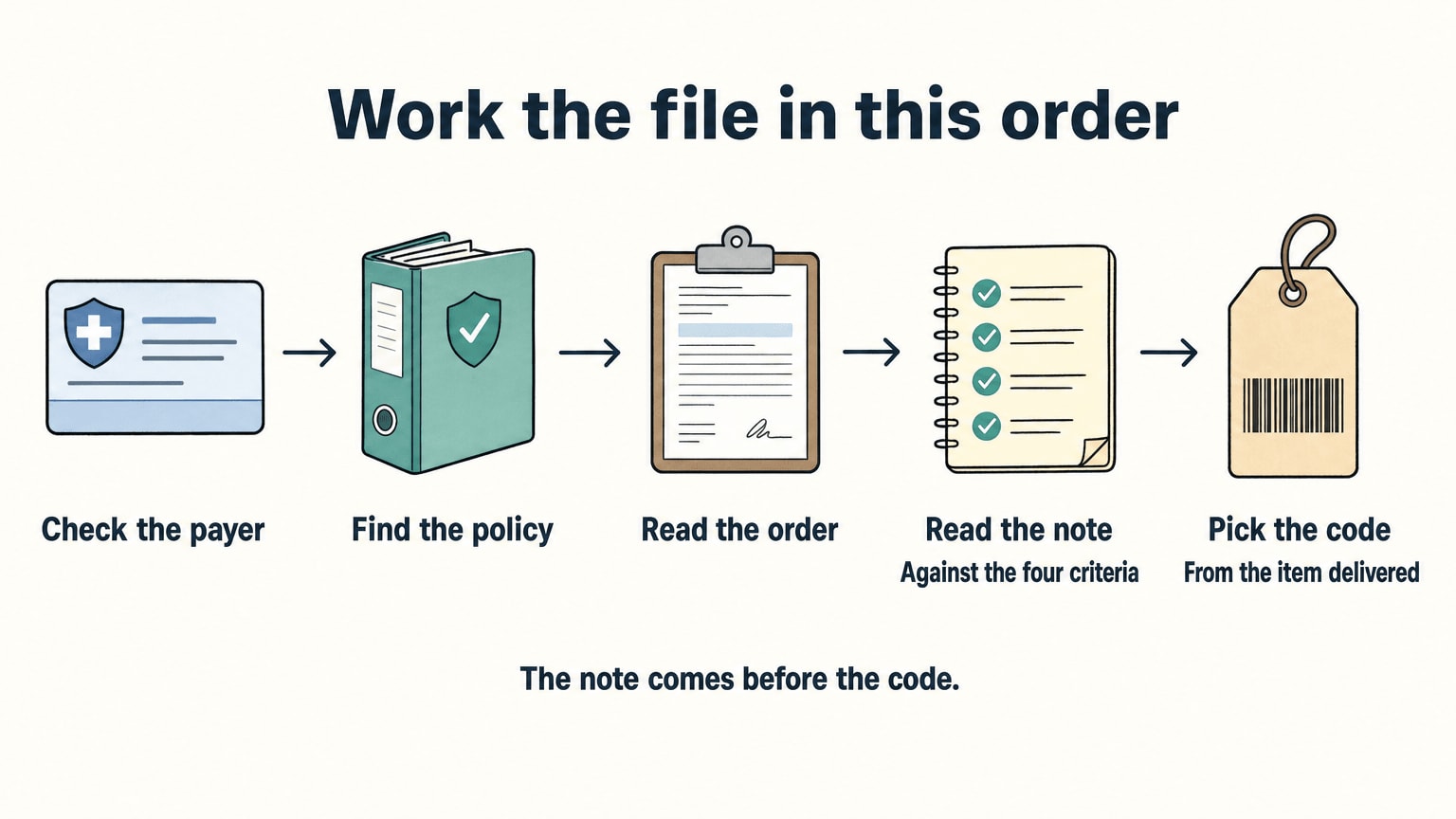
If you handle these claims for several practices, or for a supplier you do not sit next to, a fixed order saves rework. This is our suggested order, built from the criteria above. It is not a payer's published procedure.
- Check who the payer is. Original Medicare, a Medicare Advantage plan, a commercial plan or Medicaid. The rest depends on it.
- Find the policy before the code. For Original Medicare, that is the local coverage determination and policy article for seat lift mechanisms. For anyone else, it is the plan's own policy. Note its effective date.
- Read the order. Who signed it, what it says, and when. Does it describe a seat lift mechanism, or a commode, a patient lift or a seat elevator?
- Read the visit note against the four criteria. Mark each as present, absent or vague. Vague counts as absent.
- Pick the code from the item delivered, not the word on the order. E0627 for electric, E0629 for non-electric.
- Set the modifiers. New, rental or used. Add KX only if every criterion is documented.
- Match the diagnosis to the note. Same joint, same side, same severity.
- Check the line. One unit of the mechanism. No chair price on it.
- Bill, then follow up. Put a date in the diary and look at the claim when it comes back.
Steps 3 and 4 are where most of the time goes, and they cannot be done from the claim form. If the note is missing, the fix is a request to the practitioner's office, not a different code.
What to say to the practitioner's office
Offices are busy, and a vague request gets a vague answer. Ask for exactly what the payer needs, and do not suggest what the note should conclude. A coder cannot tell a practitioner what the patient's condition is.
Something like this works: "The payer's seat lift policy asks whether the patient can stand from any chair in the home, and whether the patient can walk once standing. Could you add what you found at the visit on both points?" That asks for facts, not for a yes. If the practitioner found that the patient can rise from an armchair, the note should say so, and the claim should not go out as though it said otherwise.
The same applies to a family member making the request. “Could you say in the note whether my mother can get up from any chair at home?” is a fair question. It is not pressure, and a good practitioner will answer it honestly either way.
A worked claim, line by line
This is an illustration with round numbers, not a real claim and not a real price.
Say a patient has severe osteoarthritis of both knees. Her orthopaedic practitioner has treated her for it, and the note from a face-to-face visit records four things. The condition and its severity. The lift as part of her treatment plan. That she cannot stand from any chair in her home. And that once she is up, she can walk with a cane. The practitioner writes the order for an electric seat lift mechanism, dated before delivery.
The supplier delivers a lift chair. The invoice to the family has two parts. The mechanism, which the supplier bills to Medicare. The chair, which the family pays.
The claim, as a coder would build it:
One illustrative claim line
| Field | What goes in it |
|---|---|
| Item | E0627, seat lift mechanism, electric |
| Units | 1 |
| Status modifier | NU, new equipment |
| Policy modifier | KX, only because the four criteria are documented |
| Diagnosis | The severe knee arthritis code from the practitioner's note |
| Allowed amount, for the example | $500 |
| Patient's 20% after the deductible | $100 |
| Medicare pays | $400 |
Source: worked example built from the figures this site uses for examples. Not a real claim. Modifier meanings from the rollator post, code descriptor from AAPC
Now read it back as the payer would. The code matches the item. There is one unit, because there is one mechanism. The diagnosis is a severe hip or knee condition that ties to criterion 1. The KX is backed by a note that covers all four criteria. The date of the order comes before delivery. The chair's price has not been added to the line.
What would break it? Change one fact at a time.
- If the note says "difficulty standing" and not "cannot stand from any chair", criterion 3 fails and KX should not be on the line.
- If the order is dated the day after delivery, the sequence fails.
- If the patient had a spring-release lift, the policy excludes it.
- If the supplier added the full price of the chair to E0627, the line no longer describes a mechanism.
- If the mechanism is manual and the claim says E0627, the descriptor is wrong. It should be E0629.
Each of those is a fault you can find before submission. None of them requires guessing what the payer will do.
Five short cases: bill, hold or recode
Four tests sound simple until a real order lands. These are invented illustrations, not real patients, and they use only the criteria above.
Case one. The note records severe knee arthritis, a treatment plan that includes the lift, "unable to rise from any chair in the home", and "walks with a cane once up". The order is dated before delivery and the item is an electric mechanism. Bill E0627, with the status modifier, and KX because every criterion is written down.
Case two. The note says the patient "has difficulty rising from the low recliner". Nothing more. That is the sentence the South Carolina policy says is not enough. Hold the claim and ask the office whether the patient can rise from other chairs, and what the examination found. If the honest answer is that she can, the claim should not go out with KX.
Case three. The order says "lift" for a patient who cannot bear weight and needs two people to move. That is not a seat lift mechanism. A hydraulic or mechanical patient lift is E0630, and it has its own criteria. Recode only if the item delivered really is a patient lift, and only after reading the policy for it.
Case four. The order says "lift seat for the toilet". The item is placed over or on top of the toilet. That is the E0172 description, and a payer policy may no longer list it. Check the policy and its date before you bill anything.
Case five. The mechanism is operated by hand, not by a motor. The code is E0629, non-electric, not E0627. Same criteria, different descriptor.
Notice what none of the cases did. None of them changed the code to make a claim fit. The code follows the item, and the modifier follows the chart.
Why lift chair claims come back
None of this promises a claim will be paid. These are the first checks, in the order we would run them. We did not find published denial statistics for lift chairs, so we are not giving any. These are patterns that follow directly from the criteria.
Common lift chair denials and the first thing to look at
| What happened | First check |
|---|---|
| Criteria not met in the chart | Compare the note to the four criteria one by one |
| "Difficulty rising" in the note, not "cannot stand from any chair" | Ask the practitioner whether the patient truly cannot stand, and have it recorded if so |
| Order dated after delivery | The order has to come first; a late order cannot be fixed by amending the date |
| Order from a practitioner who does not treat the condition | Get an order from the treating or consulting practitioner |
| Whole chair billed on the mechanism line | Bill the mechanism only, and put the chair on the family's invoice |
| E0628 or E0172 billed | Check the code is current for the date of service |
| E0627 for a non-electric mechanism | Use E0629 |
| KX missing or added without a record | Add only if the record exists |
If a denial lands, read it first. Our guides on reading a Medicare denial letter and how to appeal a Medicare denial take you through it. We can't say an appeal will succeed. We can say the clock runs: 120 days after the Medicare Summary Notice for Original Medicare, and 65 days for first-level Medicare Advantage and Part D appeals.
The most useful thing in a denial letter is almost always the reason line. "Not medically necessary" can point to the chart. "Missing information" can point to a modifier or an order. A coding denial can point to the descriptor. Match the reason to the table before you write a word to the payer.
Medicare Advantage, commercial plans and Medicaid
Under Original Medicare, one set of rules applies. Outside it, the rules belong to the plan.
A Medicare Advantage plan is a private plan that has to cover at least what Original Medicare covers. Our post on Medicare Part C explains how those plans work. For a lift chair, that means the same four-part test is the floor, but the plan decides things like which suppliers are in its network, whether it needs prior authorization, and what paperwork it wants. We did not find a primary source stating how any particular plan handles lift chair coding, so we are not going to guess. Read the plan's provider manual, or call provider services and ask for the seat lift policy by name.
Commercial and state plans publish their own policies. The Blue Cross Blue Shield of South Carolina policy we used above is one example. It requires preauthorization, lists E0170, E0171, E0627 and E0629, and excludes spring-release lifts, difficulty rising from a low chair as a reason, and seat elevators that raise a person while they stay seated. It also shows how payers treat code changes: it dropped E0172 on 01/01/2026. It is one plan's policy. We did not read the policies of other insurers, and we are not going to describe them. If your claim is for another payer, get that payer's current seat lift policy and compare it with the table above.
Where the rules come from
| Payer | Where the rules live | What to ask for |
|---|---|---|
| Original Medicare | The DME contractor's local coverage determination and policy article for seat lift mechanisms | The live policy and the article, by name |
| Medicare Advantage | The plan's own provider manual | The seat lift policy and whether prior authorization applies |
| Commercial plan | The plan's medical policy library | The seat lift mechanism policy and its effective date |
| State Medicaid | The state's DME manual and fee schedule | The current code list for seat lifts |
Note that the first row is a pointer, not a quote. The Medicare documents are the right place to settle a hard question, and we could not open them. Please do not treat anything above as a substitute for reading them.
If you are the family member, not the biller
You do not need the codes to get a lift chair. You need an order, a supplier who takes Medicare, and a clear picture of who pays for what. Here is the short version.
The doctor has to say the lift is needed for a reason on the list: severe arthritis of the hip or knee, or a severe neuromuscular disease. Ask the practitioner who treats that condition, not a practitioner who has never examined your parent. Ask them whether your mother meets the four tests. If she can still get up from the armchair on a good day, the honest answer may be no, and that is a thing to hear before you spend money.
If the answer is yes, ask the supplier three questions before delivery. Are you enrolled in Medicare, and do you accept assignment? What is the price of the mechanism, and what is the price of the chair? And what will I be asked to pay, now and later? In 2026, after the $283.00 deductible, your parent usually pays 20% of the approved amount for the mechanism. The chair is on top of that.
Then look at the notice. If it shows E0627 or E0629, that is the mechanism. Say the notice shows an approved amount of $500 and says you may be billed $100. That fits the 20% in our earlier example, and the chair is a separate bill from the supplier that the notice will not show. Wait for the bill before paying, and hold the supplier's invoice up against the notice, line by line. If a line is denied, read the reason given. If it shows a code you do not recognise, ask the supplier what it is. SHIP, the free State Health Insurance Assistance Program, will go through a notice with you. It does not sell anything.
Medicare does not automatically cover any of this. A lift chair is covered only when the criteria are met and a practitioner has ordered it, and the chair itself is not covered at all. If that sounds hard to take, it is a rule about the product, not a verdict on your parent. Our Medicare Parts guide explains where equipment sits in the picture.
When the chart and the daily reality don't match
Many families come to this when a parent is struggling and the test says "completely incapable". The two can feel very far apart. Your father may need help every morning and still pass the armchair test most days. That mismatch is not a failure by you or by him.
A few things help. Write down, for a week, each time he needs help to stand and from which seat. Take the list to the treating practitioner. It does not prove anything on its own, but it gives the practitioner something concrete to examine and record. If the practitioner decides the criteria are not met, ask what else might help. Other equipment, therapy or home changes may fit, and a navigator or SHIP counsellor can help you ask.
Where a navigator comes in
A navigator doesn't diagnose, treat or give medical advice, and doesn't replace your parent's doctor, a supplier, or SHIP. The job is follow-through: asking the practitioner's office for the note the payer needs, checking the supplier is enrolled, tracking the order and the delivery, and calling about a denial. Medicare doesn't automatically cover navigation. Eligibility depends on a qualifying condition or need and a provider visit, and we confirm your cost before you start. It is usually $0 with supplemental coverage. The what you will pay page sets out the detail.
Frequently asked questions
Is there a CPT code for a lift chair?
No. CPT codes are five digits and describe services. A lift chair mechanism is equipment, so it uses an HCPCS Level II code: one letter and four digits. E0627 is the usual one, for an electric mechanism.
What HCPCS code is used to bill a lift chair?
E0627, "Seat lift mechanism, electric, any type", for an electric mechanism. E0629, "Seat lift mechanism, non-electric, any type", for a non-electric one. The code describes the mechanism, not the chair.
Does Medicare pay for the whole lift chair or only the mechanism?
Only the mechanism, according to GoHealth's guide to lift chair coverage. The patient pays for the frame, cushions and upholstery. For the mechanism, Medicare usually pays 80% of the approved amount after the Part B deductible, which is $283.00 in 2026.
How do E0627, E0628 and E0629 differ?
E0627 is electric and E0629 is non-electric. E0628 was a separate electric mechanism for patient-owned furniture. AAPC lists it as deleted effective Jan. 1, 2017, so it should not appear on a current claim.
Is E0172 the same as a lift chair code?
No. E0172 is a seat lift mechanism placed over or on top of a toilet. It sits with the commode chairs. A South Carolina Blue Cross policy shows it removed on 01/01/2026, so check it is current before billing.
What diagnosis and documentation support a seat lift claim?
The diagnosis has to show severe arthritis of the hip or knee, or a severe neuromuscular disease. The note should say the lift is part of the treatment plan, the patient cannot stand from any chair in the home, and can walk once standing. A written order should come before delivery.
Can a patient lift or sit to stand frame be billed as E0627?
No. E0630 is a hydraulic or mechanical patient lift, and E0637 is a sit to stand frame with a seat lift feature. Each has its own code. E0627 is only for a lift chair's seat lift mechanism.