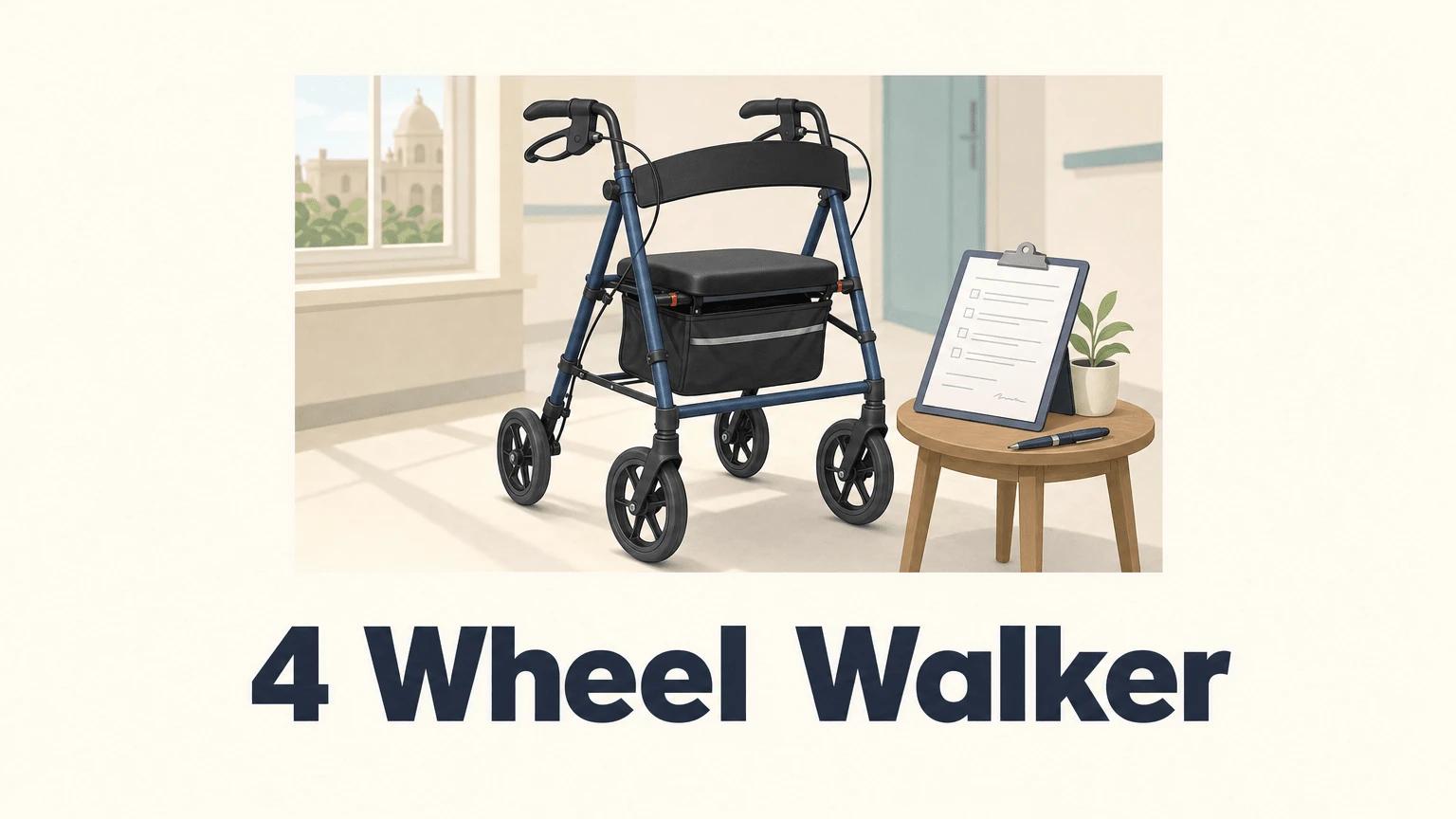
There is no 4 wheel walker with seat CPT code
In short: There is no 4 wheel walker with seat CPT code. It bills under an HCPCS Level II E-code, most often E0143. An enclosed frame with a seat is E0144, and a walker that turns into a transport chair is E0150.
Your mother's invoice shows a letter and four digits, and the search you ran said to look for five. Or you are the biller with a rollator order on the desk and a code list that seems to have six answers. Both are fair places to be stuck. The walker world has more near-duplicate codes than almost any other shelf of equipment, and the seat is exactly what makes them hard to tell apart.
If a walker was ordered and never arrived, or the claim came back denied and nobody is chasing it, a navigator can make those calls and track them. Navigate Care's medical equipment page explains how that follow-through works, and we confirm your cost before you start.
The rest of this page works from the walker, not from the code. We already wrote the short version in the rollator walker post. This one goes further: a code for every kind of seated walker, a table that starts from the features in front of you, what Medicare's own policy text says about each, and the mistakes we would look for first. One of those mistakes is in our earlier post, and we will say which.
Why a walker has no CPT code
The mix-up is not a silly one. Billers say "CPT" for anything that goes on a claim, and families repeat what the customer service line told them. So it helps to put the two lists side by side once and leave it there.
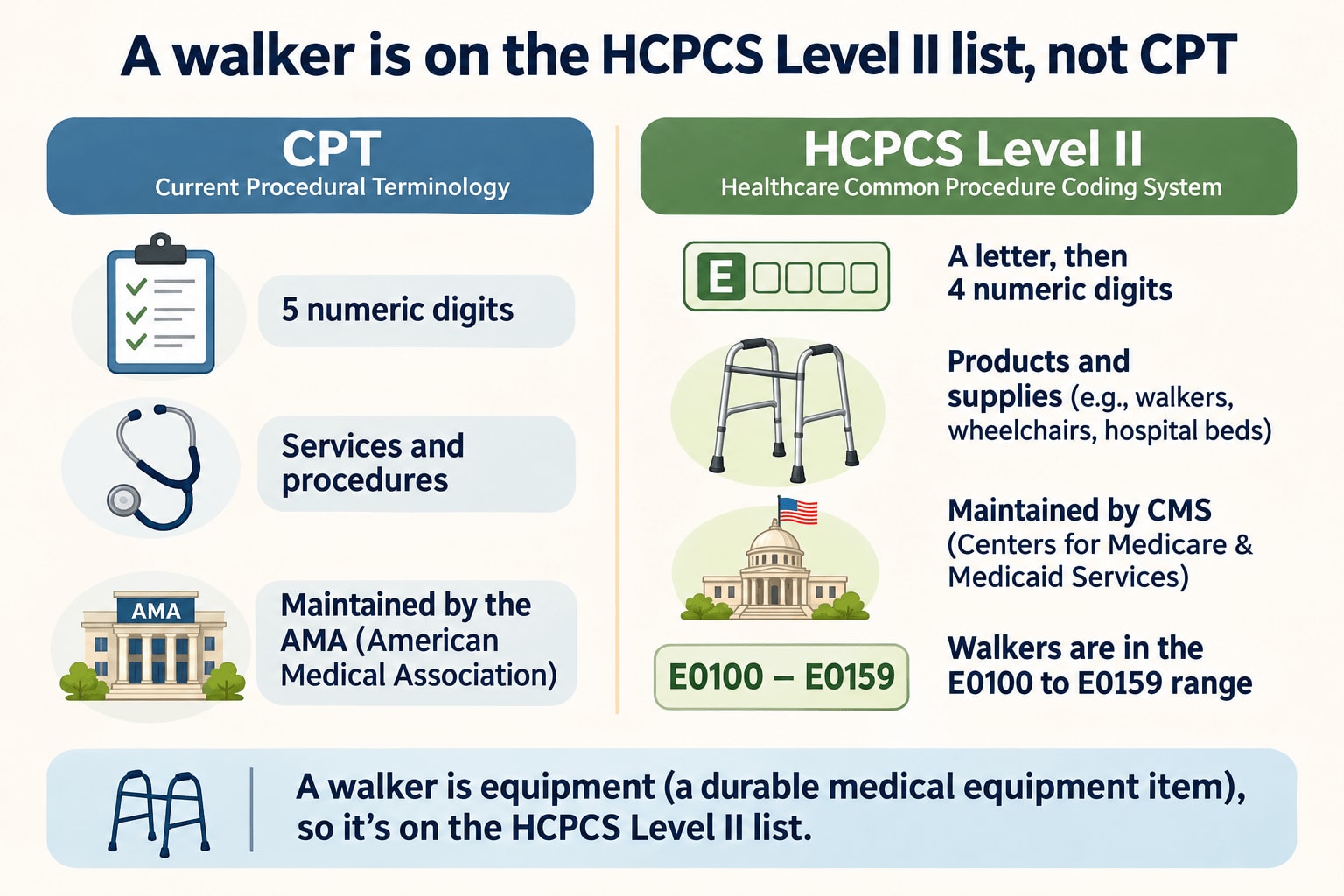
CMS says it plainly: "CPT® codes consist of 5 numeric digits." They are maintained by the American Medical Association and they identify services and procedures from physicians and other health care professionals. The same CMS page says Level II codes "consist of a single alphabetical letter followed by 4 numeric digits." CMS maintains those, and they cover products, supplies and services that CPT leaves out.
A walker is a product. So it lives on the Level II list, and it lives in the E range. AAPC files every walker code in this post under Walking Aids and Attachments, E0100 to E0159, which sits inside the durable medical equipment block, E0100 to E8002.
Two things follow, and they are worth keeping apart.
The walker is one claim. The supplier sends it, with an E-code, and the supplier is the one who needs a Standard Written Order on file. The visit where the practitioner decided your father needed a walker is a different claim. That one is the practitioner's, and it carries a five-digit CPT code for the visit. Two businesses, two claims, two lists. They meet only in the paperwork.
So when a form, a portal or a colleague asks for "the CPT code for the walker", they mean the E-code. Put the E-code in the box and you are on the right list. If you want the longer explanation of the two levels, with modifiers and diagnosis codes, our guide to reading Medicare CPT codes on a bill covers it.
Rollator, 4 wheel walker, enclosed walker: three names, one shelf
Here is the second source of confusion, and it explains why people land on the wrong code even after they have learned about E-codes. The words on the box are not the words in the code book.
"Rollator" is a brand-flavoured word that everyone now uses for a walker with four wheels, hand brakes and, usually, a seat. "4 wheel walker" is the plain-English version. "Walker with seat" describes what it does. None of those is a descriptor. The coding vocabulary is shorter and stricter: wheeled, folding, rigid, heavy duty, enclosed, and, for one code, a transport chair.
Medicare's policy article for walkers, A52503, defines wheeled walkers as having "2, 3, or 4 wheels". So the wheel count alone does not move you from one code to another. A two-wheeled frame and a four-wheeled rollator can land on the same line. What moves you is something else: whether the frame is folding or rigid, whether it is heavy duty and for whom, how the braking works, whether the frame surrounds the user, and whether the thing converts into a transport chair.
Let us take the terms one at a time, in the order a coder meets them.
A rollator is a wheeled walker you walk behind, with hand brakes. Many have a padded seat and a backrest, so the user can stop and sit. Most fold. This is the walker most families mean. A four wheel walker is the same family, and the phrase tells you only about the wheels.
An enclosed walker has a frame that goes round the user. A52503 describes E0144 as "a rigid or folding wheeled walker which has a frame that completely surrounds the beneficiary and an attached seat in the back." You step into it, rather than standing behind it. It is a different shape of product, and it has its own code. If the walker you are looking at has an open front and you hold it from behind, it is not E0144, however much the seat looks like the seat on that code.
A transport chair combination is a walker that can also be used as a chair someone else pushes. The descriptor for E0150, as AAPC prints it, is "Combination wheeled walker with seat and transport chair, folding, adjustable or fixed height". A rollator with a seat is not that. A seat you sit on while the walker is parked is one thing. A seat and footrests and handles for a companion to push is another.
A heavy duty walker is built for a heavier person. Two codes use the phrase, and they mean different things. We get to both below.
One more word matters for the claim: posterior seat. It means the seat is at the back. Only E0144 uses it in its descriptor. It does not mean that every walker with a seat at the back has to be E0144. It is part of a descriptor that also needs the surrounding frame.

The walker codes side by side
Now the codes. These are the ones the pages that rank for this search cover, plus the two that families run into. The descriptors are as AAPC prints them. The right-hand column is what we found in Medicare's own documents, the local coverage determination for walkers, L33791, and the policy article, A52503. Both were last revised on 10/01/2026.
The wheeled walker codes and what Medicare's policy says about each
| Code | Official descriptor | What the Medicare policy says |
|---|---|---|
| E0143 | Walker, folding, wheeled, adjustable or fixed height | Standard walker. Covered when the three standard criteria are met |
| E0144 | Walker, enclosed, four sided framed, rigid or folding, wheeled with posterior seat | The LCD says medical necessity "has not been established", so it is denied |
| E0147 | Walker, heavy duty, multiple braking system, variable wheel resistance | Needs a severe neurologic disorder or similar. Product must be on the PDAC list |
| E0149 | Walker, heavy duty, wheeled, rigid or folding, any type | Standard criteria plus a patient who weighs more than 300 pounds |
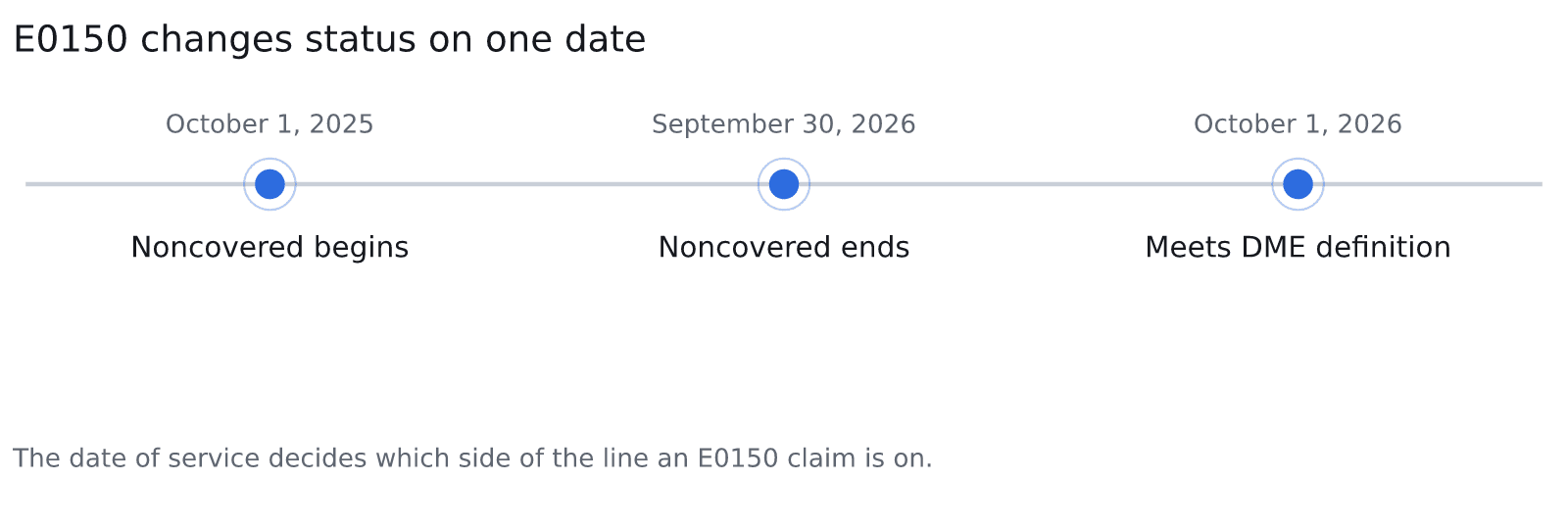
| E0150 | Combination wheeled walker with seat and transport chair, folding, adjustable or fixed height | Noncovered until September 30, 2026. DME from October 1, 2026 |
| E0156 | Seat attachment, walker | An accessory. Not billed alongside E0144 or E0150 |
Source: AAPC code pages for the descriptors; CMS LCD L33791 and CMS Policy Article A52503 for the right-hand column
You will have noticed that E0141, E0148, E0130 and E0135 are missing. The policy lists E0130 and E0135 as walkers without wheels. E0141 and E0148 are the other wheeled and heavy duty entries. They are in the policy, but a walker with a seat and four wheels is not usually one of them, so we left them out. If you need a full list with every descriptor, pull it from your own code set for the date of service. We did not verify the descriptors for E0141 or E0148 on a code page, so we are not printing them.
We will take the six one at a time, because a table can only say so much about how each behaves on a claim.
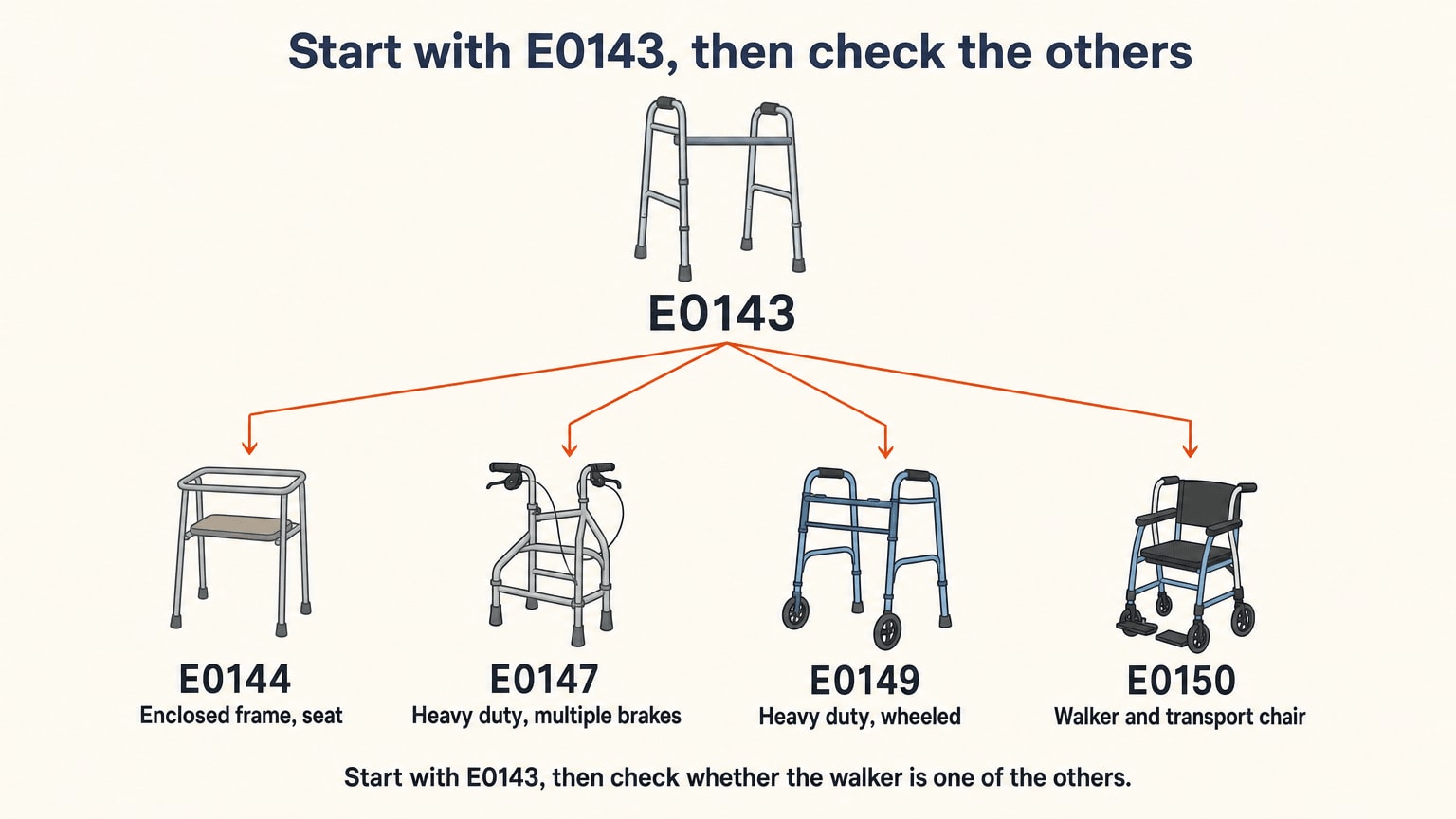
E0143: where most rollators end up
This is the starting point. AAPC gives the descriptor as "Walker, folding, wheeled, adjustable or fixed height". Under A52503, wheeled walkers have 2, 3 or 4 wheels, and E0143 is in that group.
For the standard rollator, a four-wheeled folding frame with hand brakes and an attached seat, the descriptor has no word for "seat". It does not need one. The policy gives a surrounding frame its own code, and a transport chair combination its own code, and a heavy duty frame its own codes. A folding four-wheeler that is none of those is a folding, wheeled walker. That is what we mean when we say E0143 is where it usually lands. It is our reading of how the descriptors fit together, not a sentence we found in the policy, so check it with your contractor if the product is unusual.
Brakes deserve a sentence here. A52503 says brakes other than hand operated brakes, provided at the same time as a walker (E0141, E0143, E0149), may not be billed separately on initial issue. If a supplier bills them anyway, they go on A9900 and deny as not separately payable. So a rollator with a clever braking system is still one line.
E0144: the enclosed frame with a seat
The descriptor is "Walker, enclosed, four sided framed, rigid or folding, wheeled with posterior seat". This is the code people find first, because it has "seat" in it. It is also the one most likely to be wrong.
First, the shape. The frame has to completely surround the user. An ordinary rollator has a frame on three sides at most, open at the front or the back, and a seat that sits across the rear. It does not surround anyone.
Second, the coverage. The LCD for walkers says: "The medical necessity for a walker with an enclosed frame (E0144) has not been established." It adds that an enclosed frame walker provided under the policy is denied as not reasonable and necessary. In other words, picking E0144 does not just change the code. It changes the likely outcome of the claim.
We should be straight about our own earlier post. The rollator walker post said E0144 "pays at the E0143 allowance". That came from a supplier's summary of the policy. We could not open the CMS pages when we wrote it. We can now, and the LCD says denied. Policy article A52503 says nothing about paying at the E0143 allowance. We could not confirm that statement from Medicare, so we have taken it out of our reasoning here, and you should not rely on it.
Third, the accessory. A52503 lists E0156 as a Column II code for E0144. That means the seat attachment is already bundled with the enclosed walker when both would be billed together.
E0147: the heavy duty frame with a multiple braking system
AAPC gives it as "Walker, heavy duty, multiple braking system, variable wheel resistance". This is a specific product, and the article describes it in detail. It is a four-wheeled, adjustable height, folding walker with all of these:
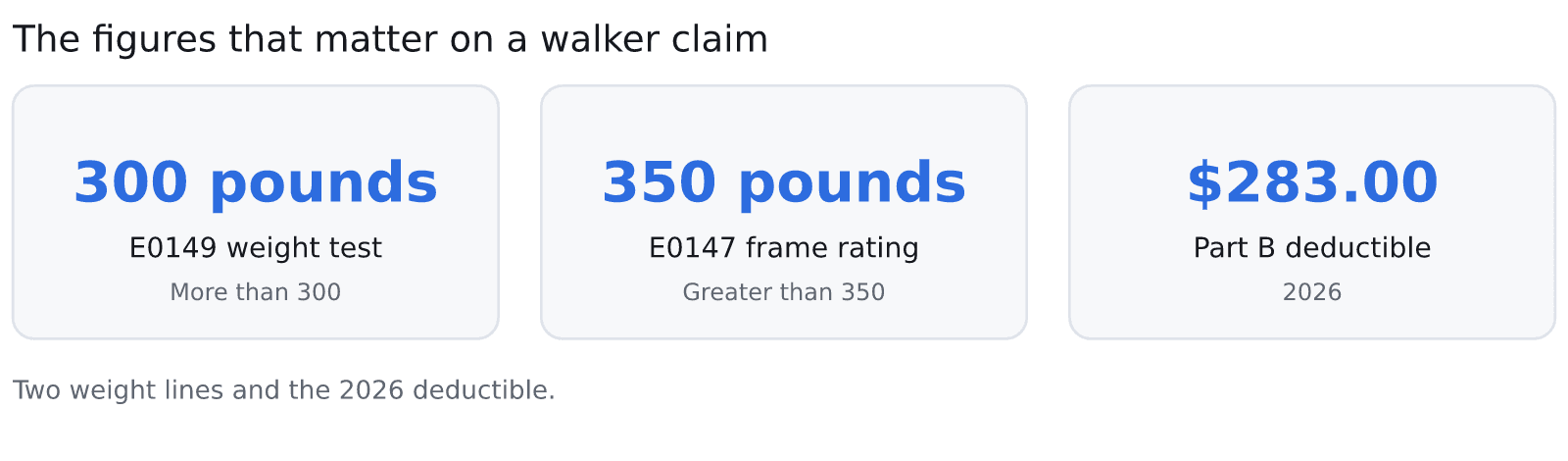
- support for beneficiaries who weigh greater than 350 pounds
- hand operated brakes that lock the wheels when the levers are released
- hand brakes that can be set so that either or both lock both wheels
- an individually adjustable pressure for each hand brake
- an additional braking mechanism on the front crossbar
- at least two wheels with brakes that can be set independently through tension adjustability, to give varying resistance
All six, not any of them. A standard heavy rollator with good brakes is not E0147 because it lacks one of the items. On top of that, the LCD says E0147 is for beneficiaries who meet the standard criteria and cannot use a standard walker because of a severe neurologic disorder or a comparable condition that restricts the use of one hand. The line you need to remember is this one: "Obesity, by itself, is not a sufficient reason for an E0147 walker."
Two billing requirements follow. The claim must include the manufacturer's name and the product name or number. And only products with a written coding verification review from the PDAC contractor, published on the Product Classification List, may be billed as E0147. We come back to PDAC below, because it is the single most useful check for the whole family of codes.
E0149: heavy duty, wheeled, rigid or folding
"Walker, heavy duty, wheeled, rigid or folding, any type". This is the code for a bariatric rollator, and the test is weight. The LCD says it is covered for beneficiaries who meet the standard criteria and weigh more than 300 pounds. At 300 pounds or less, it is denied as not reasonable and necessary. The CMS compliance tips page for walkers says the same about E0148 and E0149.
The weight is not left to memory. The KX modifier on E0148 and E0149 can be appended only if the standard criteria are met and the beneficiary's weight, within one month of providing the walker, is greater than 300 pounds. So the file needs a weight, and a date on it.
E0150: the walker that becomes a transport chair
This is the newest of the six for a coder to settle, because its status changed on a date. AAPC's descriptor is "Combination wheeled walker with seat and transport chair, folding, adjustable or fixed height". A52503 says that device "combines the function of a standard, folding wheeled walker and a transport chair". If a device does not do both, it must not be coded E0150.
On coverage, the article gives two periods. For dates of service from October 1, 2025 through September 30, 2026, an E0150 is noncovered because it does not meet the definition of DME. For dates of service on or after October 1, 2026, it "has been determined to meet the definition of DME". The LCD's revision history lines up: revision R5, effective 10/01/2026, added E0150 to its Group 1 codes.
So the date of service decides which side of the line a claim is on. Today that is a live issue, because a claim for a walker delivered in September and one delivered in November are treated differently. Check the date first.
KX for E0150 from October 1, 2026 needs two things: the standard walker criteria in the walkers LCD, and the transport chair criteria in the Manual Wheelchair Bases LCD. We did not read that second LCD, so we are not going to describe its criteria. Read it before you bill.
E0156: the seat as an add-on
"Seat attachment, walker". It is used when a seat is added to a walker that did not come with one. We give it its own section below, because it is the one people try to stack on top of a walker that already has a seat.
A feature-to-code decision table
This is the part most pages skip. They explain one code. A coder or a family member holds one walker and asks which line fits. So start from the walker. The table below goes feature by feature, and the last column says what to check before you trust the answer.
What you are holding, and the code it points to
| What the walker has | Points to | Check before billing |
|---|---|---|
| Four wheels, folding frame, hand brakes, a seat across the back, open frame | E0143 | Standard criteria met. Seat is not a separate line |
| Frame completely surrounds the user, seat at the back | E0144 | The LCD says medical necessity is not established. Expect denial |
| Four wheels, folding, patient weighs more than 300 pounds | E0149 | Weight on file, dated within one month of delivery, and KX |
| Four wheels, folding, heavy duty, six listed features, more than 350 pounds | E0147 | Severe neurologic disorder, PDAC listing, manufacturer and product name on the claim |
| Folds as a walker and converts into a transport chair | E0150 | Date of service on or after October 1, 2026. KX needs both sets of criteria |
| Walker with no seat, and a seat added separately | E0143 plus E0156 | The seat was not part of the walker when issued |
| Brakes other than hand operated, supplied with the walker | Part of the walker line | A9900 would deny as not separately payable |
| Powered walker | E0152 | Noncovered. It does not meet the definition of DME |
Source: built from CMS Policy Article A52503, CMS LCD L33791 and the CMS walker compliance tips. The mapping is our reading of those documents.
Two cautions on how to use it. The table is a map, not an authority. The authority is the policy for the date of service, and the PDAC list for the product. And the arrows only point where the descriptors point. If a walker has features from two rows, you have not found the right row yet, and the product lookup below is the way to settle it.
Five questions in the order we would ask them
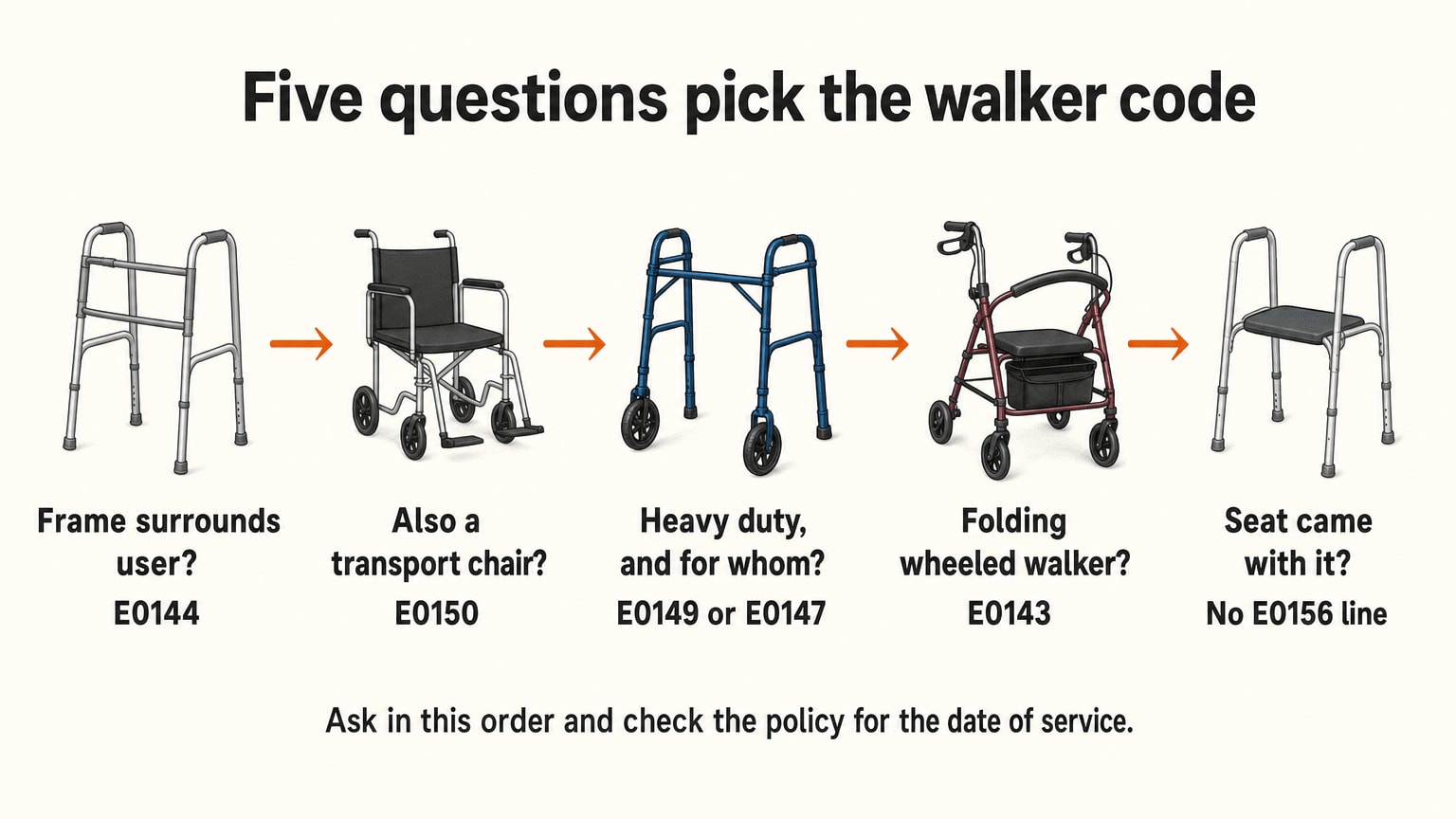
If you prefer to work down a list, this is the order that seems to produce the fewest wrong codes. It is our order, not a payer's published procedure.
- Does the frame completely surround the user? If yes, it is the enclosed family, E0144, and you should read the LCD sentence before going further. If no, carry on.
- Does it also convert into a transport chair? If it does both jobs, E0150, with the date of service in mind. If it only does one, it must not be E0150.
- Is it heavy duty, and for whom? A weight over 300 pounds and the standard criteria point to E0149. A weight over 350 pounds with a severe neurologic reason and a PDAC-listed product points to E0147. Weight without the rest is not enough.
- Is it a folding wheeled walker and none of the above? Then E0143.
- Did a seat come with it? If it did, there is no separate seat line. If it did not, and one was added, E0156 is the candidate.
Can the seat be billed on its own? E0156 and the accessory rules
Everyone asks this one, so here is the short answer. Not when the walker came with the seat. Possibly when it did not.
A52503 says codes E0154, E0156, E0157 and E0158 "can be used for accessories provided with the initial issue of a walker or for replacement components". That sentence is what makes E0156 billable at all. It is a real code with a real descriptor, "Seat attachment, walker", and it exists for a walker that has no seat of its own.
Now the limits. The same article lists E0156 as a Column II code for both E0144 and E0150. And it has one rule for the whole column: "A Column II code must not be billed at the time of billing the Column I code." Put those together. If you bill E0144 or E0150, the seat is already part of the walker, and a second line for E0156 is a bundling error. The walker has a seat, so there is nothing separate to bill.
For E0143 the position is different. The bundling table in the article lists A4636, A4637, E0155 and E0159 as Column II codes for E0143, and E0156 is not among them. So a seat attachment issued with a plain folding walker is not blocked by that table. That is a narrow point and we are reading it from a table, so we would still ask the contractor before building a business on it.
A rollator that was delivered with its seat is not that case, though. If the seat is built into the product, it is part of the walker, and it is not an attachment. Putting E0156 on that claim would bill the same seat twice.
The accessory rules have two more lines worth knowing.
An enhancement accessory is, in the article's words, "one which does not contribute significantly to the therapeutic function of the walker". The article says to use A9270 when one is billed. It gives no list of which accessories count, so ask the contractor before you decide that an extra is an enhancement.
And brakes. Hand brakes are part of the walker. Other kinds of brakes, provided at the same time as an E0141, E0143 or E0149 walker, cannot be billed separately on initial issue. If a supplier insists, the line goes on A9900 and it denies as not separately payable. There is a separate code for replacement brakes, E0159, listed as "Brake attachment for wheeled walker, replacement, each". That one is for later, when a brake wears out, and not for the day of delivery.
Seat and brake questions, answered by when they happen
| Situation | What the article points to |
|---|---|
| Walker delivered with a built-in seat | One line for the walker. No E0156 |
| Walker with no seat, seat added at initial issue | E0156 is an accessory provided with the initial issue |
| E0144 or E0150 billed, E0156 on the same claim | A Column II code is not billed with its Column I code |
| Non-hand brakes supplied with an E0143 walker | A9900 if billed, and it denies as not separately payable |
| Brake worn out and replaced later | E0159, replacement brake attachment, each |
Source: CMS Policy Article A52503
What Medicare covers: the three tests for a standard walker
Coding the walker correctly gets the claim to the starting line. Coverage decides whether it runs. The walkers LCD, L33791, sets the test for a standard walker, and it applies to E0130, E0135, E0141 and E0143. Three criteria, and the LCD says all of them must be met.
The first is a mobility limitation. The beneficiary has one that significantly impairs the ability to take part in one or more mobility-related activities of daily living in the home. The LCD defines those activities itself, so read its wording before you write a note around it. A limitation qualifies if it prevents the activity altogether, puts the person at heightened risk of illness or death when they try it, or prevents them completing it in a reasonable time.
The second is safe use. The beneficiary is able to safely use the walker. A walker for a person who cannot control it is not a solution, and the chart should say the person can.
The third is that the deficit can be sufficiently resolved. The functional mobility problem has to be one a walker actually fixes. If the person needs something with more support, the walker is not the answer to the problem.
If any one fails, the LCD says the walker is denied as not reasonable and necessary. Medicare.gov puts the family-facing version this way: Part B covers walkers, including rollators, if you are eligible, and it covers medically necessary DME if a doctor or other health care provider orders it for use in your home.
The words "for use in your home" matter. A walker needed only for getting about outside the home is a GY modifier case, as we explain below. And the heavy duty and E0147 tests are on top of these three, not instead of them.
Which extra test goes with which walker
| Code | The standard three | Extra test |
|---|---|---|
| E0143 | Yes | None |
| E0149 | Yes | Weight over 300 pounds, recorded within one month of delivery |
| E0147 | Yes | Severe neurologic disorder or similar, cannot use a standard walker, PDAC-listed product |
| E0150 | Yes | Transport chair criteria in the Manual Wheelchair Bases LCD, for dates of service from October 1, 2026 |
| E0144 | Not enough | LCD says medical necessity is not established |
Source: CMS LCD L33791 and CMS Policy Article A52503
A note on what we could not find. The article carries no ICD-10 diagnosis list. The ICD-10 sections of A52503 are placeholders. So there is no approved list of diagnoses to copy for a walker. The diagnosis on the claim should come from the practitioner's note, and the note has to show the mobility limitation. We are not going to invent a list from memory.
The order, the record and the modifiers
Equipment claims are paper claims in all but name. The code is the easy part. These are the documents that decide whether it pays.
The written order
The LCD says it flatly: "A Standard Written Order (SWO) must be communicated to the supplier before a claim is submitted." Claims billed without a completed SWO are denied as not reasonable and necessary. The LCD refers readers to the Standard Documentation Requirements article, A55426, for the details, and we did not read that one, so we are not going to list the elements of an SWO as if we had.
The policy article adds a second point. It cites Final Rule 1713 and says it "requires a face-to-face encounter and a Written Order Prior to Delivery (WOPD) for specified HCPCS codes". If a supplier delivers an item before receiving a WOPD where one is required, it is denied as not reasonable and necessary. The article does not list the codes in the text we read, so check whether the code you are billing is on the list that applies on the date of service.
For a family member this boils down to something simple. Make sure the order exists, in writing, before the walker arrives. A walker that turns up first and a paper that follows is the most common shape of trouble in equipment. Our lift chair post makes the same point about another item, and it holds here.
The chart
The LCD says the beneficiary's medical records are expected to reflect the need for the care provided. So the note from the visit should say what the person cannot do without a walker, in the home, and say that the person can use it safely. "Weak, uses rollator" is a thin note. "Cannot walk from the bedroom to the bathroom without holding on to furniture, and has had a fall getting there" is the sort of thing that answers criterion one. That second sentence is our invention for illustration, a made-up note and not a real chart.
The LCD also lists four general requirements on a supplier: an SWO, medical record information, correct coding and proof of delivery. Correct coding is the one this page is about. The other three are what sit behind it.
The modifiers
Modifiers are short two-letter additions to the line. For walkers the ones that matter are these, as A52503 describes them.
KX says the requirements of the policy are met. On E0148 and E0149 it is appended only if the standard criteria are met and the beneficiary's weight, within one month of providing the walker, is greater than 300 pounds. On E0150 from October 1, 2026, it needs both the standard walker criteria and the transport chair criteria in the Manual Wheelchair Bases LCD.
GA is used when a properly executed advance beneficiary notice, an ABN, is on file. GZ is the opposite case: no valid ABN was obtained. The article's rule is that if the KX criteria are not met, you use GA where there is a valid ABN or GZ where there is not.
GY goes on when the walker is needed only for mobility outside the home. For E0150, it goes on the item code. For other walkers, it goes on the item and all its accessories.
And the sharp edge: a line for E0148, E0149 or E0150 without KX, GA, GY or GZ is "rejected as missing information". So with the heavy duty codes and the transport chair combination, a missing modifier is a rejection, not a denial on the merits. The claim needs to be corrected and sent again.
Never add KX because the claim looks thin. It says the record exists. The weight on file, with its date, is what KX stands for on E0149. If you cannot point to it, the modifier is wrong.
Walker modifiers in one place
| Modifier | What it says on a walker line | The catch |
|---|---|---|
| KX | The policy requirements are met | Heavy duty needs a weight over 300 pounds within one month of delivery |
| GA | A properly executed ABN is on file | Used when KX criteria are not met |
| GZ | No valid ABN was obtained | Used when KX criteria are not met |
| GY | Needed only outside the home | On the item and its accessories, except E0150, where it goes on the item |
Source: CMS Policy Article A52503
NU, RR and UE, for new, rental and used equipment, are the other modifiers you will see on walker lines. They are what our earlier posts describe, and we did not re-verify them in this round, so check them against your supplier manual.
Verify the product before you pick the code
Here is the check that prevents the most rework, and the one the ranking pages leave out. A code can be right for the walker in your head and still be wrong for the product in the box.
The article says E0147 may be billed only for products that have a written coding verification review, or CVR, from the Pricing, Data Analysis and Coding contractor, the PDAC, and that are published on the Product Classification List. If a product is billed with a code that needs a CVR and is not on the list, the article tells suppliers to contact the PDAC for guidance.
In practice, there are three steps.
- Find the manufacturer's name and the model on the walker or its box.
- Look the product up on the PDAC's Product Classification List and read the code it was verified for.
- Compare that code with the one you were about to bill. If they differ, the list wins. If the product is not there and the code needs a review, stop.
We could not open the PDAC's own pages. They returned an error to our requests. So we cannot tell you where on the site the list lives or how its search works, and we are not going to guess. Search for the PDAC Product Classification List and check the host is the DME PDAC, not a reseller.
That matters for the family too. A supplier who has the PDAC letter for the walker has done the step. If your parent's walker was billed as something that sounds heavier or fancier than the box suggests, ask the supplier which product verification they relied on.
For E0147, the claim must also carry the manufacturer's name and the product name or number. That is the same fact, written on the claim.
Miscoding examples, and what each one would have needed
These are illustrations. None of them is a real claim, a real product or a real patient, and the numbers come from the policy and from round figures only. Each one changes a single fact, so you can see what the fact does.
A plain rollator billed as E0144. The supplier sees "seat" and "four wheels" on the box and picks the code with "posterior seat" in the descriptor. The frame does not surround the user. The line has the wrong descriptor, and the LCD would deny E0144 anyway. The fix is to code the walker for what it is, a folding wheeled walker, E0143, if it meets the standard criteria and nothing else on the list applies. Check the product's PDAC listing first.
Next, a bariatric rollator billed as E0149 with no weight on file. The patient weighs 400 pounds at the time of the visit, but nobody recorded it, and the supplier added KX. The modifier says a weight over 300 pounds was documented within one month of delivery. If there is no record, KX is wrong. The fix is to get the practitioner's office to supply a dated weight, if one exists, before the claim goes out. If no dated weight exists, do not add KX.
A heavy rollator billed as E0147 because the patient is large. The patient is heavy. The LCD says obesity alone is not a sufficient reason for E0147. E0147 needs the severe neurologic disorder, or something comparable that stops the person using a standard walker, plus a PDAC-listed product with all six features. Without those, the heavy duty line that fits is E0149, and only if the weight test is met.
A seat attachment added to a rollator with a seat. The walker was delivered with a seat. The supplier adds an E0156 line anyway. The seat is already part of the walker. If the walker were E0144 or E0150, the Column II rule would also block it. Remove the line.
A transport chair rollator with a September date of service. The date of service is the thing. The article says E0150 was noncovered for dates of service from October 1, 2025 through September 30, 2026. If the date of service is in September, the claim is on the wrong side of that line, even when it is sent in November. Check the date of service on the claim against the date range.
Then a "transport" rollator that is only a rollator. The product has a seat and it is called a "rolling chair" in the catalogue, but it has no footrests and no way for someone else to push it. The article says a device that does not combine both functions must not be coded E0150. Code it as the walker it is.
An E0150 line with no modifier. From October 1, 2026, a line without KX, GA, GY or GZ is rejected as missing information. It is fixable, but it is a rejection and not a denial, and the claim has to be corrected and resubmitted. Add KX only when both sets of criteria are documented.
Last, a walker for the garden only. The note says the patient uses the walker only to get around outside the home. The in-home test is not met. GY says so. Do not add KX to make the line pay.
Six miscoding patterns and the first check for each
| What was billed | What went wrong | First check |
|---|---|---|
| E0144 for an open-frame rollator | Frame does not surround the user | Does the frame completely surround the user? |
| E0149, KX, no weight record | KX says a weight is documented | Is there a weight over 300 pounds within one month of delivery? |
| E0147 for a heavy patient | Obesity alone is not enough | Severe neurologic reason and PDAC listing? |
| E0156 beside a built-in seat | The seat is billed twice | Was the seat part of the walker? |
| E0150 with a September date of service | Date of service before October 1, 2026 | Check the date of service |
| E0150 with no modifier | Rejected as missing information | KX, GA, GY or GZ, as the facts allow |
None of these is a promise that a corrected claim will pay. They are the things to look at before the claim goes, or when it comes back. If a denial does land, read it first. Our guides on reading a Medicare denial letter and how to appeal a Medicare denial take you through it, and we cannot say an appeal will succeed.

Two worked claims, line by line
Both of these are illustrations with round numbers. They are not real claims, real products or real prices.
The first is the common one. A patient has a mobility limitation that keeps her from getting from the bedroom to the kitchen without holding the furniture. The practitioner's note says so, says she can use a walker safely, and says a walker resolves the problem. The order is written and signed before the supplier delivers. The supplier delivers a four-wheeled folding rollator with hand brakes and a seat across the back. It is an open frame. It is not heavy duty, and it does not convert into a chair.
One illustrative claim line for a standard rollator
| Field | What goes in it |
|---|---|
| Item | E0143, walker, folding, wheeled, adjustable or fixed height |
| Units | 1 |
| Seat | No separate line. It came with the walker |
| Allowed amount, for the example | $500 |
| Patient's 20% after the deductible | $100 |
| Medicare pays | $400 |
Source: worked example built from round figures. Not a real claim. Descriptor from AAPC
Notice what is missing. We have not put KX on the line, because the KX instructions we read in A52503 are for E0148, E0149 and E0150, and we found none for E0143. If your contractor says otherwise, follow the contractor. Our earlier rollator post showed KX on an E0143 line, and on this point we would now say: check before you add it, because the policy text we read does not call for it.
Read the claim back the way the payer would. The code matches a folding wheeled walker. One unit. No seat line, because the seat is part of the walker. The order came before delivery. The note covers the three standard criteria. Change one fact and the claim changes. If the note only says "uses rollator", criterion one is thin. If the order is dated after delivery, the sequence fails. If the walker is the enclosed type, the code is E0144 and the LCD sentence applies.
The second claim is the heavy duty one. The patient weighs 400 pounds at a visit, and the practitioner's office records the weight in the note on that date. The same standard criteria are documented. The supplier delivers a heavy duty wheeled walker within a month of the weighing.
One illustrative claim line for a heavy duty rollator
| Field | What goes in it |
|---|---|
| Item | E0149, walker, heavy duty, wheeled, rigid or folding, any type |
| Units | 1 |
| Policy modifier | KX, only because the weight is on file and within one month of delivery |
| Weight record | 400 pounds, dated, in the chart |
| Seat | No separate line |
Source: worked example built from round figures. Not a real claim. Modifier rule from CMS Policy Article A52503
Now break it. If the weight is 300 pounds, the LCD says denied, because the patient must weigh more than 300 pounds. If the weight was taken long before delivery, the one-month window fails. If the supplier left off KX, the line is rejected as missing information. If the walker is a PDAC-listed E0147 product and the patient has a severe neurologic disorder, the code could be E0147 instead, with the manufacturer and product name on the claim.
A checklist to hold against a file
Use it before the claim goes out. A "no" on any row is a reason to hold the claim.
Before billing a seated walker
| Question | If no |
|---|---|
| Does the note show a mobility limitation in the home, safe use, and that a walker resolves the problem? | Ask the practitioner's office to complete the note |
| Is there a Standard Written Order, dated before the claim and before delivery? | Hold the claim |
| Does the frame completely surround the user? | If yes, expect the E0144 denial. If no, it is not E0144 |
| Does the product do both jobs, walker and transport chair? | If not, it must not be E0150 |
| Is the date of service on or after October 1, 2026, for an E0150? | The article says earlier dates are noncovered |
| For E0149, is a weight over 300 pounds on file within one month of delivery? | Do not add KX |
| For E0147, is there a severe neurologic reason and a PDAC listing? | Use another code, or hold |
| Did the walker come with its seat? | If yes, no E0156 line |
Source: built from CMS LCD L33791 and CMS Policy Article A52503
Medicare Advantage, Medicaid and other payers
Everything above is Original Medicare, through the DME contractors. Outside it, the rules belong to the plan.
A Medicare Advantage plan is a private plan that has to cover at least what Original Medicare covers. Our post on Medicare Part C explains how those plans work. For a walker, that means the standard criteria are the floor. The plan decides things like which suppliers are in its network and whether it needs prior approval. We did not find a primary source on how any particular plan codes a walker with a seat, so we are not going to guess. Call provider services and ask for the walker policy by name.
State Medicaid programs and commercial insurers publish their own policies and fee schedules, and we did not read them for this post. If the payer is not Original Medicare, get that payer's current walker policy and compare it with the table above before you assume the same code works.
If you are the family member, not the biller
You do not need the codes to get a walker. You need an order, a supplier who takes Medicare, and a clear idea of who pays for what.
Part B can cover a walker, including a rollator, for an eligible patient, if a doctor or other provider orders it for use at home, according to Medicare.gov. Medicare only pays for DME from suppliers enrolled in Medicare. And after the Part B deductible, which is $283.00 for 2026 according to the Federal Register notice that sets it, you pay 20% of the Medicare-approved amount if the supplier accepts assignment. That last phrase means the supplier takes Medicare's approved amount as payment for the covered part.
Here is a round-number illustration, not a real price. Say the approved amount for a standard walker is $500 and the deductible is already met. Twenty per cent is $100 for your parent. Medicare pays the other $400. Our Medicare Part B guide covers the deductible and the 20% in more detail, and our Medicare Parts guide shows where equipment sits in the picture.
Medicare does not automatically cover a walker. It has to be ordered, and the patient has to meet the criteria in the section above. If the notice shows a code you do not recognise, ask the supplier what it is.
Three questions to ask before delivery, in plain words:
- Which walker is it, by manufacturer and model, and which code will you bill?
- Do you accept assignment, and are you enrolled in Medicare?
- Does the walker come with its seat, or is the seat a separate item?
If the notice shows a line your parent did not expect, wait for the bill before paying, then match the supplier's invoice to the notice line by line. SHIP, the free State Health Insurance Assistance Program, will go through the notice with you. It does not sell anything.
And if the answer to "does she qualify?" is no, that is a rule about the product. It is not a verdict on your mother. A walker has to match a test written for the home, and the test has no room for how hard the day was. Other help may fit: therapy, a different piece of equipment, changes at home. A navigator or SHIP counsellor can help you ask the right person.

Where a navigator comes in
A navigator doesn't diagnose, treat or give medical advice, and doesn't replace your parent's doctor, the supplier or SHIP. The job is follow-through. That means asking the practitioner's office for the order and the note the policy needs, checking the supplier is enrolled, tracking the delivery, and calling about a denial. Medicare doesn't automatically cover navigation. Eligibility depends on a qualifying condition or need and a provider visit, and we confirm your cost before you start. It is usually $0 with supplemental coverage. The what you will pay page sets out the detail.
Frequently asked questions
Is there a CPT code for a 4 wheel walker with a seat?
No. CPT codes are five digits and describe services. A walker is equipment, so it uses an HCPCS Level II code, one letter and four digits. CMS maintains that list. A folding four-wheeler with a seat is usually E0143.
Which HCPCS code applies to a standard rollator with seat and hand brakes?
Usually E0143, "Walker, folding, wheeled, adjustable or fixed height". The descriptor has no word for a seat, and the policy gives surrounding frames, heavy duty frames and transport chair combinations their own codes. That is our reading, so check it against the product's PDAC listing.
When is E0144 used instead of E0143 or E0149?
E0144 is for a frame that completely surrounds the user, with a seat at the back. E0149 is for a heavy duty wheeled walker and a patient who weighs more than 300 pounds. The LCD says medical necessity for E0144 has not been established, so expect a denial.
Does Medicare cover a walker with a seat, and what paperwork does it need?
Part B can cover a walker, including a rollator, if you are eligible and a doctor or other provider orders it for use at home. The supplier needs a Standard Written Order before the claim goes, and the chart must show the mobility limitation, safe use and that a walker resolves the deficit.
Can a walker seat attachment, E0156, be billed separately?
Only when the walker came without a seat and the seat was added at initial issue. Policy article A52503 lists E0156 as a Column II code for E0144 and E0150, and a Column II code must not be billed with its Column I code. A built-in seat is part of the walker.
What is E0150?
"Combination wheeled walker with seat and transport chair, folding, adjustable or fixed height". It must do both jobs. For dates of service from October 1, 2025 through September 30, 2026 it was noncovered. From October 1, 2026 it meets the definition of DME, and KX needs two sets of criteria.
Is there a code for a heavy duty rollator?
Two. E0149 is a heavy duty wheeled walker for a patient who weighs more than 300 pounds. E0147 is a heavy duty frame with a multiple braking system for a patient who weighs more than 350 pounds and has a severe neurologic disorder or similar. Obesity alone does not qualify for E0147.
What does a patient pay for a walker?
Part B pays most of it for an eligible patient. After the 2026 deductible of $283.00, the patient usually pays 20% of the Medicare-approved amount if the supplier accepts assignment. Other coverage may reduce that, and a Medicare Advantage plan may set its own cost sharing.