How to become a caregiver: two routes, two sets of steps
In short: How to become a caregiver depends on which kind you mean. For a family member, you get your parent's permission and paperwork in place. For a paid job, you complete training your state or agency requires.
Most people searching this are in the first group. Nobody applied. A fall, a diagnosis or a hospital discharge happened, and one person in the family became the caregiver by being the one who picked up the phone. If that's you, the work after the doctor's visit is mostly calls, forms and follow-up, and a navigator can take some of it off your list. Navigate Care explains how that works, and how it differs from other kinds of help, on its compare page.
The two routes share a name and almost nothing else. One has no application and no certificate. The other has both, and the rules change by state. Here are both, so you can find yours.
The two routes side by side
| Family caregiver | Paid caregiver | |
|---|---|---|
| How you start | A need appears in your family | You train, apply and get hired |
| Papers you need | Your parent's signed permission, and ideally a health care proxy | Training certificate, background check, sometimes a state listing |
| Who sets the rules | Your parent, the doctor's office, Medicare | Your state and your employer |
| Who pays | Usually nobody. Support services may exist | An agency or a family pays you |

Becoming a family caregiver, step by step
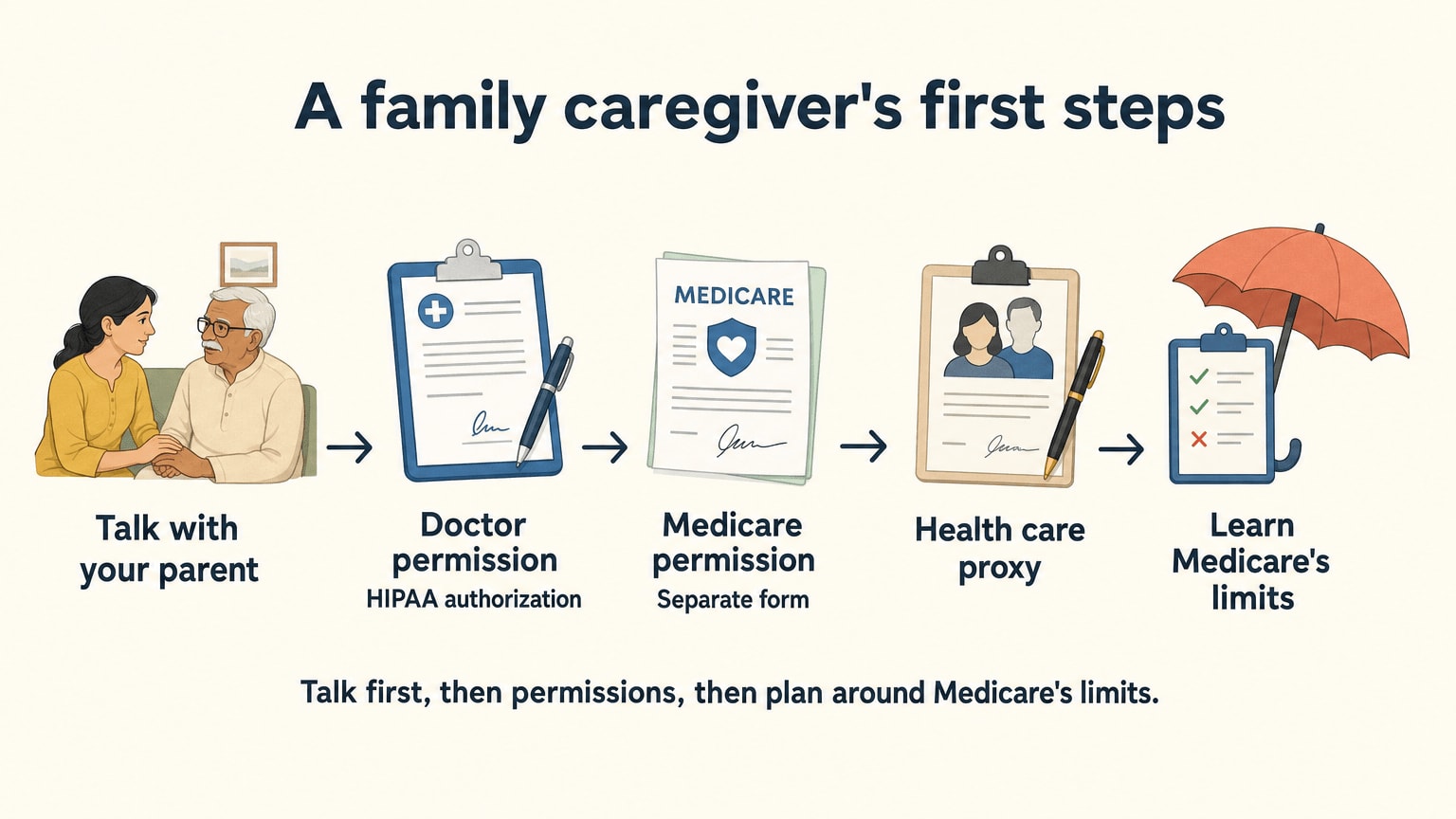
There is no licence for this. What you need is a short list of things in place, ideally before a crisis. AARP says having the documents in place while the person you're caring for can still make decisions is a good idea. That is the whole reason to start early.
Talk first. Before any form, ask your parent what matters to them and who they trust to speak for them. AARP suggests talking about priorities and wishes so they can guide medical decisions. If your parent pushes back, you are not failing at this. Plenty of parents say no to the first offer. Try again in a calmer week, with one small ask.
Get permission to talk to the doctor. A HIPAA authorization lets providers share medical information with you. AARP notes your parent can name one person or several, and can revoke it at any time, preferably in writing. Most doctor's offices keep a form.
Get permission to talk to Medicare. This is the one people miss. AARP says that even if you hold a health care proxy, you'll still need a separate Medicare authorization form to talk with Medicare about claims. Your parent can print it from Medicare.gov, or use the "Manage my representatives" option in their online Medicare account.
Ask about a health care proxy. It gives you the legal right to talk with doctors and make medical decisions if your parent can't. Rules differ by state, and we don't give legal advice. An elder law attorney can draw it up, and your state's rules decide what counts.
Write down what your parent can no longer do alone. Stairs, showers, pills, driving, the mail. Specifics help the doctor order the right help. They also tell you which of the next jobs is yours.
Learn the Medicare line before you hit it. Medicare sends skilled care into the home when a doctor orders it and your parent is homebound. It generally does not pay for daily personal care as the only need. Our guide on how to get a caregiver through Medicare goes through the order of calls, and Medicare Part B explains the costs.
What a family caregiver actually does
The tell is rarely medical. It's logistical. You book the follow-up the surgeon recommended, then book it again when it's cancelled. You chase the walker that was ordered and hasn't come. You read the denial letter. You find the driver. You remember every medication and every name.
None of that is clinical. A caregiver does not diagnose or treat, and that is the doctor's job. You follow through on what the doctor says. We cover who counts and why the paperwork is the real job in What Is a Caregiver? Who Counts and Where Help Is.
If your parent has Alzheimer's or another dementia, the planning has a few extra steps, and our post on what Medicare pays for in Alzheimer's care lays them out.
Becoming a paid caregiver
Paid caregiving is a job, and the job has levels. A companion or personal care aide helps with bathing, meals and company. A home health aide works for a Medicare-certified agency and does that work alongside nurses and therapists. The higher you go, the more rules apply.
The US Bureau of Labor Statistics says home health and personal care aides typically need a high school diploma or equivalent, but some positions do not require it. It adds that those working in certified home health or hospice agencies may need to complete formal training or pass a standardized test. And aides may need to meet requirements specific to the state where they work. The median annual wage was $35,800 in May 2025.
The federal rule for aides at Medicare-certified agencies is more specific. Under 42 CFR 484.80, classroom and supervised practical training must total at least 75 hours. A minimum of 16 hours of classroom training must come before 16 hours of supervised practice. After that, a home health aide must receive at least 12 hours of in-service training in each 12-month period.
States can add to this. So the order we'd follow is simple:
- Check your state's rules for aides. Your state health department or board is the source, and it will say whether you need a certificate, a registry listing or neither.
- Decide whether you want an agency or private work. Agencies often handle training, background checks and insurance. Private work usually puts those on you and the family.
- Complete the training your state or agency requires, then ask for the certificate in writing.
- Expect a background check, and keep your references ready.
- Ask what the job pays, in writing, before your first shift.
We can't give tax or financial advice on being paid by a family, so ask the Internal Revenue Service or a professional about that part.
Questions to ask before you say yes to a client
A paid role goes better when the edges are clear on day one. Ask what tasks are part of the job and which are not. Ask whether lifting or transfers are expected, and whether you will be trained for them. Ask who you call when your client's health changes in a way you can't judge. A caregiver reports what they see to the nurse or doctor. They don't diagnose or decide. And ask how time off works, because the same pull that makes families burn out hits paid caregivers too.

Can a family member be paid to care?
Sometimes, but not through Medicare. Medicare doesn't pay family members for caregiving hours. Some state Medicaid programs and some private arrangements do pay relatives, and the rules differ widely. Your state Medicaid agency has the real answer. Our Medicaid vs Medicare post explains why the two programmes split the way they do.
What to set up in the first month
Whichever route is yours, the first month is about getting the basics down so you aren't improvising in the middle of the night.
- Signed HIPAA and Medicare authorizations on file, and a health care proxy if your parent is willing
- A list of doctors, medications and phone numbers in one place
- The plan type: Original Medicare or Medicare Advantage. It changes who you call
- The night and weekend number for each doctor and agency
- Your local Area Agency on Aging contact

That last one is the one families skip. The Eldercare Locator, a public service of the Administration for Community Living, connects older adults and their families with local services. Call 1-800-677-1116 and ask about the family caregiver support programme by name. Depending on where you live, it may offer information, counselling, support groups, training and respite care, so you get time off.
Plan your own rest in that first month too. Respite care exists so a family caregiver can step away, and it is easier to ask for in week one than in month nine. If you're already worn out, our page on caregiver overwhelm is written for you. This is what the job does to people when they do it alone.
That page puts the number of unpaid caregivers in the US at 53 million. That is Navigate Care's figure, not a survey we ran. Whatever the true count, you are not the only one at the kitchen table with a pile of letters.
Where a navigator comes in
A navigator doesn't treat anyone, give medical advice or replace the doctor, a lawyer or SHIP, the free State Health Insurance Assistance Program. SHIP is a good first call for a plan or bill question. What a navigator does is the follow-through: asking for the referral, checking the equipment arrived, tracking the visits.
Medicare doesn't automatically cover navigation. Eligibility depends on a qualifying condition or need and a provider visit, and we confirm your cost before you start. It is usually $0 with supplemental coverage. Our what you will pay page has the details.
Frequently asked questions
Do I need a licence or certificate to be a family caregiver?
No. There is no licence for looking after a parent. What helps is paperwork: your parent's signed HIPAA authorization, a Medicare authorization, and ideally a health care proxy. Rules about proxies differ by state.
How do I become a caregiver for my parent?
Talk with your parent about who they trust to speak for them. Then get the permissions signed while they can still sign, write down what they need help with, and call your local Area Agency on Aging through the Eldercare Locator on 1-800-677-1116.
How do I become a certified home health aide?
Check your state's rules first. At Medicare-certified agencies the federal rule requires at least 75 hours of classroom and supervised practical training, and at least 12 hours of in-service training in each 12-month period. States may add requirements.
Can I get paid to care for a family member?
Not through Medicare. Some state Medicaid programs and private arrangements pay relatives, but it varies. Ask your state Medicaid agency or Area Agency on Aging what exists where your parent lives.
Does Medicare pay for a caregiver at home?
Only for skilled home health that a doctor orders when your parent is homebound. It generally does not pay for personal care as the only need, or for round-the-clock help.
Can I talk to Medicare for my parent?
Usually only with your parent's permission on file. AARP says you need a separate Medicare authorization form, even if you hold a health care proxy.